There are two honest ways to prepare for HOSA: self-study and coaching. Both produce strong results — the difference is whether you want structure and feedback, or prefer to drive it yourself. This guide does not start by selling a course. It breaks HOSA’s three tracks down to example events, gives a four-phase roadmap, walks the Webloom registration path, and shows how to pick your event — a guide that is genuinely useful even if you self-study.
First, know what you are preparing for
The right prep method depends entirely on which track and event you enter, because HOSA’s three families test almost opposite skills. Here is the breakdown with example events:
| Track | What it is | Example events | Self-study-friendly? |
| ATC Foundational Studies |
Written knowledge tests | Biology, Chemistry, Pathophysiology, Medical Terminology, Human Growth & Development | ✅ Yes, if your science base is strong |
| CCE Professional Studies |
Clinical / skills & presentation events | Clinical Specialty, Sports Medicine, Dental Science, Nursing Assisting, Medical Innovation | ⚠️ Hard — needs feedback on execution |
| BCE Public Welfare Impact |
Project & teamwork events | Public Health, Health Education, Community Awareness, Health Career Display | ⚠️ Hard — needs review cycles |
An ATC testing event and a CCE clinical event reward almost opposite preparation. Settling your track and event first is the single most useful decision you can make — it determines whether self-study is even viable for you.
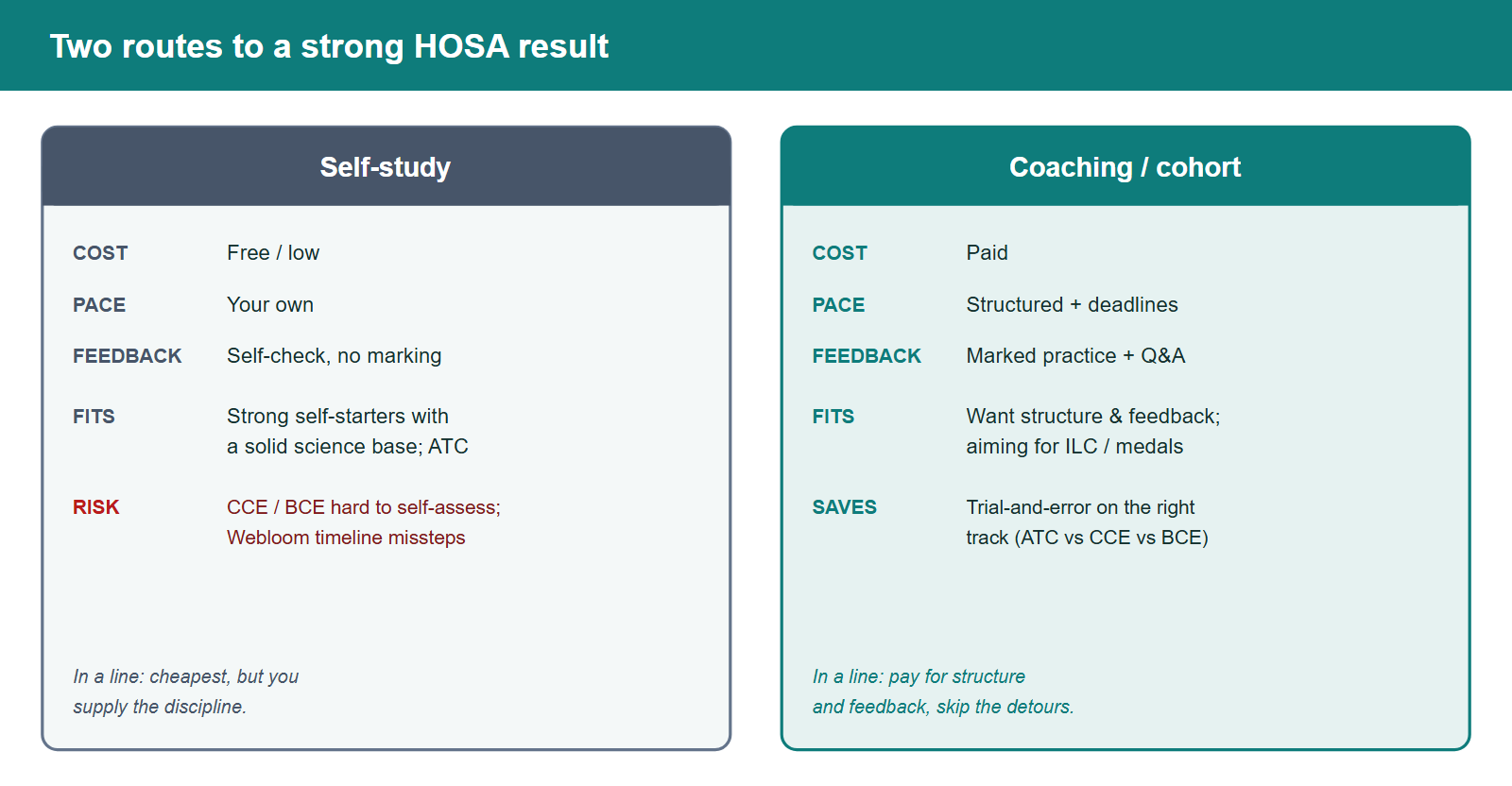
Self-study vs coaching: how to choose
An honest test, by track:
- Self-study is genuinely viable if your event is an ATC testing event (Biology, Chemistry, Pathophysiology…), your science base is solid, and you can drill past content and self-mark reliably. Disciplined self-studiers place well in ATC every year.
- Coaching moves the needle for CCE clinical and BCE project events, where the gap between “knowing it” and “performing it” is wide and very hard to judge alone. Students chasing the International Leadership Conference (ILC) or medals usually lose ground on event-specific execution, not knowledge — and that is the hardest thing to fix without an outside eye.
The four-phase roadmap below works for both routes: self-studiers follow it themselves; coached students use it to check that a program actually covers each phase.
A four-phase self-study roadmap (~16 weeks)
Break preparation into four phases, each with a clear output. Start about 3–4 months before the Initial Assessment:
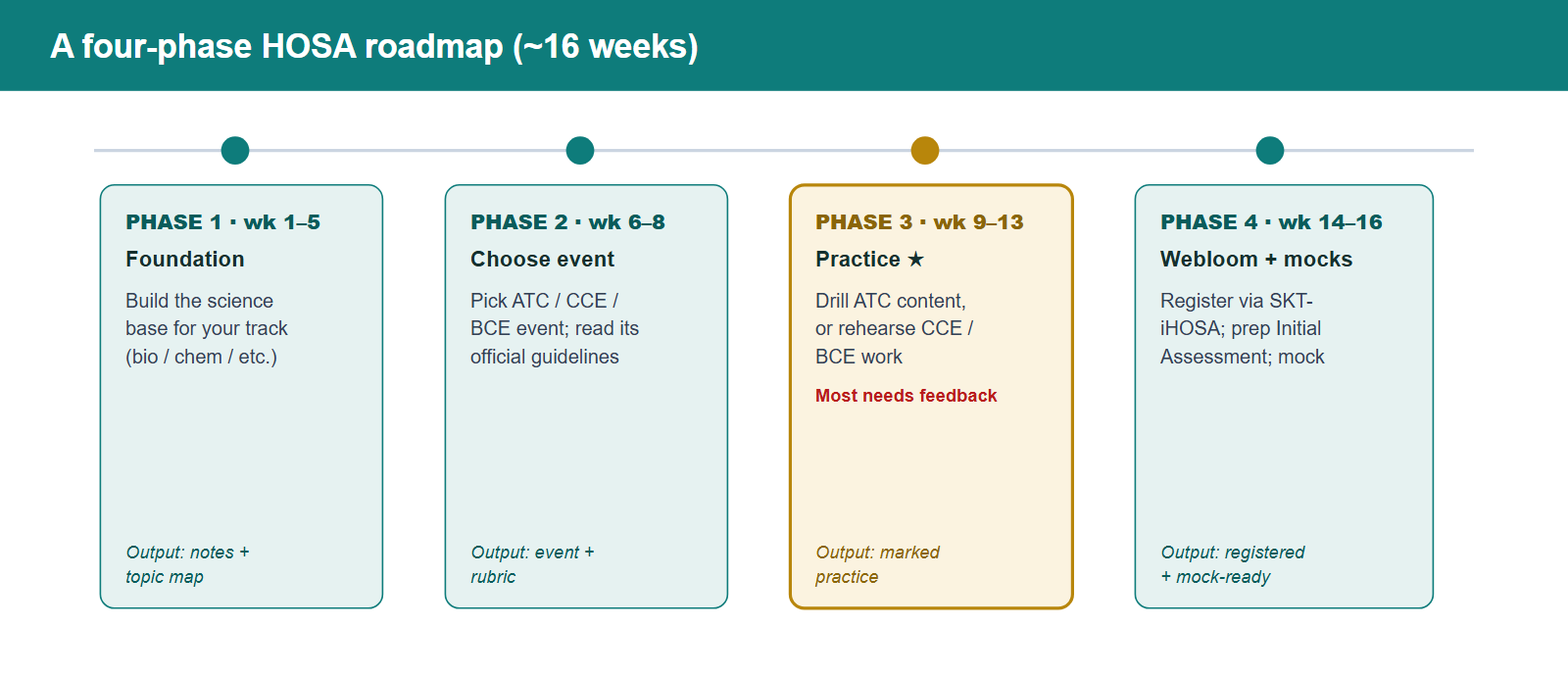
Phase 1 (Foundation) builds the science base your track needs — for ATC Biology that means systems, genetics and physiology; for a CCE clinical event it means the underlying medical knowledge. Phase 2 (Choose event) is decisive: read the official event guidelines and rubric for your exact event before you prepare anything. Phase 3 (Practice) is the divider — drilling for ATC, but rehearsing and getting feedback for CCE/BCE. Phase 4 (Webloom + mocks) turns preparation into a registered entry; see the registration walkthrough below.
How to pick your event (by goal)
Choosing the right event matters as much as preparing for it. Match the track to your goal and strengths:
| If you are… | Lean toward… | Why |
| A strong test-taker, pre-med, limited time | ATC (Biology / Pathophysiology) | Self-studiable, rewards your science base, clean medal signal |
| Pre-med / pre-dent wanting clinical depth | CCE (Clinical Specialty / Dental Science) | Showcases applied, clinical skills — strongest pre-health narrative |
| A leader / public-health-minded, team player | BCE (Public Health / Health Education) | Project + impact story; great for public-health and leadership angles |
A practical note for international students: ATC events travel best for self-study because they are content-based; CCE and BCE reward the kind of rehearsal and feedback that is hard to arrange alone.
The Webloom registration path (don’t miss the window)
For China-region students, HOSA participation runs through SKT-iHOSA and the official Webloom registration system. The path, in order: ① register on Webloom (autumn) → ② sit the Initial Assessment (winter) → ③ qualify for and compete at the SLC (spring) → ④ advance to the ILC (late June). The single most common avoidable mistake is missing the registration or Initial Assessment window — a strong student with no registration scores nothing. Mark these dates first, prepare second. Always confirm the current windows on the official HOSA and SKT-iHOSA channels.

What good HOSA prep looks like (a checklist you can use either way)
Whichever route you pick, judge any prep — including ours — against these five. Treat it as a buyer’s checklist:
| ✅ 1 · Track-specific | Does it prepare you for your event (ATC vs CCE vs BCE), not generic “HOSA tips”? |
| ✅ 2 · Real feedback | Is clinical / project work actually reviewed and marked — the thing self-study can’t give you? |
| ✅ 3 · Webloom & timeline clear | Does it walk the SKT-iHOSA registration (Webloom), Initial Assessment and the SLC→ILC path? |
| ✅ 4 · Transparent results | Are results specific by year, event and medal — not a vague “many winners”? |
| ✅ 5 · No guarantees | Honest coaching never promises a medal — results depend on the student; it promises process. |
About our cohort (disclosure + real results)
To be transparent: this site is the SKT-iHOSA editorial desk, and we run a HOSA preparation cohort — so this section is a disclosure of commercial interest. We coach because we have verifiable, real HOSA results (Hanlin internal data, anonymised):
2024 — our SKT-iHOSA cohort won 1 gold and 1 bronze in ATC Biology and a national silver in ATC Chemistry.
2020–2024 — students earned national golds in ATC Biology and Chemistry, and in 2022 two students placed national-1st in HOSA Emergency events.
These are actual HOSA / ATC outcomes — not numbers borrowed from another competition. We publish them precisely so you can run checklist items 4 and 5 against us. Our cohort turns the four-phase roadmap above into a structured program, with the most effort on the step self-study can’t replicate: Phase 3 marked practice and event-specific feedback.
A realistic timeline
Self-study or coached, the calendar is the same: autumn — register on Webloom and start Phases 1–2 → winter — Initial Assessment and Phase 3 practice → spring — SLC → late June — ILC (2026 marks HOSA’s 50th anniversary, Indianapolis, 17–20 June). Start 3–4 months before the Initial Assessment for the most comfortable run; the closer to competition, the more valuable feedback on your specific event becomes. Confirm all dates on the official HOSA and SKT-iHOSA channels.
The mistakes that cost international HOSA students
When strong students underperform at HOSA, it is rarely the science — it is one of four avoidable habits, and every one of them is fixable. Missing the Webloom window: a capable student who registers late scores nothing, so the registration and Initial Assessment dates matter more than any study plan — lock them in first. Choosing the wrong track: entering a CCE clinical event with an ATC test-taker’s habits, or the reverse, wastes months on the wrong skill; settle your event in Phase 2 before you prepare anything. Self-studying a CCE or BCE event: these reward rehearsed execution and reviewed project work, which no amount of solo reading supplies — if you pick one, build in feedback from the start. Treating the Initial Assessment as a formality: it is a real gate, and students who coast into it lose the qualification their content knowledge deserved. Fixing these four is usually worth more than another textbook — and notice that three of the four are about strategy and timing, not knowledge, which is exactly why an outside eye helps even strong self-studiers.
Is a HOSA result worth it for applications?
For students applying to pre-med, pre-dent, pre-nursing, public-health or biomedical programs, the honest answer is yes — but as evidence of a real, sustained interest in health, not as a single trophy. HOSA has decades of admissions-side recognition, and a medal or Distinction signals two things at once: the academic preparation to perform under competition conditions, and a genuine, multi-year commitment to a health career. The track you choose shapes the story it tells — an ATC result reads as academic strength, a CCE result as applied clinical interest, a BCE result as leadership and public-health impact. None of this guarantees admission, and you should treat it as one credible signal among many. Used well, the preparation itself — the systems knowledge, the clinical reasoning, the project work — is the part that genuinely strengthens a health-career application, whether or not you medal.
Frequently asked questions
Do I need a coach to do well at HOSA?
Not always. For ATC testing events, a strong, disciplined self-studier can do very well alone. Coaching matters most for CCE clinical and BCE project events, where feedback on execution — not knowledge — is the deciding factor. Use the checklist above to judge whether any prep is worth it.
Which HOSA events are easiest to self-study?
ATC (Foundational Studies) testing events such as Biology, Chemistry or Pathophysiology, if your science base is solid, because you can drill past content and self-mark. CCE and BCE events are much harder to prepare for without outside review.
How do I register for HOSA from China?
Through SKT-iHOSA and the official Webloom system: register in autumn, sit the Initial Assessment in winter, then advance SLC→ILC. Confirm the current windows on the official channels and register before you focus on content — a missed window scores nothing.
How long should I prepare, and when do I start?
About 3–4 months (roughly 16 weeks) before the Initial Assessment, following the four-phase roadmap: foundation → choose event → practice with feedback → Webloom and mocks.
Are your HOSA results real and how can I check?
Yes — they are actual HOSA / ATC outcomes from our SKT-iHOSA cohort (Hanlin internal data, anonymised), specific by year, event and medal, such as the 2024 ATC Biology gold and bronze. We do not relabel results from other competitions as HOSA results.
Can coaching guarantee a medal?
No. Any “guaranteed medal” claim is a red flag. Results depend on the student’s own effort; honest coaching only commits to the process — track-specific prep, marked feedback and a clear registration timeline.
This site is the SKT-iHOSA editorial desk, operated by Hanlin Education as the China-region partner for HOSA Future Health Professionals. This article describes our own preparation cohort, so it is a disclosure of commercial interest. The results cited are real HOSA / ATC outcomes from our SKT-iHOSA cohort (Hanlin internal data, anonymised) — actual HOSA results, not borrowed from other competitions. Confirm current events, dates and registration on the official HOSA and SKT-iHOSA (Webloom) channels; confirmed errors are corrected within 7 working days.

Oct 20, 2026
iHOSA ATC Division I vs II: Allocating Study Time by Weighting Differences
Students in grades 9-10 and 11-12 face different topic weightings in the iHOSA ATC Biology and Chemistry exams. This guide breaks down…
Oct 17, 2026
iHOSA Biology Explanations: Connect a Feedback Loop to a Change in the Body
Mastering negative and positive feedback loops is essential for iHOSA Biology. Learn how to connect physiological mechanisms to observable changes with worked…
Oct 15, 2026
iHOSA Health Education: Test Whether an Audience Understood Your Message
In iHOSA Health Education, testing whether your audience understood your message is not an afterthought—it is the core deliverable. Learn how to…