
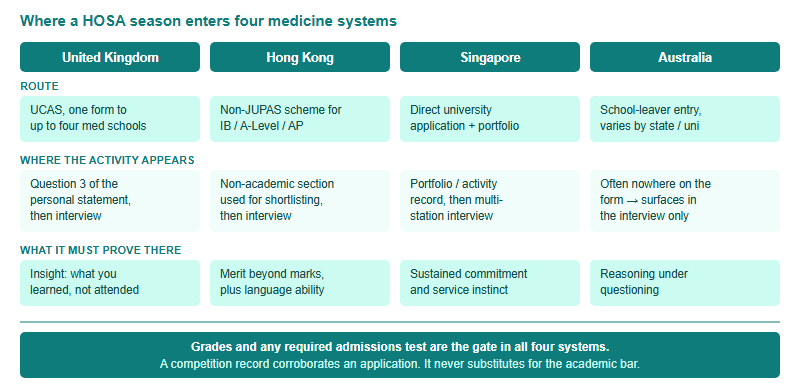
If you are aiming at medicine in the UK, Hong Kong, Singapore or Australia rather than a US pre-med track, a HOSA season still counts — but it is read inside a much narrower box, judged against a far shorter word budget, and weighted behind grades and admissions tests. This guide maps where the activity actually enters each system, what it has to prove once it gets there, and what does not transfer at all.
Direct entry changes what the activity is for
The single structural fact that reshapes everything: in the UK, Hong Kong, Singapore and Australia, medicine is commonly a direct-entry undergraduate degree. You apply to medicine at seventeen or eighteen, from school, against a course-specific bar. In the US you apply to a university, study anything, and apply to medical school four years later.
That difference does three things to your HOSA record:
- The audience becomes subject-specific. A US admissions officer reads your whole person. A UK medical school admissions tutor is reading for one question: is there evidence this applicant understands what medicine is actually like, and has tested that understanding?
- The space collapses. A US application can absorb an activities list, supplements and letters. Direct-entry systems typically give you a few hundred characters and an interview.
- Corroboration beats accumulation. Five competitions do not read better than one competition you can talk about for ten minutes under questioning. In a short form, breadth is indistinguishable from padding.
If you are still deciding what HOSA is and how the tracks differ, start with our overview of HOSA Future Health Professionals and the ATC, CCE and BCE track comparison — because the track you sit in determines what you are honestly able to claim later.
The UK: your season lives in Question 3
This is the change most students and quite a few advisers have not absorbed. From 2026 entry onwards, UCAS replaced the single free-text personal statement with three structured questions, each answered in its own box:
- Why do you want to study this course or subject?
- How have your qualifications and studies helped you to prepare for this course or subject?
- What else have you done to prepare outside of education, and why are these experiences useful?
The overall budget is 4,000 characters across all three answers, with a minimum of 350 characters per question. Confirm the current wording and limits on ucas.com before you draft, since UCAS refines guidance between cycles.
Three consequences for a HOSA applicant:
- Your competition record belongs in Question 3, and almost nowhere else. HOSA is preparation outside formal education. Squeezing it into Question 1 as a reason you love medicine wastes the box where tutors expect motivation and reading.
- The clause "and why are these experiences useful" is the part that scores. Roughly half the answer should be the transfer, not the description. A student who writes 200 characters naming events and 40 characters of reflection has answered the wrong question.
- You cannot list. The boxes are read separately and the character counter is unforgiving. One event described with consequence outperforms four listed in a row — and a listed activity you cannot defend at interview is a liability, not an asset.
Most UK medical schools also use an admissions test and a structured interview, frequently in a multiple-mini-interview format. The specific test, its content and which schools require it have changed more than once in recent cycles, so treat every second-hand claim as potentially out of date and check each medical school's current admissions page directly.
Hong Kong: Non-JUPAS shortlisting, and the language clause nobody plans for
If you hold IB, A-Level or AP qualifications rather than the HKDSE, you are applying to HKU or CUHK medicine through the Non-JUPAS admissions scheme rather than the local JUPAS system. Two features matter for a HOSA applicant.
First, shortlisting is explicitly not grades-only. HKU's medical admissions pages describe Non-JUPAS candidates being shortlisted for interview on the basis of individual merit shown by academic records and other non-academic achievements. That is the doorway a documented, sustained competition record can walk through — provided it is specific enough to distinguish you from every other applicant claiming an interest in medicine.
Second, and far more decisive in practice: HKU states that MBBS applicants, local and non-local alike, need a good working knowledge of English and Cantonese. Clinical years involve patients. For a mainland student who speaks Mandarin and English but not Cantonese, this is a planning fact that outranks every prize on the CV, and it needs a two-to-three-year answer rather than a panic in Year 13. Confirm the current requirement wording directly with the faculty.
Both universities describe competition for non-local places as keen and expect non-local candidates to be exceptionally well qualified. Non-JUPAS rounds are assessed on a rolling basis and the dates move between cycles and move between cycles — confirm on the university's admissions site rather than any summary, including this one.

Singapore and Australia: shorter forms, heavier interviews
Singapore's undergraduate medical programmes and Australia's school-leaver medicine entry share a pattern: the written application is comparatively lean, and the selection weight sits in interviews and, where used, aptitude testing. Requirements differ by institution and are revised between intakes, so the responsible move is to read each faculty's current admissions page rather than a general guide.
What is stable enough to plan around is the shape of the question you will face. Interview panels and station assessors are not scoring the prestige of your activity; they are scoring whether you can reason about it. In practice they probe four things:
- Motivation tested against reality — what did you see or do that could have put you off, and why did it not?
- Ethical reasoning — can you hold two competing obligations at once without collapsing into a slogan?
- Teamwork under friction — a team event where nothing went wrong is not evidence of anything.
- Honesty about limits — a candidate who says "our sample was one school, so I would not generalise" scores higher than one who oversells.
This is where a HOSA season genuinely earns its place, and where our guide to the ILC conference experience becomes useful preparation material: conference-level competition gives you concrete, defensible stories about pressure, teamwork and judged feedback that generic volunteering rarely produces.
What transfers, and what does not
| Element of a HOSA season | Transfers well because… | Transfers badly, or not at all |
|---|---|---|
| A clinical-skills or professional event you can demonstrate | It is a procedure you performed and were assessed on — concrete, checkable, interview-friendly | Do not imply it constitutes clinical training or patient contact |
| A public-health or community project | Shows initiative, planning and service over months — the sustained commitment these systems look for | A one-week campaign with no follow-up reads as a box-tick |
| A written report or research component | Evidences reading, method and the ability to state limitations honestly | Claiming "research experience" for a literature summary invites a damaging interview question |
| Team events and leadership roles | Gives you a real conflict-and-resolution story for interview stations | A title with no described decision proves nothing |
| Test-based placings and ranks | Corroborate academic strength in a health-science domain | Rank language rarely lands outside the US; no admissions system converts a placing into an offer |
| The number of events entered | — | Actively harmful in a 4,000-character form; breadth reads as padding |
Turning one event into text that scores — and what it cannot do
Nearly every weak Question 3 answer fails the same way: it stops at layer two. Use three layers and check the character split.
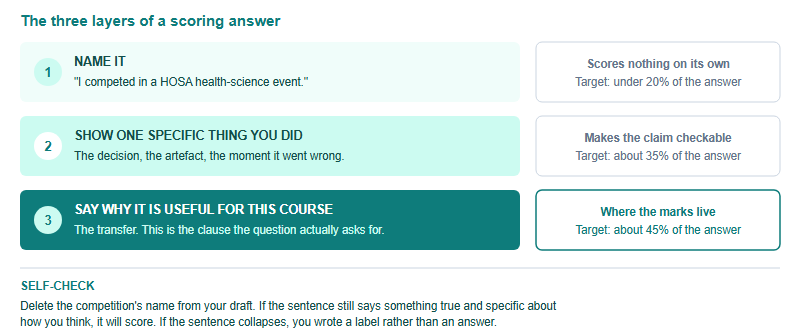
Two habits to drop before you draft. Do not translate US pre-med vocabulary directly — "pre-med" is not a category in these systems, and describing yourself as being on a pre-med track can read as though you have misunderstood the degree you are applying to. And do not inflate. Describing a school-based project as clinical work, or a literature summary as research, is the fastest way to lose a panel that will simply ask a follow-up question.
Finally, the honest ceiling: no competition record, HOSA included, produces an offer. Every one of these systems gates on grades first and on any required admissions test second. What a well-documented season can realistically do is make you shortlistable where non-academic merit is assessed, and give you defensible material when a panel asks you to think out loud. That is a real advantage. It is not a guarantee, and any adviser who tells you otherwise is selling something.
Frequently asked questions
Where exactly does HOSA go in the new UCAS personal statement?
Question 3, which asks what you have done to prepare outside education and why it is useful. Spend most of that box on the "why useful" half.
Is a HOSA placing worth more than volunteering for UK medicine?
Not automatically. Tutors weigh reflection and consistency, not the label. A defensible story from either source outperforms an impressive name you cannot discuss.
Do I need Cantonese for medicine in Hong Kong?
HKU states MBBS applicants need a good working knowledge of English and Cantonese. Treat it as a multi-year plan and confirm current wording with the faculty.
Should I enter more events to strengthen a non-US application?
No. These forms are short and interview-led. One event you can defend under questioning beats four listed names every time.
Published by the HOSA (SKT-iHOSA) editorial desk, operated by Hanlin Education for China-based international-school students. Official rules are set by the competition and change yearly — confirm current details on hosa.org. University admissions requirements are set by each institution and change between cycles — confirm on the university's own admissions pages. Errors are corrected within 7 working days.

Oct 20, 2026
iHOSA ATC Division I vs II: Allocating Study Time by Weighting Differences
Students in grades 9-10 and 11-12 face different topic weightings in the iHOSA ATC Biology and Chemistry exams. This guide breaks down…
Oct 17, 2026
iHOSA Biology Explanations: Connect a Feedback Loop to a Change in the Body
Mastering negative and positive feedback loops is essential for iHOSA Biology. Learn how to connect physiological mechanisms to observable changes with worked…
Oct 15, 2026
iHOSA Health Education: Test Whether an Audience Understood Your Message
In iHOSA Health Education, testing whether your audience understood your message is not an afterthought—it is the core deliverable. Learn how to…