HOSA organizes its 50+ competitive events into three structured tracks: ATC (Foundational Studies), CCE (Professional Studies), and BCE (Public Welfare Impact). Each was designed for a different applicant profile. The track determines what assessment format you face, what skills are tested, which events you can enter, and ultimately how the credential reads on a US college application. For SKT-iHOSA China cohort delegates, the track is chosen during registration on Webloom and locked once the season’s initial station begins — effectively a start-of-season decision, and switching later requires a formal request that almost always costs months. For the 2027 China season, SKT-iHOSA’s published schedule runs pre-registration 12 Jun – 20 Aug 2026, study Jun–Dec 2026, the initial station in December 2026, the China station late Mar – mid Apr 2027, and the global station 23–26 Jun 2027 (per SKT-iHOSA; confirm current dates on webloom.cn). This decision guide matches each track to a real applicant profile, breaks down rubric weighting, and shows how each track lands on a Common App “Activities” entry.
Quick Facts
| Track | Full Name | Format | Best For | Effort |
|---|---|---|---|---|
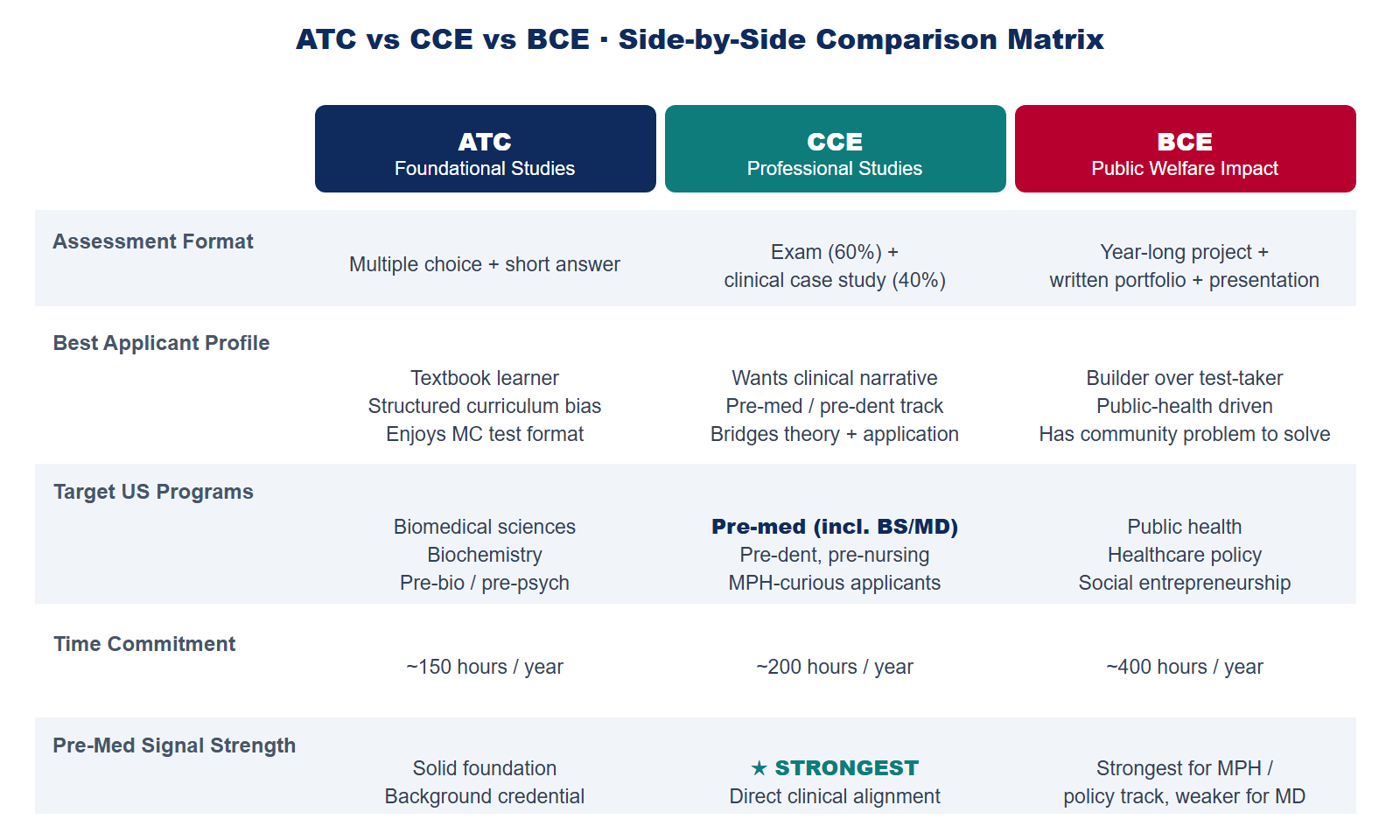
| ATC | Foundational Studies | Exam-style (MC + short answer) | Biomedical sciences, biochemistry, pre-bio | Year-long study, ~150 hours |
| CCE | Professional Studies | Exam + clinical case study | Pre-med, pre-dent, pre-nursing, MPH | Year-long study + case prep, ~200 hours |
| BCE | Public Welfare Impact | Year-long project, documented | Public health, healthcare policy, social entrepreneurship | Year-long execution, ~400 hours |
SKT-iHOSA 2027 China season — first-party snapshot (per SKT-iHOSA; confirm current details on webloom.cn)
- ATC academic track subjects: Biology, Chemistry and Psychology (objective exams). Reported curriculum overlap for the Biology paper: up to ~95% IB, ~83% A-Level, ~82% AP.
- Initial station format: a 45-minute online test — 45 single-answer multiple-choice questions + 5 tie-breaker questions.
- BCE public-welfare track: teams of 3–6 build a health-impact project (one of four health domains) and produce a 30-second PSA plus a public-health class.
- Fees: ATC 498 RMB / BCE 698 RMB per person (early-bird and combined-entry discounts apply before the published deadlines).
- Tracks offered: the published 2027 China lineup centers on the ATC academic line (above) and the BCE public-welfare line; CCE (Professional Studies) is part of HOSA’s wider event catalog — confirm which tracks your current season offers on webloom.cn.
Note: the hour estimates and rubric-weight breakdowns in this guide are editorial illustrations to help you compare tracks; official event specifications, scoring, and the current-season schedule are on hosa.org and webloom.cn.
The Track Decision Is Not About Difficulty
A common failure mode: students pick a track based on “which sounds easier.” All three tracks demand serious year-long effort. The real question is which assessment format matches how you actually learn — and which application story you need to tell. A student aiming at BS/MD admissions tells a different story than a student aiming at public health graduate school. The track has to align with the destination.
ATC · Foundational Studies
ATC is the exam-style track. Events test deep knowledge of biomedical fundamentals via multiple-choice and short-answer questions. The format is similar to AP Biology or college-level biochemistry exam style — if you do well on the College Board AP framework, you’ll do well in ATC.
Representative ATC Events
- Medical Reading — comprehension of professional health literature, ~120 questions
- Medical Spelling — terminology accuracy under time pressure
- Medical Terminology — Greek/Latin root identification + clinical context
- Pathophysiology — mechanisms of disease, biochemistry-heavy
- Human Growth & Development — life stages, developmental science
Rubric Weighting (typical ATC event)
| Component | Weight | What’s Measured |
|---|---|---|
| Multiple choice (Round 1) | ~60% | Speed + accuracy across 100-150 items |
| Short answer (Round 2, top finalists) | ~30% | Recall under no-aids condition |
| Tie-breaker items | ~10% | Highest-difficulty questions for placement |
When ATC Is the Right Pick
Pick ATC if you are applying to biomedical sciences, biochemistry, or pre-bio undergraduate programs and your test-taking discipline is strong. ATC’s credibility on a US application is “this student knows the biology cold.” It is not the strongest signal if you’re applying to BS/MD or direct pre-clinical programs — CCE matches that destination better.
CCE · Professional Studies
CCE is the strongest pre-med signal HOSA offers. The track blends exam-style assessment with clinical case studies, so events test both knowledge depth and application thinking — exactly what BS/MD admissions committees look for in 17-year-old applicants.
Representative CCE Events
- Clinical Specialty (Pediatric Medicine, Sports Medicine, Dental Science variants) — specialty-specific cases
- Biomedical Laboratory Science — lab procedures + interpretation
- Medical Innovation — design new diagnostic/therapeutic; can be ATC- or BCE-adjacent depending on event variant
- Clinical Nursing — pre-nursing direct alignment
- Veterinary Science — pre-vet variant
Rubric Weighting (typical CCE event)
| Component | Weight | What’s Measured |
|---|---|---|
| Exam (Round 1) | ~50% | Specialty knowledge under standard test conditions |
| Clinical case study (Round 2) | ~35% | Apply knowledge to a presented case — diagnosis, decision tree, communication |
| Professional skills (interview/presentation) | ~15% | Articulating reasoning under judge observation |
When CCE Is the Right Pick
Pick CCE if you are applying to pre-med, BS/MD combined degree, pre-dent, or pre-nursing and you want the credential to directly signal “this student is on the clinical track.” CCE is by far the most common track choice among SKT-iHOSA China cohort delegates with US BS/MD ambition — and the case-study format is closer to what medical school admissions committees ultimately interview applicants on.

BCE · Public Welfare Impact
BCE is the project-based track — completely different from ATC and CCE. Instead of tests, you design, execute, and document a year-long community-health initiative. The deliverable is a portfolio: project plan, execution evidence, impact measurement, and a presentation defending your work.
Representative BCE Events
- Public Health — design a public-health intervention; document execution
- Healthcare Issues Exam-Plus — written + project hybrid
- HOSA Service Project — chapter-level coordinated initiative
- Behavioral Health — mental-health-focused community initiative
- Community Awareness — health-education campaign delivery
Rubric Weighting (typical BCE event)
| Component | Weight | What’s Measured |
|---|---|---|
| Written portfolio | ~40% | Plan quality, evidence completeness, reflection depth |
| Project execution | ~30% | Did the project actually run? Measurable outcomes? |
| Presentation | ~20% | Defending the work to judges in-person |
| Q&A from judges | ~10% | Robustness of understanding under questioning |
Common BCE misconception: “projects are easier than tests.” False. BCE is the highest-effort track by hours. The work runs from October through May. Document quality is judged rigorously. Pivoting mid-season often costs the entire year. Only pick BCE if you have a community problem you actually want to solve and the time runway to execute.
When BCE Is the Right Pick
Pick BCE if you are applying to public health, healthcare policy, social entrepreneurship, or global health tracks at undergraduate level. BCE produces a portfolio of actual community work that you can also use in college essays, supplemental application materials, and graduate-school applications years later. The credential signals “this student doesn’t just learn about health — they execute on it.”
The Decision Tree
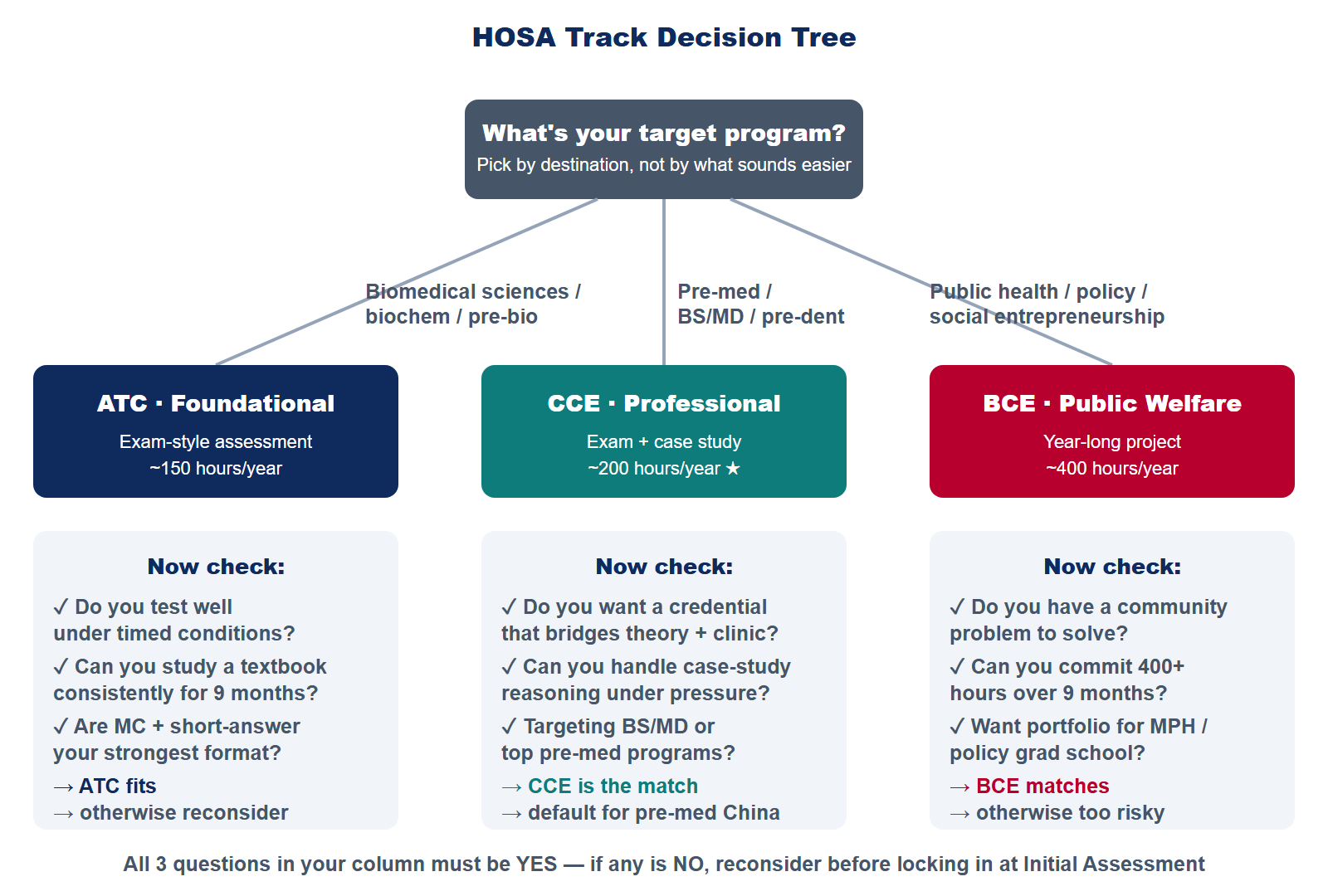
Strip away the marketing language and the decision becomes mechanical. Start from your target US undergraduate program and work backward:
How Each Track Lands on a Common App “Activities” Field
The Activities section on the Common App allows 150 characters for activity name and 150 characters for description. Each track writes differently. Below are framing templates that admissions readers see as clearly differentiated:
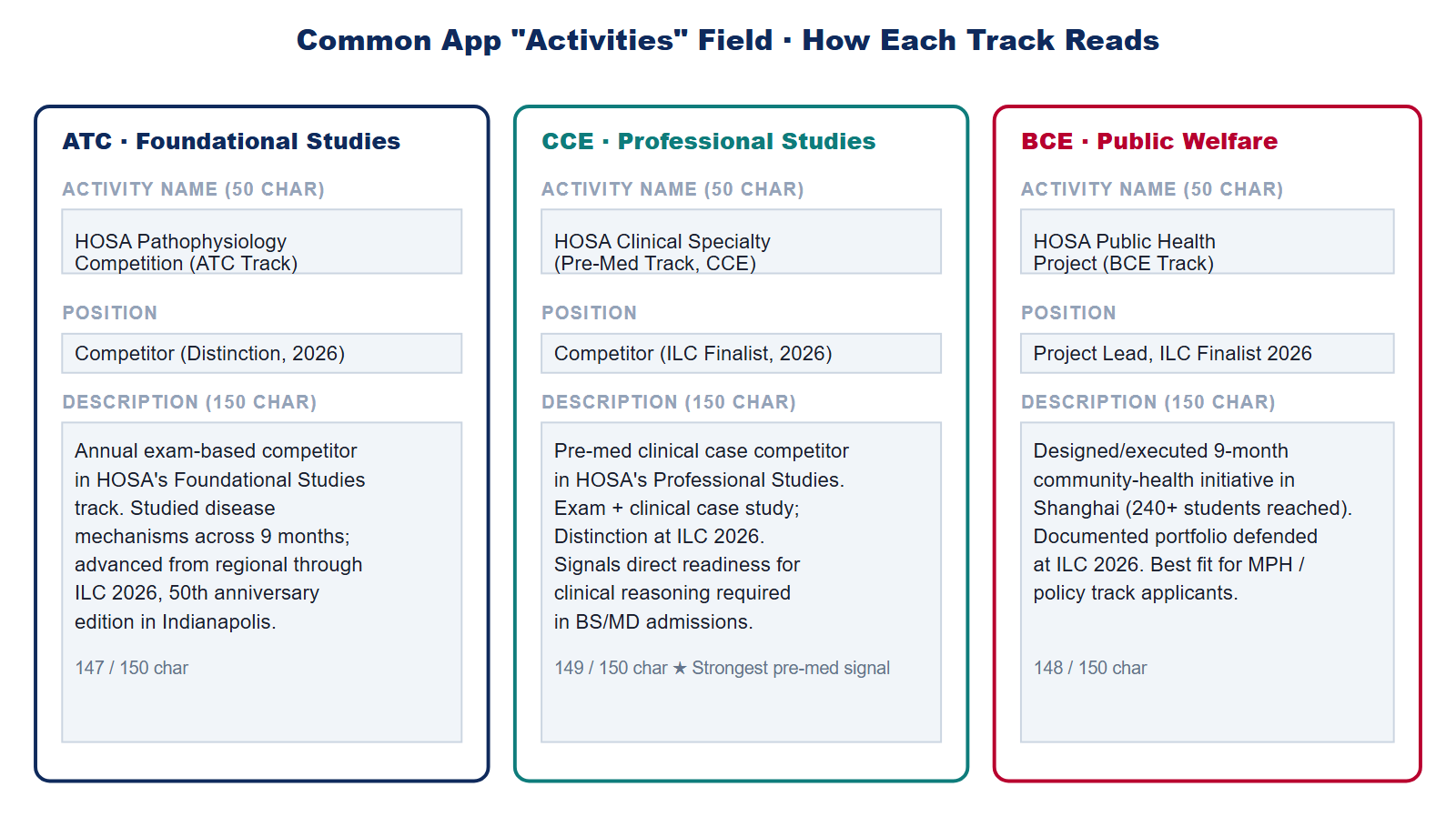
Notice how the CCE description includes the phrase “direct readiness for clinical reasoning required in BS/MD admissions.” This is the kind of framing that connects HOSA to the destination program in language admissions readers immediately understand. ATC’s framing is more generic; BCE’s framing explicitly positions toward MPH and policy. Match the framing language to your target school.
Common Pitfalls When Choosing a Track
- “BCE is easier because no exam” — false. BCE is the highest-effort track measured in hours. Project documentation rigor is brutal.
- “ATC is the foundation everyone should start with” — false. If you’re applying to clinical programs, CCE’s narrative is stronger from the start. ATC is the strongest signal for biomedical-sciences applicants, not a “default.”
- “Pick whatever has the highest medal odds.” — short-sighted. A Distinction in CCE that aligns with your application matters more than a Gold medal in ATC that doesn’t.
- “You can switch mid-season if it’s not working.” — technically true, practically expensive. Switching requires formal request before Initial Assessment date. After Initial Assessment, the track is locked. Re-prep cost is months of wasted hours.
- “Doing all three tracks signals more commitment.” — discouraged. SKT-iHOSA does not allow simultaneous entry across all three tracks for any single applicant. You pick one primary track. Some events span tracks (Medical Innovation has ATC and BCE variants), but core declaration is one track.
Frequently Asked Questions
What does ATC, CCE, and BCE stand for in HOSA?
In SKT-iHOSA terminology, ATC is “Foundational Studies” (exam-style biomedical sciences track), CCE is “Professional Studies” (exam + clinical case study, pre-med focused), and BCE is “Public Welfare Impact” (year-long community-health project track). The three tracks correspond to different HOSA event clusters within the 50+ events catalog.
Which HOSA track is best for pre-med applicants?
CCE (Professional Studies) is the strongest pre-med signal. The track combines exam-style assessment with clinical case studies, which directly mirrors what BS/MD and pre-med admissions committees evaluate. ATC is solid for biomedical-sciences applicants but doesn’t carry the clinical narrative; BCE is best for public-health or healthcare-policy applicants.
Can I switch tracks mid-season?
Technically yes, but only through a formal request before the season’s initial station (for the 2027 China season, around December 2026 — confirm on webloom.cn). After the initial station, the track is locked for the season. Switching costs months of wasted preparation, so this should be a last resort, not a planning option.
How many hours does each HOSA track require?
Approximate annual time commitments: ATC ~150 hours (year-long textbook study), CCE ~200 hours (study + case practice), BCE ~400 hours (project design, execution, documentation, presentation prep). BCE is the highest-effort track, not the easiest.
Does HOSA allow students to compete in multiple tracks?
SKT-iHOSA does not allow simultaneous entry across all three tracks for any single applicant in one season. Each delegate declares one primary track at registration. Some events (Medical Innovation, for example) have variants in both ATC and BCE — but the core track choice remains one per season.
Which track has the best medal odds?
Medal odds vary by event within each track, not by track itself. ATC events often have larger competitor pools (more medal opportunities by absolute count, but more competition); BCE events have smaller fields (fewer competitors, but project judging is subjective); CCE sits in between. Choose for application story alignment, not medal odds — a Distinction in the right track beats a Gold in the wrong track for admissions purposes.
When does track selection happen for China cohort delegates?
Track is declared at SKT-iHOSA registration on Webloom near the start of the season and locked once the initial station begins. For the 2027 China season, pre-registration runs 12 Jun – 20 Aug 2026 and the initial station is in December 2026 (per SKT-iHOSA; confirm on webloom.cn). A free advisor consultation before registration helps applicants confirm track-program fit.
Related Resources
- 📘 HOSA foundation guide → What Is HOSA Future Health Professionals? A 2026 Complete Guide
- 📋 ILC 2026 complete guide → HOSA ILC 2026 Indianapolis Complete Guide
- 📋 Webloom registration walkthrough → SKT-iHOSA Webloom Registration Step-by-Step
- 📋 Cohort 2025 results → Cohort 2025 Results: 12 China Delegates
- 📋 Admissions hub → HOSA for US College Admissions · Pre-Med Pathway Hub
- 📋 About HOSA → About HOSA · 50 Years
- 🌐 Official event guidelines → hosa.org/competitive-events
- 📞 Talk to a HOSA advisor → Contact HOSA Advisors · WeChat for Inquiries
Editorial desk · Hanlin Education · last updated 2026-05-26 · This guide is published by the independent SKT-iHOSA editorial desk at en.hosa.org.cn. SKT-iHOSA is the authorized China cohort program for HOSA International, but this site is not the official HOSA International administration site. Official HOSA information is at hosa.org. All facts on this page are cross-referenced against hosa.org official competitive-events guidelines, SKT-iHOSA cohort 2025 briefing notes, and Common App framing references. We correct any factual errors within seven working days of a reported issue.

Oct 20, 2026
iHOSA ATC Division I vs II: Allocating Study Time by Weighting Differences
Students in grades 9-10 and 11-12 face different topic weightings in the iHOSA ATC Biology and Chemistry exams. This guide breaks down…
Oct 17, 2026
iHOSA Biology Explanations: Connect a Feedback Loop to a Change in the Body
Mastering negative and positive feedback loops is essential for iHOSA Biology. Learn how to connect physiological mechanisms to observable changes with worked…
Oct 15, 2026
iHOSA Health Education: Test Whether an Audience Understood Your Message
In iHOSA Health Education, testing whether your audience understood your message is not an afterthought—it is the core deliverable. Learn how to…