International and China-based students take part in HOSA the same way US members do — through a chartered association. In China, that route is SKT-iHOSA, the China-region program operated by Hanlin Education. You register on Webloom, choose one of three tracks (ATC, CCE, or BCE), clear the regional and China rounds, and top placers advance to the global stage at HOSA's International Leadership Conference (ILC), held 17–20 June 2026 in Indianapolis.
Can international students join HOSA at all? Yes — through a chartered association
HOSA — Future Health Professionals was founded in 1976 and now reports more than 350,000 members across 54–56 chartered associations. Most are US states, but several are outside the United States. HOSA's own 2025 ILC materials list international charters including China, Canada, Korea, Vietnam, American Samoa, and Puerto Rico. So “HOSA for international students” is not a workaround — China is an official HOSA charter, and the China-region program is run as SKT-iHOSA.
If you are at an international school in mainland China, you do not apply to a US state association. You enter through SKT-iHOSA, which functions as your “state/country” level for the purpose of advancing to the international finals. (New to the program? Start with our explainer, What Is HOSA.)
HOSA is organised into three membership divisions by grade: Middle School (grades 6–8), Secondary (grades 9–12), and Postsecondary/Collegiate. For international-school applicants targeting US or UK universities, the Secondary division (grades 9–12) is where almost all the action is — this is the cohort SKT-iHOSA primarily serves.
Why does the charter detail matter so much for admissions? Because a US admissions officer reading your application sees the same organisation name — HOSA — whether you competed in Texas or in China. The activity is recognised globally; it has run since 1976 and now spans well over 350,000 members. What an officer cares about is what you did inside it: which track, how far you advanced, and what you actually built or learned. Entering through SKT-iHOSA does not water that down — it is the legitimate China route into the same competitive structure.
Eligibility: who can enter SKT-iHOSA in 2026
Use the table below as a first-pass eligibility check. Where a number or date is season-specific, treat it as “confirm on the official site” rather than fixed — HOSA and SKT-iHOSA publish exact rules each cycle.
| Question | What applies to international / China-region students |
|---|---|
| Grade level | Secondary division = grades 9–12 (the SKT-iHOSA core). Middle School (6–8) exists in HOSA globally; confirm whether your track is open to your grade on the official guideline. |
| School affiliation | You can enter as a school cohort (your school registers) or as an individual through Webloom. A US-style local chapter is not required to start — SKT-iHOSA is the China charter. |
| Nationality / location | Open to students based in the China region, including international-school students. You are competing under the China charter, not a US state. |
| Track fit | Choose ATC (foundational), CCE (professional/clinical), or BCE (public-welfare). See ATC vs CCE vs BCE track selection before you lock one in. |
| One event at the finals | HOSA rules let a competitor take only one event to the international level, and you must have competed in that same event at the charter level in the immediately preceding school year. Plan your track accordingly. |
| Fees & deadlines | Season-specific. Confirm on Webloom / the SKT-iHOSA program before registering. |
The Webloom registration flow, step by step
In the China region, SKT-iHOSA registration runs on the Webloom platform (webloom.cn). The registration window typically opens around August–December, but exact dates move each season — confirm on the official program before you rely on them. Here is the practical sequence most international-school students follow.
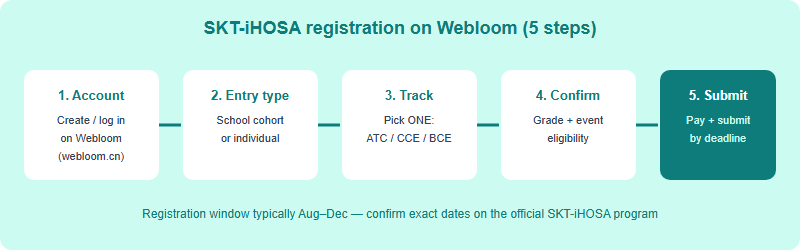
- Create or log in to a Webloom account. School-organised cohorts are usually enrolled by the school; individual students register themselves on the Bloom web portal.
- Choose your entry type — school cohort or individual. International-school students who do not have a teacher running a group can still enter individually.
- Select exactly one track. This decision shapes your whole season; do not pick ATC because it looks easiest if your goal is a pre-med signal. Read the track guide first.
- Confirm grade and event eligibility against the current SKT-iHOSA guideline (grade bands and available events can shift by season).
- Pay and submit before the deadline. Keep your confirmation; it carries through the regional and China rounds.

The three tracks: ATC, CCE, BCE
SKT-iHOSA runs three tracks built for different stages and goals. The plain-English version:
| Track | What it is | Best fit | Signal it sends |
|---|---|---|---|
| ATC | Foundational — objective, test-style biology/chemistry assessment, well aligned to AP / IB / A-Level science. | Grades 9–10, or anyone building a science base. | Solid academic foundation in bio/chem. |
| CCE | Professional / clinical — health-profession disciplines connecting to university-prep coursework (e.g., pathophysiology, biotechnology). | Students with a strong bio/chem base, pre-med / pre-dent direction. | The strongest pre-med-style signal of the three. |
| BCE | Public-welfare — a project where you run a real health initiative in your community and document the impact. | Students who want hands-on public-health / leadership experience. | Initiative, leadership, community impact. |
Because HOSA rules let you take only one event to the international finals — and you must have competed in that same event at the charter level the year before — your track choice is effectively a year-long commitment. We unpack the trade-offs, with applicant-profile matching, in ATC vs CCE vs BCE track selection.
How the season maps to ILC
Here is the part international students most often get wrong: SKT-iHOSA is the China charter's qualifying ladder, and ILC is the global finish line. Across HOSA, the top placers at the state/country (charter) level advance to the International Leadership Conference; the standard rule is that the top three in an event qualify to compete in that same event at ILC. So the China rounds are not a separate, parallel contest — they are how China-region students earn an ILC slot.
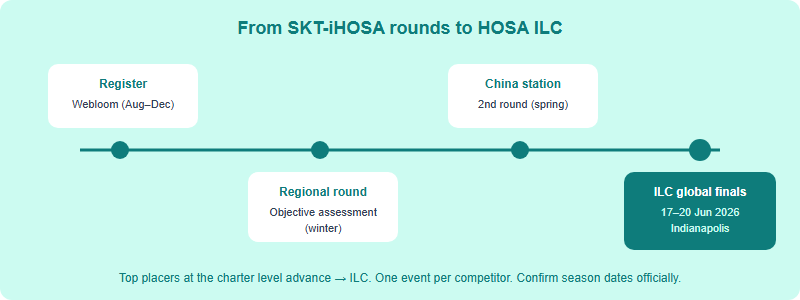
For context: the 2025 ILC (the 48th) was held in Nashville, 18–21 June 2025, drawing more than 14,000 members and guests. The 2026 ILC (the 49th) is scheduled for 17–20 June 2026 at the Indianapolis Convention Center. If you are aiming for the global stage, that June window is your true deadline — everything in the China season is built to get you there in time. Our full breakdown of the trip, events, and what to expect is in the HOSA ILC 2026 guide.
One first-party planning note from running China-region cohorts: international-school families consistently underestimate the summer-exam clash. ILC sits in mid-to-late June, which overlaps AP exams, IB results season, and end-of-year school commitments. Build your track choice and travel plan around that calendar early — not in May.
Three mistakes international students make — and how to avoid them
From advising China-region applicants, the same avoidable errors come up every season. None of these are official rules — they are practical patterns worth planning around.
- Treating the China rounds as “the whole thing.” The regional and China stations are qualifiers, not the destination. If your goal is an international-level credential, your plan has to reach the ILC window in June, not stop at the China station in spring.
- Picking the easiest-looking track instead of the right one. ATC's objective format feels safest, but if you are pre-med and want a clinical signal, CCE is the stronger fit; if you want demonstrated leadership and community impact, BCE is. The “one event at the finals” rule makes a wrong early pick expensive to undo.
- Registering late and missing the prerequisite year. Because the international level requires that you competed in the same event at the charter level in the immediately preceding school year, a first-time entrant cannot shortcut straight to ILC. Plan a two-stage horizon: this season to qualify, the cycle that follows to compete internationally.
If you are weighing whether to prepare independently or with structured coaching, that is a separate decision from eligibility — and an honest one: many strong students self-study the ATC track successfully. Choose based on your starting base and how much time you can commit, not on pressure.
FAQ
Do international students have to live in the US to join HOSA?
No. China is an official HOSA chartered association. China-region students join through SKT-iHOSA and compete under that charter.
What grades can enter SKT-iHOSA?
HOSA's Secondary division is grades 9–12, which is the SKT-iHOSA core. Middle School (6–8) exists in HOSA globally; confirm your track's grade band officially.
How do China-region students reach the HOSA ILC?
Register on Webloom, clear the regional and China rounds; top placers advance to ILC. The 2026 ILC is 17–20 June in Indianapolis.
Can I compete in more than one HOSA event at the finals?
No. HOSA rules allow only one event at the international level, in the same event you competed in at the charter level the prior year.
Published by the HOSA (SKT-iHOSA) editorial desk, operated by Hanlin Education for China-based international-school students. Official rules, fees, dates, and eligibility are set by the competition and change every season, so confirm current details on hosa.org and the SKT-iHOSA program before you register. We are an editorial and preparation resource and do not control official outcomes. Confirmed errors are corrected within 7 working days.

Oct 20, 2026
iHOSA ATC Division I vs II: Allocating Study Time by Weighting Differences
Students in grades 9-10 and 11-12 face different topic weightings in the iHOSA ATC Biology and Chemistry exams. This guide breaks down…
Oct 17, 2026
iHOSA Biology Explanations: Connect a Feedback Loop to a Change in the Body
Mastering negative and positive feedback loops is essential for iHOSA Biology. Learn how to connect physiological mechanisms to observable changes with worked…
Oct 15, 2026
iHOSA Health Education: Test Whether an Audience Understood Your Message
In iHOSA Health Education, testing whether your audience understood your message is not an afterthought—it is the core deliverable. Learn how to…