
HOSA ATC events (Academic Testing Center, the Foundational / knowledge-test track) are timed multiple-choice exams in single subjects such as Biology and General Chemistry. Per hosa.org, each is a 50-item test with a maximum of 60 minutes plus one tie-breaker, drawn from one identified textbook per event. This guide explains how they work, what to study, and a realistic pacing strategy. Confirm the current event list and rules on the official site each year.
What ATC events are — and where they sit in HOSA
HOSA divides its competitive program into several event categories. The Academic Testing Center (ATC) events are a distinct series of single-subject written tests delivered through National Geographic Learning (NGL) / Cengage. They are pure knowledge exams — no presentation, no skills station, no team component. You sit a timed multiple-choice test in one subject, and your score is your result.
In the China region program, SKT-iHOSA (operated by SKT with mentorship from Hanlin Education on the Webloom platform) groups its events into three tracks, and ATC is the Foundational / subject-foundation track. The other two tracks sit alongside it: CCE is the Professional / clinical track (pre-med and pre-dent profiles), and BCE is the public-welfare / project track. If you are still deciding which track fits you, read our companion piece on ATC vs CCE vs BCE track selection first, and our overview of what HOSA is for the bigger picture.
The key thing to internalise: ATC rewards depth in one subject, not breadth across activities. That makes it the most “exam-like” thing in HOSA — and the most coachable through disciplined study, because the syllabus is anchored to a specific text.
The official ATC subject list (cite hosa.org each year)
HOSA publishes the current ATC catalogue annually. As listed on hosa.org for the 2025–2026 program, the NGL Academic Testing Center events include the following. Always re-check the live list before you register — events are added, retired, or renamed from year to year, so treat the table below as orientation, not a locked roster.
| ATC event | Domain | Notes for international students |
|---|---|---|
| Biology | Life science | Broad cell/genetics/organismal scope; popular entry point |
| General Chemistry | Physical science | Periodic table provided in-test |
| Biochemistry | Life + physical | Periodic table provided in-test |
| Organic Chemistry | Physical science | Mechanism- and structure-heavy |
| Anatomy & Physiology | Health science | Strong pre-med signal |
| Microbiology | Life science | Pairs well with a CCE clinical interest |
| Human Heredity | Genetics | Focused scope; good for genetics-minded students |
| Physics (College) | Physical science | Quantitative; reward careful unit work |
| Math for Health Professionals | Quantitative | Applied calculation under time pressure |
| Allied Health Statistics | Quantitative | Data interpretation focus |
| Environmental Health | Public health | Bridges toward BCE-style interests |
A first-party note from our editorial desk: for Chinese international-school students, Biology and General Chemistry are usually the most accessible starting ATC events because they map closely onto IGCSE / A-Level / AP science you may already be studying. Anatomy & Physiology carries a stronger pre-med signal but assumes more health-specific vocabulary. We do not claim any single event is “the best” — the right pick is the subject where your existing coursework gives you a head start.

How an ATC test actually works (format, time, device)
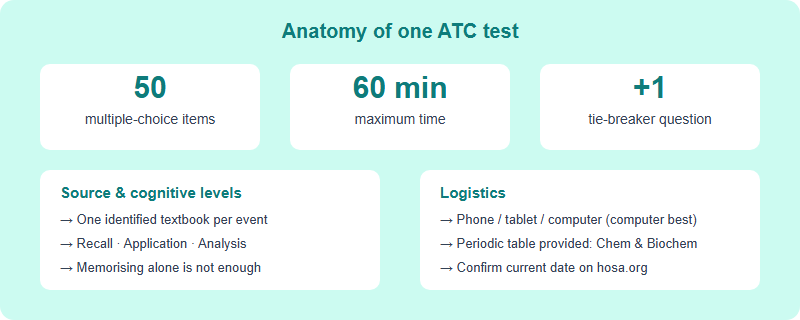
According to the official ATC guidelines on hosa.org, every event in the NGL ATC series follows the same structural template, which makes preparation predictable:
- 50 multiple-choice items in a maximum of 60 minutes, plus one tie-breaker question used only to separate equal scores.
- Items are drawn from one identified textbook specific to each event — the test is explicitly anchored to a named source rather than a vague syllabus.
- Questions are written to measure understanding at the recall, application, and analysis levels — so memorisation alone is not enough; you must apply concepts.
- For Biochemistry and General Chemistry, a copy of the periodic table of the elements is provided during the test.
- Tests can be taken on a smartphone, tablet, or computer, though hosa.org notes the best testing experience is from a computer.
In the SKT-iHOSA China calendar, the online ATC assessment for the current cycle was scheduled for 2 January 2026, with Division I (grades 9–10) and Division II (grades 11–12) sitting age-appropriate divisions. Exact dates, the testing window, and the device/proctoring setup are set by the program and can change — confirm the current assessment date and instructions on the SKT-iHOSA program and hosa.org rather than relying on last cycle’s schedule.
What to study: anchor to the cited text, not the whole internet
The single most useful fact about ATC preparation is that each event is tied to one identified textbook. This is a gift: it bounds your study universe. Instead of revising “all of biology,” you revise the topics that the named source actually covers, in the proportions that source emphasises. Our first-party coaching take is to build your prep around three concentric layers:
| Layer | What you do | Why it matters for a 50-item test |
|---|---|---|
| 1. Map | Skim the cited text’s table of contents; list every chapter and the weight it gets | Tells you where the 50 questions are most likely concentrated |
| 2. Master | Work each chapter’s core definitions, processes and worked examples; make a one-page summary per chapter | Builds recall + application — the two lower cognitive levels |
| 3. Apply | Do mixed-topic timed sets where you must choose the best answer, not just recognise a term | Trains the analysis-level questions and pacing simultaneously |
Two subject-specific tips. For General Chemistry and Biochemistry, because the periodic table is supplied, do not waste revision time memorising atomic masses — invest instead in the reasoning that uses the table (periodic trends, mole calculations, stoichiometry) so you can exploit the resource fast under time pressure. For Biology, the breadth is the trap: a wide scope means shallow-but-wide questions, so prioritise confident coverage of every major theme over deep mastery of one favourite topic.
Whether you prepare this solo or with structured help is a separate question — both can work. The deciding factor is usually accountability and feedback on your timed practice, not access to “secret” content, since the source text is public. If you want a frank breakdown of that trade-off, ask an advisor (below) for an honest steer rather than a sales pitch.
A realistic test-taking strategy for the 60 minutes
A 50-item, 60-minute test gives you roughly 72 seconds per question on average — enough to think, but not enough to agonise. The students who underperform on ATC rarely lack knowledge; they lose points to pacing and second-guessing. Here is a disciplined run-of-test plan that you can rehearse in every practice set so it becomes automatic on assessment day.
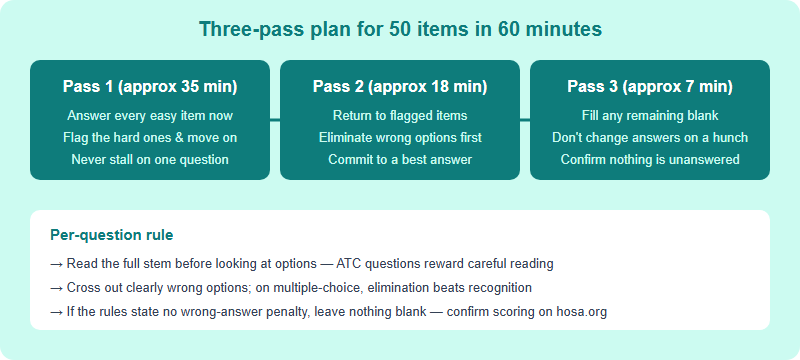
Four habits that turn the plan above into points:
- Rehearse the clock, not just the content. Do at least three full 50-item timed runs before assessment day so 60 minutes feels familiar. Most lost marks come from running out of time, not from gaps in knowledge.
- Default to elimination. On a four-option item, removing two clearly wrong choices doubles your odds even when you are unsure — a discipline that compounds across 50 questions.
- Trust your first read. Reserve answer changes for cases where you find a concrete reason; changing on anxiety alone tends to cost more than it gains.
- Prepare your device. Since the test runs on phone, tablet or computer, use a computer with a stable connection if you can, charge fully, and close everything else. A logistics failure wastes minutes you cannot get back.
Finally, keep ATC in context. A strong Foundational result is a credible academic signal, and it pairs naturally with the experiential tracks — if your ATC subject went well and you are heading toward the international round, our HOSA ILC 2026 guide covers what the global event looks like. But no competition guarantees an admissions outcome; treat ATC as evidence of disciplined subject mastery, which is exactly what it measures.
FAQ
How many questions are on a HOSA ATC test and how long do I get?
Per hosa.org, each NGL ATC event is 50 multiple-choice items in a maximum of 60 minutes, plus one tie-breaker used only to separate equal scores.
Is a periodic table provided for the chemistry tests?
Yes. HOSA’s official guidelines state a copy of the periodic table of the elements is provided during the Biochemistry and General Chemistry ATC tests.
Which ATC event should an international student start with?
Often Biology or General Chemistry, because they overlap with IGCSE / A-Level / AP coursework. Pick the subject where your current studies give you a head start; verify the live event list on hosa.org.
What is ATC in the SKT-iHOSA China program?
ATC is the Foundational / subject-foundation track (knowledge tests like biology and chemistry), alongside CCE (clinical) and BCE (public-welfare). Confirm the current tracks and dates on the SKT-iHOSA program.
Published by the HOSA (SKT-iHOSA) editorial desk, operated by Hanlin Education for China-based international-school students. Official rules are set by the competition and change yearly, so confirm current details — the event list, format, dates, and scoring — on hosa.org and the SKT-iHOSA program before you register. Confirmed errors are corrected within 7 working days.

Oct 20, 2026
iHOSA ATC Division I vs II: Allocating Study Time by Weighting Differences
Students in grades 9-10 and 11-12 face different topic weightings in the iHOSA ATC Biology and Chemistry exams. This guide breaks down…
Oct 17, 2026
iHOSA Biology Explanations: Connect a Feedback Loop to a Change in the Body
Mastering negative and positive feedback loops is essential for iHOSA Biology. Learn how to connect physiological mechanisms to observable changes with worked…
Oct 15, 2026
iHOSA Health Education: Test Whether an Audience Understood Your Message
In iHOSA Health Education, testing whether your audience understood your message is not an afterthought—it is the core deliverable. Learn how to…