HOSA competitive events are organised by the official program into seven categories — Health Science, Health Professions, Emergency Preparedness, Leadership, Teamwork, Recognition, and the National Geographic Learning Academic Testing Center — spanning 88 traditional events plus 15 testing-center events (103 total for 2025–2026). For China-based students, SKT-iHOSA groups these into three working tracks: ATC (Foundational), CCE (Professional/clinical) and BCE (Public-welfare). This guide maps the two systems and shows how to choose by your pre-health direction.
Two maps of the same territory: official categories vs. SKT-iHOSA tracks
If you have already read what HOSA is, the next confusion most students hit is the event list itself. There are two ways the same events get described, and mixing them up is where families lose time.
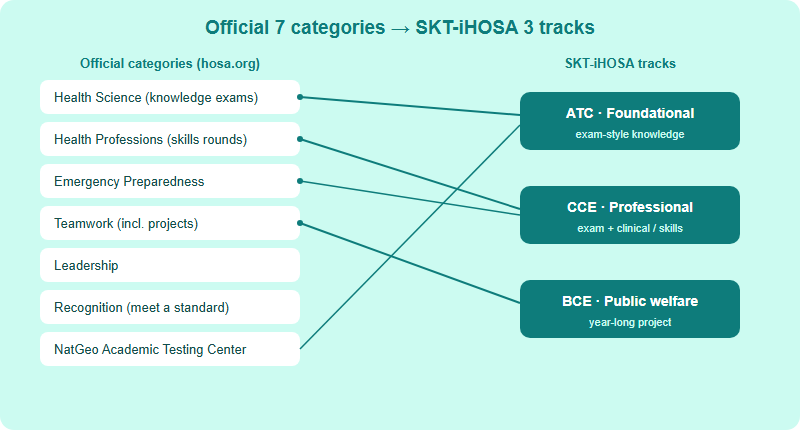
The official structure published on hosa.org sorts every event into seven categories. The first five — Health Science, Health Professions, Emergency Preparedness, Leadership and Teamwork — are genuinely competitive, meaning only top-scoring individuals and teams are recognised. The sixth, Recognition, is different: members meet a published standard and earn a pin, certificate or plaque rather than placing 1st/2nd/3rd, and these can be done in addition to a competitive event. The seventh is a series of National Geographic Learning Academic Testing Center exams, also available on top of your main event.
The SKT-iHOSA working framing (the China-region program operated by Hanlin Education) collapses that into three direction-based tracks so students can choose by intent rather than memorising 100+ names:
- ATC — Foundational Studies: exam-style, knowledge-first events. Best fit for biology/biochemistry-leaning applicants who want a clean academic-rigour signal.
- CCE — Professional Studies (clinical): events that pair an exam with clinical case application or a skills round — the strongest pre-med / pre-dent signal.
- BCE — Public Welfare Impact: project-based events built around a community-health initiative documented over time — the public-health / global-health direction.
The first-party point worth internalising: ATC/CCE/BCE are not a fourth, parallel rulebook — they are a lens over the official seven categories. An event like Sports Medicine lives under the official “Health Professions” category and reads as a CCE-style clinical event; Medical Terminology sits under “Health Science” and behaves as an ATC-style foundational exam. Below we connect both maps explicitly. Always confirm the current-year event name and rules on the official guidelines page, because events are added, renamed or retired every cycle.
ATC track (Foundational): the knowledge-exam events
ATC-style events draw mainly from the official Health Science category and the Academic Testing Center exams. They are written, knowledge-first tests — multiple choice and, in some events, short answer — with no clinical skills round to perform. If your strongest asset is biology and chemistry mastery and you want a portable academic signal for biomedical-sciences applications, this is your lane.
Officially confirmed Health Science events for 2025–2026 include Behavioral Health, Medical Terminology, Medical Spelling, Medical Reading, Medical Math, Pathophysiology, Pharmacology, Nutrition, Medical Law and Ethics, Health Informatics, Healthcare Administration, Dental Terminology and World Health and Disparities, among others. The National Geographic Learning Academic Testing Center adds a further set of subject exams (15 for this cycle) that you can take in addition to your main event.
A practical first-party tip from coaching China-based cohorts: ATC events reward vocabulary discipline. Medical Terminology and Medical Spelling are won on systematic root/prefix/suffix drilling, not last-minute cramming — which is exactly why they suit students who want a structured, self-pace-able prep before they ever decide on a clinical specialty.
One nuance China-based students often miss: an ATC-style event is still a HOSA competitive event and is scored against other competitors, whereas the National Geographic Learning Academic Testing Center exams are a separate add-on series you layer on top. So a biomedical-leaning student can, for example, run Pathophysiology as their main ATC event and stack a relevant Testing Center exam in the same season — two academic-rigour signals from one body of study. Confirm the exact exam list and any limits in the current-year General Rules before you plan this.

CCE track (Professional / clinical): exam + skills or case events
CCE-style events are the closest thing HOSA offers to “doing the job.” They draw from the official Health Professions category (and some clinically-flavoured Health Science events), and they typically run in two rounds: a Round-One written test, after which top scorers advance to a Round-Two skills assessment or live judging. This is the format that produces the strongest pre-med, pre-dent and pre-allied-health signal because it asks you to apply knowledge under observation.
Confirmed Health Professions events for 2025–2026 include Sports Medicine, Nursing Assisting, Pharmacy Science, Phlebotomy, Physical Therapy, Occupational Therapy, Respiratory Therapy and Veterinary Science. Dental Science and Clinical Specialty are well-known clinical events in this family — Clinical Specialty lets you choose a health career, build a portfolio, record a skill demonstration and present live to judges; for 2025–2026 its guidelines were updated to add Occupational Therapy and Surgical Technologist options, and Surgical Technologist moved from pilot to a regular event. Always check the current guideline PDF for the exact skill list, because the duplicable-skills rules change yearly.
Choosing inside CCE is really about which clinical world you want to test-drive. A pre-dent student should look hard at Dental Science; a future physio at Physical Therapy; an undecided pre-med at Clinical Specialty, which is deliberately flexible. For a deeper decision framework between the three tracks, see our dedicated ATC vs CCE vs BCE selection guide.
BCE track (Public welfare) and the team/leadership events
BCE-style events are project-driven and live mostly across the official Emergency Preparedness, Teamwork and Leadership categories. Instead of a single exam day, you design, run and document a body of work over the season — ideal for students whose strength is initiative, communication and real-world impact rather than test-taking, and who are leaning toward public health, health policy or community medicine.
Confirmed placements: Public Health and CPR/First Aid sit under Emergency Preparedness (with Epidemiology, Emergency Medical Technician and Mental Health Promotion). Community Awareness, Medical Innovation, Forensic Science, Creative Problem Solving, Health Career Display and Public Service Announcement sit under Teamwork. Prepared Speaking, Researched Persuasive Writing and Speaking, Research Poster and Health Career Photography sit under Leadership. And the Barbara James Service Award is a Recognition event — you meet a service-hours standard rather than placing — that pairs naturally with a BCE-minded student.
| SKT-iHOSA track | Official category source | Format | Representative events (confirm current names on hosa.org) | Best-fit direction |
|---|---|---|---|---|
| ATC · Foundational | Health Science; NatGeo Testing Center | Written exam (MC / short answer) | Medical Terminology, Medical Spelling, Pathophysiology, Pharmacology, Behavioral Health | Biomedical sciences, biochemistry |
| CCE · Professional | Health Professions (+ clinical Health Science) | Exam → skills / live judging (2 rounds) | Sports Medicine, Dental Science, Clinical Specialty, Nursing Assisting, Pharmacy Science | Pre-med, pre-dent, allied health |
| BCE · Public welfare | Emergency Preparedness; Teamwork; Leadership | Project / presentation over the season | Public Health, Community Awareness, Medical Innovation, Prepared Speaking | Public health, policy, global health |
| (add-on) | Recognition | Meet a published standard | Barbara James Service Award | Any — stacks on your main event |
How to choose your event by pre-health direction
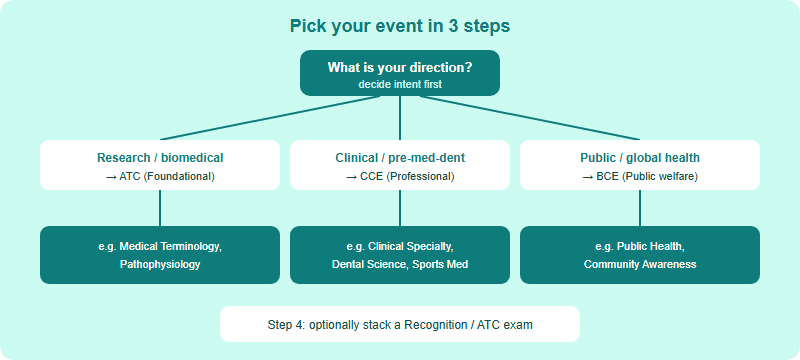
Reverse the question. Don't start from “which event sounds impressive” — start from where you're headed, then pick the track, then the event. A useful order of operations: (1) name your direction (biomedical research, clinical medicine/dentistry, or public/global health); (2) pick the matching track (ATC, CCE, BCE); (3) inside that track, pick one event you can realistically prepare for the season; (4) optionally stack a Recognition or Academic Testing Center event on top, since both are designed to be additive.
A worked example. A Grade 11 student at a Chinese international school who wants to read Dentistry abroad should not default to a generic knowledge exam just because it feels safer. Direction = clinical (dentistry); track = CCE; event = Dental Science, which runs a Round-One written test and a Round-Two skills assessment that mirrors real chairside competencies. If that student also logs significant community service, the Barbara James Service Award (a Recognition event) can sit alongside it — one focused clinical signal, plus documented service, from a single season. Contrast that with a future epidemiology major, whose cleanest fit is BCE: Public Health or Epidemiology under Emergency Preparedness, where the deliverable is a researched, presented body of work rather than a chairside skill.
Two honest cautions. First, prestige is not transferable across fit — a strong showing in an ATC exam beats a thin attempt at a clinical CCE event you weren't ready to perform. Second, no competition guarantees an admissions outcome; the real value is the depth of preparation and the evidence trail it produces. For students aiming at the international stage, our HOSA ILC 2026 guide walks through how events advance to the global round.
Frequently asked questions
How many HOSA competitive events are there in 2025–2026?
HOSA lists 88 unique traditional competitive events plus 15 National Geographic Learning Academic Testing Center events, for 103 total unique offerings this cycle.
Are ATC, CCE and BCE official HOSA category names?
No. They are SKT-iHOSA (China-region) working tracks that group HOSA's seven official categories by direction. Official rules and names are on hosa.org.
Can I enter more than one HOSA event?
You choose one main competitive event, but Recognition events and Academic Testing Center exams are designed to be done in addition. Confirm limits in the current General Rules.
Which track is the strongest pre-med signal?
The CCE (Professional/clinical) track, because events like Clinical Specialty and Dental Science pair an exam with applied clinical skills judged live.
Published by the HOSA (SKT-iHOSA) editorial desk, operated by Hanlin Education for China-based international-school students. Official competitive-event rules, category names and event lists are set by the competition and change every year, so always confirm current details on hosa.org and through the SKT-iHOSA program before you register. Confirmed errors are corrected within 7 working days.

Oct 20, 2026
iHOSA ATC Division I vs II: Allocating Study Time by Weighting Differences
Students in grades 9-10 and 11-12 face different topic weightings in the iHOSA ATC Biology and Chemistry exams. This guide breaks down…
Oct 17, 2026
iHOSA Biology Explanations: Connect a Feedback Loop to a Change in the Body
Mastering negative and positive feedback loops is essential for iHOSA Biology. Learn how to connect physiological mechanisms to observable changes with worked…
Oct 15, 2026
iHOSA Health Education: Test Whether an Audience Understood Your Message
In iHOSA Health Education, testing whether your audience understood your message is not an afterthought—it is the core deliverable. Learn how to…