HOSA’s BCE events — the project-based, public-welfare track — ask you to design, run and document a real community-health initiative instead of sitting a multiple-choice exam. They map to HOSA’s portfolio-and-presentation events such as Public Health, Community Awareness, Health Education, Public Service Announcement and Mental Health Promotion, most run by teams of 2–6 and judged on a campaign or presentation you build over months. If you’d rather measure your year by impact than by a test score, this is your track.
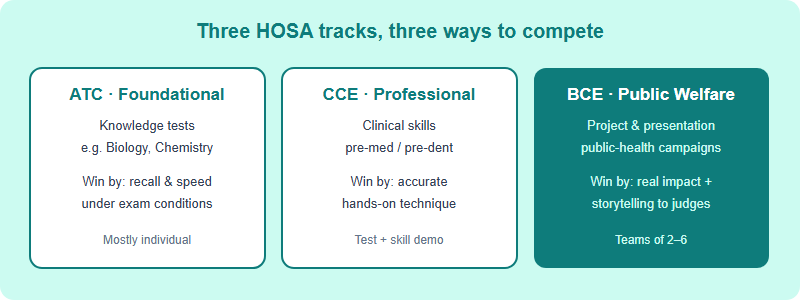
In the SKT-iHOSA China region (operated by Hanlin Education), “BCE” is shorthand for HOSA’s public-welfare / project family of events — the counterpart to ATC (Foundational, knowledge tests like biology and chemistry) and CCE (Professional / clinical, pre-med and pre-dent skills). For the difference between all three, start with our ATC vs CCE vs BCE track-selection guide; for the basics of the organisation itself, see What Is HOSA. This article goes one level deeper into the BCE events themselves.
What “BCE” actually means in HOSA’s official event list
HOSA does not print the letters “B-C-E” on its official guidelines — that label is how the SKT-iHOSA program groups the events for China-based students. On hosa.org, the events we call BCE live mostly inside HOSA’s Teamwork, Emergency Preparedness and Recognition categories. What unites them is method, not category name: you produce a portfolio, campaign, video or live presentation rather than answer a timed knowledge test.
That distinction matters because it changes how you spend your year. An ATC event rewards consistent study and fast, accurate recall under exam conditions. A BCE event rewards project management: choosing a real health problem, planning an intervention, executing it in your community, gathering evidence of impact, and telling that story to judges. The skill HOSA names again and again in these guidelines is the ability to “inform the public” and “engage with diverse communities and stakeholders” — communication and advocacy, backed by data.
A useful first-party reality check from coaching SKT-iHOSA delegates: students routinely assume “no test = easier.” In practice the opposite is true. A project event has no ceiling — there is always one more survey to run, one more revision of the trailer, one more community session to document. Budget your time as if the BCE track is the most demanding option, not the least.
The core BCE events, side by side
Below are the flagship project events in this track, with the structure HOSA publishes in its 2025–2026 ILC guidelines. Team sizes and round formats are taken directly from the official event pages on hosa.org; topics rotate every year, so always confirm the current annual theme on the official site before you commit.
| Event | HOSA category | Team | What you produce | Format |
|---|---|---|---|---|
| Public Health | Emergency Preparedness | 2–6 | Live community presentation + a pre-judged video “trailer” | Two rounds (video, then in-person) |
| Community Awareness | Teamwork | 2–6 | A local community campaign + a portfolio documenting it | Portfolio + presentation to judges |
| Health Education | Teamwork | 2–6 | A lesson for a target group of learners, taught and evaluated | Portfolio + presentation |
| Public Service Announcement | Teamwork | 2–6 | A video PSA + a talk on your creative process | One round, presented to judges |
| Mental Health Promotion | Emergency Preparedness | 2–6 | A published social-media campaign on a mental-health topic | Pre-judged digitally, then presented at ILC |
| Barbara James Service Award | Recognition | Individual | Documented health-related volunteer service hours | Recognition (hours-based) |
| Health Literacy Ambassador | Recognition | Individual | Completed health-literacy modules (NLM / MedlinePlus) | Recognition (modules) |
Two practical notes. First, several of these are “Teamwork” events on paper but project events in spirit — Community Awareness, Health Education and PSA all hinge on a portfolio or finished media artefact, not a test. Second, the Recognition events (Barbara James, Health Literacy Ambassador) are individual and lower-overhead, which makes them a smart on-ramp if your chapter is new to the BCE world. Whether each specific event is offered, and exactly how it is entered, can vary by region — confirm on the official site and with the SKT-iHOSA program before you build your plan.

Inside the flagship: how Public Health is structured and judged
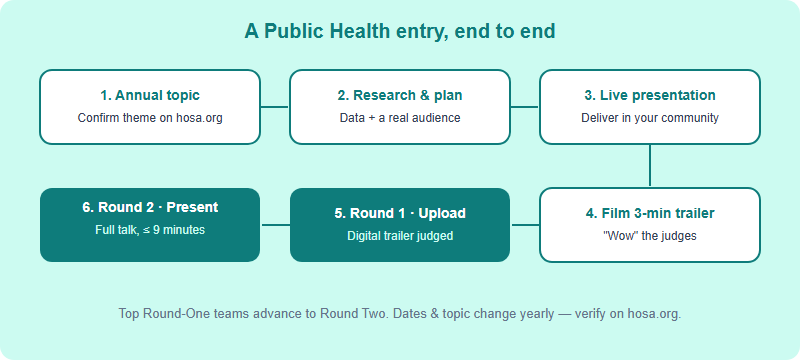
Public Health is the clearest example of what a BCE event demands, so it’s worth dissecting. Per HOSA’s 2025–2026 ILC guidelines, the event runs in two rounds for teams of 2–6. In Round One, your team uploads a three-minute video “trailer” to the HOSA Digital Upload System — think of a movie trailer whose only job is to convince a judging panel to watch your full presentation. The highest-scoring teams advance. In Round Two, judges watch your complete in-person community presentation, which must run no more than nine minutes.
The content rotates yearly. HOSA assigns a single annual topic — for 2025–2026 it is “Food Wars: Battling Big Soda and Ultra-Processed Food,” sponsored by the U.S. Public Health Service. The brief is explicit that the goal is to “create and deliver a presentation to a live community audience” about the assigned issue: you are expected to actually present in your community, then bring that work to competition. Presentation tools — posters, props, costumes, music — are not just allowed but encouraged. (Always verify the current year’s topic on hosa.org; do not assume last year’s theme still applies.)
What this rewards is a specific blend: data literacy to interpret a real health trend, the discipline to run an actual community session, and the communication craft to make nine minutes land. For Chinese international-school students, the highest-leverage move is usually localisation — taking a U.S.-framed topic and grounding it in evidence and an audience you can genuinely reach. Note one mechanical detail: HOSA’s guidelines reference a digital-upload deadline (the Public Health guidelines cite May 15 for ILC trailer uploads, with SLC deadlines set by your advisor), and deadlines change year to year — treat every date as “confirm on the official site” rather than fixed.
The other project events: campaigns, lessons and media
Community Awareness is the portfolio-heavy sibling of Public Health. Teams of 2–6 plan a local campaign around one health- or safety-related issue of local, state or national interest, then build a portfolio that documents and explains the campaign and its activities — and present that portfolio to judges. Where Public Health centres a single polished presentation, Community Awareness rewards a documented body of work across a quarter or semester. It is an excellent fit for a chapter that wants its competition to double as a genuine service program.
Health Education narrows the lens to teaching. A team of 2–6 selects a health concept or instructional objective, prepares a lesson for a specific group of learners, delivers the instruction, and evaluates the results — then presents a portfolio and talk to judges. If you like the idea of building curriculum and measuring whether people actually learned something, this is your event.
Public Service Announcement is the most media-forward option: a single round in which a team of 2–6 produces a video PSA on a significant health issue and presents their creative process to judges. It rewards students who can edit video, write a tight script and defend their creative choices — skills that transfer directly to digital advocacy.
Mental Health Promotion, developed with the prevention field in mind, asks a team to create and publish a social-media campaign promoting protective factors around a chosen mental-health topic, judged first digitally and then presented at the International Leadership Conference. For students already fluent in social platforms, it turns that fluency into structured health advocacy. (For where these culminate, see our HOSA ILC 2026 guide.)
Which student is the BCE track for?
Honest answer: the BCE track fits a specific profile, and it is not “everyone.” Choose it if several of the following describe you.
- You’d rather lead a project than sit an exam. If you light up planning, organising people and shipping a finished thing, the project format plays to your strengths.
- You can commit across the year. Project events reward sustained execution and documentation, not a sprint of revision the week before. If your schedule is already saturated by exam-prep, an ATC event may be the lower-friction choice.
- You want a portfolio artefact for applications. A documented community-health campaign, a taught lesson with outcomes, or a published PSA is concrete evidence of initiative — useful for university applications without overclaiming. (No competition guarantees admission; treat it as one signal among many.)
- You have a team. Most BCE events need 2–6 members. If you’re a strong solo competitor with no team, look first at the individual Recognition events (Barbara James, Health Literacy Ambassador) or consider the ATC / CCE tracks.
A grounded way to decide is to estimate the work realistically. Project events are open-ended, so the honest framing for SKT-iHOSA delegates is that BCE typically costs more total hours than the test-based tracks, not fewer — the absence of a fixed syllabus means there is always more you could do. If that sounds energising rather than exhausting, you’re in the right place. For a structured walk-through of how track selection locks in during the China-region registration window, see the track-selection guide; SKT-iHOSA delegates confirm their track during the September–October registration on Webloom.
| If you want… | Strong BCE fit |
|---|---|
| One high-impact live presentation | Public Health |
| A documented, semester-long service campaign | Community Awareness |
| To build and teach a real lesson | Health Education |
| To make and defend video / media | Public Service Announcement |
| Mental-health advocacy via social media | Mental Health Promotion |
| A solo, lower-overhead entry point | Barbara James · Health Literacy Ambassador |
Frequently asked questions
Is “BCE” an official HOSA term?
No. “BCE” is how the SKT-iHOSA program groups HOSA’s project-based public-welfare events for China-based students. The official guidelines on hosa.org organise these under Teamwork, Emergency Preparedness and Recognition categories.
How big is a HOSA Public Health team?
HOSA’s 2025–2026 ILC guidelines specify teams of 2–6 members, running two rounds: a pre-judged three-minute video trailer, then a live in-person presentation of up to nine minutes.
Are BCE project events easier than the test tracks?
Usually no. Project events are open-ended with no fixed syllabus, so they often demand more sustained work across the year than knowledge-test (ATC) events — plan accordingly.
Where do I confirm deadlines, topics and rules?
On the official HOSA site (hosa.org) and through the SKT-iHOSA program. Annual topics, upload deadlines and event availability change yearly, so verify current details before you commit.
Published by the HOSA (SKT-iHOSA) editorial desk, operated by Hanlin Education for China-based international-school students. Official rules are set by the competition and change yearly, so confirm current details on hosa.org and through the SKT-iHOSA program. We are an independent editorial desk and not the national HOSA organisation; confirmed errors are corrected within 7 working days.

Oct 20, 2026
iHOSA ATC Division I vs II: Allocating Study Time by Weighting Differences
Students in grades 9-10 and 11-12 face different topic weightings in the iHOSA ATC Biology and Chemistry exams. This guide breaks down…
Oct 17, 2026
iHOSA Biology Explanations: Connect a Feedback Loop to a Change in the Body
Mastering negative and positive feedback loops is essential for iHOSA Biology. Learn how to connect physiological mechanisms to observable changes with worked…
Oct 15, 2026
iHOSA Health Education: Test Whether an Audience Understood Your Message
In iHOSA Health Education, testing whether your audience understood your message is not an afterthought—it is the core deliverable. Learn how to…