
HOSA is not a golden ticket, and no activity guarantees admission anywhere. But read correctly, a HOSA record sends a specific, legible signal to admissions readers evaluating a health-focused applicant: sustained, structured commitment to a medical or health-science interest, tested against external standards rather than self-declared. This article explains what that signal actually communicates to a pre-med or BS/MD reader, what it does not, and how China-based SKT-iHOSA students can present it honestly.
Why “signal” is the right word
Selective admissions is, in part, a problem of credibility. Thousands of applicants write that they want to be doctors; readers cannot verify a feeling. What they can read is evidence — and the value of an extracurricular is largely how much credible information it carries per line of the application. HOSA scores well on this axis for three structural reasons:
- It is externally validated. HOSA — Future Health Professionals (per hosa.org) is a recognised organisation with defined competitive events and a progression structure. A placement or sustained participation is checkable, not a claim a student invents.
- It is topically precise. Unlike a generic leadership club, HOSA points squarely at health and medicine. For a pre-med narrative, it reinforces the exact field the rest of the application is arguing for.
- It is effortful. Clearing an online qualifier or preparing a clinical event takes months of work. Effort that an applicant could not have faked late in the cycle reads as genuine interest.
For the foundations of the programme and where its events sit, see our What Is HOSA overview.
The signal is not the same as a guarantee
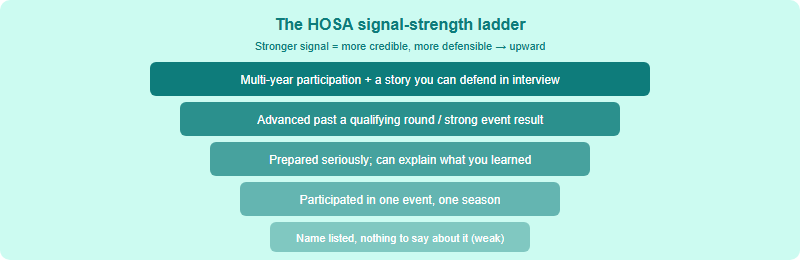
Here is the honest part, and SKT-iHOSA will not soften it: HOSA does not admit anyone to anything. Admissions outcomes depend on the whole application — academics, essays, recommendations, context, and institutional priorities. Treat any claim that a single competition “gets you into medical school” as a red flag. What HOSA can realistically do is make a health-focused story more credible and more coherent; it cannot rescue a thin transcript or substitute for genuine reflection. The most damaging way to use HOSA is as a trophy to list; the most useful way is as evidence inside a story you can defend in an interview.
| HOSA can credibly signal… | HOSA does not signal… |
|---|---|
| Sustained, specific interest in health/medicine | A guaranteed admission or scholarship |
| Willingness to be measured against an external standard | That you are a stronger applicant than your transcript shows |
| Subject knowledge in your event area (e.g., terminology, physiology) | Clinical competence or licensure |
| Initiative — you sought out a hard, field-specific challenge | Leadership you did not actually exercise |
| Continuity, when you participate across multiple years | Depth from a single one-off entry with no follow-through |

How the three SKT-iHOSA tracks read differently
Not all HOSA participation sends the same message, because the three SKT-iHOSA event families test different things. Choosing the track that fits your wider narrative is part of using the signal well — our ATC vs CCE vs BCE breakdown covers the choice in depth; here is the admissions-reading shorthand:
- ATC (Foundational, test-based). Biology/chemistry-style examinations. To an admissions reader this reinforces academic readiness for a science-heavy pathway — it pairs naturally with strong grades in the sciences and signals that you can perform under a standardised test format.
- CCE (Professional / clinical). Pre-med and pre-dental clinical events. This reads as the most direct pre-med signal of the three: you engaged with the procedural, patient-facing dimension of medicine, not just the textbook. It supports a “why medicine, specifically” narrative.
- BCE (Public-welfare / project). Project- and public-health-oriented events. This reads as initiative and community/health-systems thinking — valuable for applicants whose story is about population health, advocacy, or building something, and a strong complement to a research or service record.
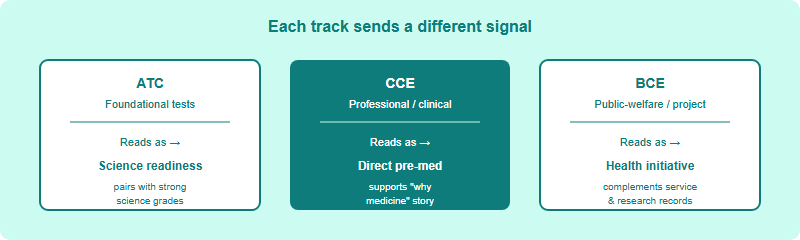
A coherent applicant picks the track that amplifies the rest of their file rather than contradicting it. A student whose essays are about clinical curiosity is better served by CCE depth than by collecting one of each.
Presenting HOSA honestly on the application
The mechanics of how you list HOSA matter as much as the participation itself. Four principles, all grounded in writing things you can substantiate:
- State the verifiable facts. Name the event(s), your division, the years, and any result exactly as the records show. Never round a regional result up into something it was not; readers and interviewers can ask.
- Show continuity over collection. Two years in one event with growth beats five events entered once. Continuity is the part of the signal hardest to fake.
- Connect it to a reflection. The activity is the evidence; your essay or interview is where you say what it taught you. “I prepared for a clinical event and learned X about how I think under pressure” carries more weight than the line item alone.
- Use accurate framing for SKT-iHOSA. SKT-iHOSA is the China-region pathway operated by Hanlin; describe your route accurately rather than implying a different relationship to the U.S. organisation. Accuracy is itself a credibility signal.
Pitfalls that turn the signal negative
Used carelessly, HOSA can subtract credibility. Avoid these:
- Overclaiming. Describing participation as a guaranteed credential, inflating a result, or implying official status you do not hold. An exaggeration that unravels in interview is worse than a modest, true record.
- The trophy pile. Listing HOSA alongside many unrelated competitions with no through-line signals collecting, not commitment. A focused file reads as a person; a scattered one reads as a checklist.
- No reflection. If you cannot say what you learned, the reader assumes there was nothing to learn. The line item without a story is the weakest rung of the ladder.
- Mismatched track. Entering a track that contradicts your stated interests creates a question, not an answer. Align the event with the narrative.
If you are weighing whether the time investment is worth it relative to other activities, the honest answer is: it depends on whether health is genuinely your direction and whether you will go deep. For students who are, HOSA is among the cleaner ways to make a health interest legible — see the ILC 2026 guide for what the top of the progression looks like.
Frequently asked questions
Does HOSA guarantee admission to medical school or a BS/MD program?
No. No extracurricular guarantees admission. HOSA can make a health-focused application more credible and coherent, but outcomes depend on the whole file. Treat any “guaranteed” claim as a warning sign.
Which HOSA track is the strongest pre-med signal?
The clinical (CCE) events read as the most directly pre-med, while ATC reinforces science readiness and BCE signals public-health initiative. The best track is the one that amplifies your wider narrative — see our track guide.
Is one season of HOSA enough to matter?
It can show interest, but continuity over multiple years sends a much stronger, harder-to-fake signal. Depth and reflection matter more than the number of events entered.
How should I describe SKT-iHOSA on my application?
Accurately: it is the China-region pathway operated by Hanlin Education. List your events, division, years, and results exactly as recorded, and confirm event details on hosa.org.
Published by the HOSA (SKT-iHOSA) editorial desk, operated by Hanlin Education for China-based international-school students. Official rules are set by the competition and change yearly — confirm current details on hosa.org. Any error will be corrected within 7 working days.

Oct 20, 2026
iHOSA ATC Division I vs II: Allocating Study Time by Weighting Differences
Students in grades 9-10 and 11-12 face different topic weightings in the iHOSA ATC Biology and Chemistry exams. This guide breaks down…
Oct 17, 2026
iHOSA Biology Explanations: Connect a Feedback Loop to a Change in the Body
Mastering negative and positive feedback loops is essential for iHOSA Biology. Learn how to connect physiological mechanisms to observable changes with worked…
Oct 15, 2026
iHOSA Health Education: Test Whether an Audience Understood Your Message
In iHOSA Health Education, testing whether your audience understood your message is not an afterthought—it is the core deliverable. Learn how to…