Clearing HOSA’s online qualifier feels like the finish line — but for most events it is only the first gate. The score that earns recognition is usually decided in Round Two: a conference round that, depending on your event, is a second written test, a hands-on skill demonstration, or a judged presentation. This guide explains how that second round works and how China-based international-school students competing through SKT-iHOSA should prepare for a format that rewards a very different muscle. Round structures and scoring differ by event and year — always confirm on your event’s guideline at hosa.org.
Why Round Two deserves its own playbook
HOSA’s Competitive Events Program spans five broad categories — Health Science, Health Professions, Emergency Preparedness, Leadership, and Teamwork events (per hosa.org). The online qualifier we cover in our Round 1 test decoder is built to do one job: objectively rank a wide field so scarce second-round slots can be allocated. Once you are through that filter, the assessment changes character entirely.
The trap is psychological. A student who spent months drilling multiple-choice questions can arrive at a presentation or skill round under-rehearsed, because they treated the qualifier as the whole event. Round Two is where the medal is actually won — and it almost never looks like Round One. Treat it as a separate project with its own preparation, not as an afterthought. If you are still building a mental model of how HOSA fits together, our What Is HOSA overview sets out the organisation and where competitive events sit within it.
The three shapes Round Two usually takes
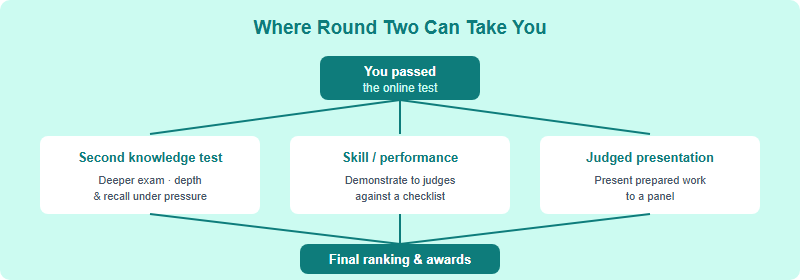
Across HOSA’s event catalogue, second rounds tend to fall into three families. Your specific event will name exactly which one applies — but knowing the families lets you anticipate the work:
| Round Two family | What you actually do | Common in | The skill it tests |
|---|---|---|---|
| Second knowledge test | A harder or deeper written exam for those who advanced | Many Health Science (knowledge) events | Depth & recall under pressure |
| Skill / performance round | Demonstrate a procedure or technique to judges, often against a checklist | Health Professions & Emergency Prep events | Hands-on competence & accuracy |
| Judged presentation / project | Present prepared work — slides, a report, a public-health project — to a panel | Leadership, Teamwork & project-based events | Research, structure & delivery |
Read the rubric, then build to it
The single most useful habit for any Round Two is to read the event’s official rating sheet before you prepare anything. HOSA events are judged against published criteria, and the point distribution tells you exactly where to invest. The recurring SKT-iHOSA observation is that students lose marks not on the hardest content but on the easy, rubric-listed points they never checked — time limits, required sections, citation rules, dress or professionalism lines, and submission formatting.
- Find the rating sheet in your guideline and list every scored line. If a criterion is worth points, it is worth your attention; if it is not on the sheet, it does not score.
- Map your time to the point weights. If delivery or “use of evidence” carries the most points, rehearse those, not the parts that feel comfortable.
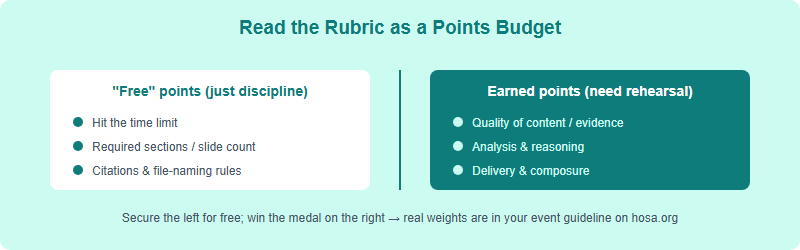
- Treat formatting and logistics as free points. Hitting the time limit, the required slide/section count, and the file-naming rule costs nothing but discipline — and missing them is a self-inflicted loss.
The exact rubric, point split, time limit, and any collateral (a written report, references page, or pre-submitted materials) are all event- and year-specific. Confirm them in your event’s current guideline on hosa.org rather than assuming they match last year or another event.
A simple way to internalise this is to picture the rating sheet as a budget: every point is currency, and the criteria with the biggest allocations are where you should spend the most rehearsal time. The diagram below shows the recurring split SKT-iHOSA students under-invest in — the “free” logistics and structure points on the left that cost nothing but discipline, versus the content and delivery points on the right that need genuine practice. The proportions are illustrative; your event’s real point weights are in its guideline.

Round Two by track: what changes for ATC, CCE and BCE students
Because SKT-iHOSA organises China-cohort entry around three tracks, the Round-Two work differs sharply depending on which you chose. Our ATC vs CCE vs BCE track guide covers the choice; here is how each track tends to feel at the conference stage:
| SKT-iHOSA track | Nature | Round-Two emphasis (typical) | Prepare by |
|---|---|---|---|
| ATC — Foundational tests | Academic / examination | Often a deeper test; depth over breadth | Harder past-style questions at real tempo |
| CCE — Professional / clinical | Skill & applied knowledge | Often a demonstration or applied round | Rehearsing the procedure against a checklist |
| BCE — Public-welfare / project | Project-based | A judged presentation of prepared work | Building & rehearsing the project + collateral |
For ATC students, the second round usually keeps the discipline of the qualifier but raises the ceiling — the same recognition-speed and tie-breaker logic from our ATC test-strategy article applies, just deeper. For CCE students, the shift to a skill round means rehearsal beats reading: you cannot memorise your way through a procedure judged against a checklist. For BCE students, the project and its presentation are the event — start the build early, because polish in spring is what separates clustered teams.
A first-party Round-Two checklist for China-based students
SKT-iHOSA’s editorial view, from running China-cohort seasons, is that the avoidable Round-Two losses are almost always logistics, not knowledge. We promise no outcome — HOSA is selective by design — but working through this list closes the self-inflicted gaps:
- Confirm the format the day you qualify. Open your event guideline and identify whether Round Two is a test, a skill, or a presentation. Do not assume.
- Extract the rating sheet and build a one-page checklist of every scored criterion and every hard requirement (time, sections, references, professionalism).
- Rehearse in the real format. Time your presentation; run your skill against the checklist; sit your second test under exam conditions. Rehearsal under realistic constraints is the whole point.
- Prepare collateral early. If a written report, references page, or pre-submission is required, treat its deadline as seriously as the test date — late or missing collateral can cap your score before you present.
- Plan the China-region logistics. How you advance, present, or submit through the SKT-iHOSA pathway is operated regionally — treat the SKT-iHOSA channel’s instructions as authoritative for China-based competitors.
If you have not yet entered, our SKT-iHOSA pathway guide explains how China-based students join, and the ILC 2026 guide covers what the international finals look like at the top of the chain.
The five Round-Two losses we see most often
From running China-cohort seasons, SKT-iHOSA’s editorial team sees the same avoidable mistakes recur — none of them about intelligence, all about execution. Naming them lets you pre-empt them:
- Treating the qualifier as the finish. The most common error is mental: students celebrate the pass and lose two weeks of preparation runway before realising Round Two is a different event entirely.
- Never reading the rating sheet. Preparing “generally” instead of to the published criteria means you over-invest in what feels important and under-invest in what actually scores.
- Skipping a real rehearsal. Reading your slides is not rehearsing your presentation; thinking through a procedure is not performing it against a checklist. The format has to be practised in the format.
- Missing collateral deadlines. Where a written report or pre-submission is required, a late or malformed upload can cap a score no matter how strong the live performance is.
- Ignoring the China-region logistics. How you present, submit, or advance through SKT-iHOSA is operated regionally; assuming it mirrors a U.S. blog’s description is a needless risk.
None of this guarantees a result — HOSA is competitive by design and strong fields cluster tightly. What it does is remove the self-inflicted losses, so your placement reflects your actual preparation rather than a missed instruction. For students still deciding whether to take on Round Two solo, the self-study vs coaching roadmap weighs both approaches track by track.
Frequently asked questions
Is passing the online test enough to win an award?
Usually no. For most events the qualifier only advances you; final ranking and awards are decided in Round Two — a second test, skill demo, or judged presentation. Confirm your event’s structure on hosa.org.
What format is Round Two for my event?
It depends on the event. The three common shapes are a deeper knowledge test, a hands-on skill round, or a judged presentation. Your event guideline names the exact format and rubric.
Do I need to submit anything before the conference round?
Some events require collateral — a report, references, or pre-submitted materials — with its own deadline. Check your guideline; missing collateral can cap your score.
How is Round Two scored?
Against a published rating sheet with weighted criteria. Read it first and map your preparation time to where the points are, including logistics like time limits.
Published by the HOSA (SKT-iHOSA) editorial desk, operated by Hanlin Education for China-based international-school students. Official rules are set by the competition and change yearly — confirm current details on hosa.org. Any error will be corrected within 7 working days.

Oct 20, 2026
iHOSA ATC Division I vs II: Allocating Study Time by Weighting Differences
Students in grades 9-10 and 11-12 face different topic weightings in the iHOSA ATC Biology and Chemistry exams. This guide breaks down…
Oct 17, 2026
iHOSA Biology Explanations: Connect a Feedback Loop to a Change in the Body
Mastering negative and positive feedback loops is essential for iHOSA Biology. Learn how to connect physiological mechanisms to observable changes with worked…
Oct 15, 2026
iHOSA Health Education: Test Whether an Audience Understood Your Message
In iHOSA Health Education, testing whether your audience understood your message is not an afterthought—it is the core deliverable. Learn how to…