The iHOSA 2027 season introduces two significant reforms, and both are good news if you plan for them. The ATC academic track has been re-aligned to sit closer to the AP, IB and A-Level syllabuses — so preparing for it now reinforces your school coursework instead of pulling against it. And the BCE public-welfare track has broken its single fixed annual theme into a dual structure, adding a self-proposed topic route. This guide sets out what changed and how a China-based student should plan around it. iHOSA is the China-region programme (SKT-iHOSA) of HOSA — confirm current rules and dates on the official channels.
Reform 1 · The ATC track moves closer to your school syllabus
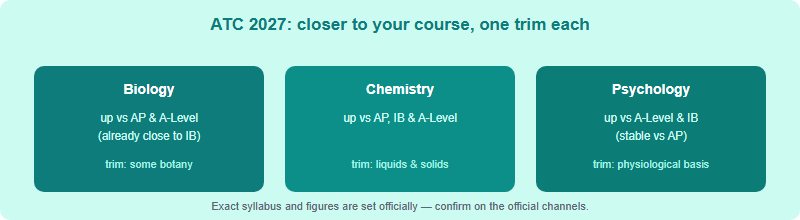
The single most useful change for 2027 is that the ATC academic track (its biology, chemistry and psychology subjects) has trimmed out-of-syllabus content and raised its overlap with the mainstream international courses. In practice, that means the hours you spend preparing double as revision for AP, IB or A-Level. The direction of travel across the three subjects:
| ATC subject | Alignment change (2027) | Notable trim |
|---|---|---|
| Biology | Closer to AP and A-Level; already very close to IB | A few botany points removed |
| Chemistry | Closer to AP, IB and A-Level | The “liquids and solids” chapter removed |
| Psychology | Closer to A-Level and IB; stable vs AP | The “physiological basis of behaviour” chapter removed |
Treat the specific alignment percentages the programme publishes as a guide to direction, not a fixed contract — the exact figures and the current syllabus are set by the organiser and confirmed on the official channels. The strategic takeaway is durable: for 2027, ATC preparation and school-course revision reinforce each other more than before, which lowers the real cost of entering. The ATC assessment itself remains an individual online objective test (45 minutes; multiple-choice, with a small set of tie-break questions), compatible with all three course systems.
Reform 2 · The BCE track splits into two routes
The BCE public-welfare track — the team, project-based route that produces a real deliverable rather than a test score — has changed the most. For 2027 it runs as two parallel routes, giving students far more freedom in what they build:
- New self-proposed route. Instead of a single fixed annual theme, students may now propose their own project around one of four health directions — physical, mental, social and environmental health — and choose their own topic. This route has its own judging pool, with the same award ratios and rules as the theme route.
- Annual-theme route. The official prompt is released in early September. Because of the reformed calendar, students get a longer runway — on the order of 70 extra days — to build a complete project.
Across both routes, the study directions are standardised into two familiar formats — an “advertising” deliverable and a “classroom” deliverable. At the Preliminary, that typically means a 30-second public-health advertisement and a public-health class plan (delivered to a real audience) — short, high-craft pieces that reward clarity and persuasion. BCE is a team route (roughly 3–6 students); confirm the current team size and deliverables officially.

The 2027 season and how the tracks fit together
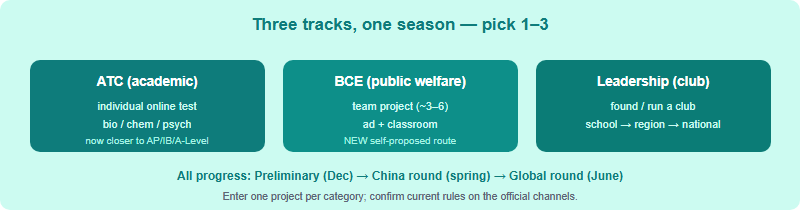
iHOSA runs as a multi-stage progression, and a student may take part in one to three activity categories — the ATC academic track, the BCE public-welfare track, and a leadership route (the iHOSA club) — entering one project per category. The published season shape:
| Stage | When (2027 season) |
|---|---|
| Registration | June to late August |
| Preliminary (初级站) | Mid-to-late December — online project submission and an online objective test |
| China round (中国站) | Around March–April 2027 — in person |
| Global round (全球站) | Late June 2027 (confirm the exact dates officially) |
Awards run at both national and regional level: China is split into five regions, and each challenge is judged separately, with national gold / silver / bronze for roughly the top 5% / 5–15% / 15–30%, and regional bands below that. Every entrant receives an official HOSA certificate of participation. For where the ATC track sits next to the pure biology olympiads, see our comparisons with USABO, BBO and Brain Bee.
How to plan for the reformed season
Two moves follow from the changes. First, if you are taking the ATC track, lean into the tighter course alignment: prepare the subject that matches your strongest school course, and treat the two as one body of work rather than two. Second, if you are taking the BCE track, decide early between the self-proposed route (best if you already have a health cause you care about) and the annual theme (best if you want an official prompt to react to) — and use the longer runway to build a genuinely finished project rather than a rushed one. As context, in the 2025–26 season Hanlin students advanced five entrants to the global round, taking a gold, two silvers, an excellence award and a rookie award (Hanlin student data, de-identified; results vary and are not guaranteed).
Frequently asked questions
What changed in iHOSA for 2027?
Two things: the ATC academic track was re-aligned closer to AP/IB/A-Level (with a chapter trimmed from each of biology, chemistry and psychology), and the BCE public-welfare track added a self-proposed topic route alongside the annual theme.
Does ATC preparation help with school exams now?
More than before — the 2027 ATC syllabus overlaps more with AP, IB and A-Level, so preparation reinforces coursework. Confirm the current syllabus officially.
What is the new BCE self-proposed route?
Students may propose their own project around physical, mental, social or environmental health, judged in its own pool with the same award ratios as the annual-theme route.
When is the iHOSA 2027 season?
Registration runs June to late August; the Preliminary is in mid-to-late December; the China round around spring 2027; and the global round in late June 2027. Confirm exact dates officially.
Published by the SKT-iHOSA editorial desk, operated by Hanlin Education as the China-region programme of HOSA (Future Health Professionals). Official rules, the syllabus, tracks, dates and award structures are set by the organiser and can change each year — always confirm current details on the official HOSA / SKT-iHOSA channels. Achievement figures are Hanlin student data, de-identified; results vary and are not guaranteed. Confirmed errors are corrected within 7 working days.

Oct 20, 2026
iHOSA ATC Division I vs II: Allocating Study Time by Weighting Differences
Students in grades 9-10 and 11-12 face different topic weightings in the iHOSA ATC Biology and Chemistry exams. This guide breaks down…
Oct 17, 2026
iHOSA Biology Explanations: Connect a Feedback Loop to a Change in the Body
Mastering negative and positive feedback loops is essential for iHOSA Biology. Learn how to connect physiological mechanisms to observable changes with worked…
Oct 15, 2026
iHOSA Health Education: Test Whether an Audience Understood Your Message
In iHOSA Health Education, testing whether your audience understood your message is not an afterthought—it is the core deliverable. Learn how to…