
Not every strong pre-med student is at their best in a multiple-choice exam. HOSA's Leadership events — Prepared Speaking, Researched Persuasive Writing and Speaking, Research Poster, Extemporaneous Writing and others — reward a different set of strengths: research, writing, and public speaking. For a student who reads and argues well in English but is not a clinician or a pure test-taker, this is often the most under-used corner of the catalogue. This guide decodes how the Leadership track works and who it fits, for China-based international-school students competing through SKT-iHOSA. Event lists, formats, time limits, and rules are set by HOSA and change yearly — confirm the current guideline on hosa.org.
Why communicators should look at the Leadership track
HOSA organises its Competitive Events Program into several broad families, and Leadership events are one of them (per hosa.org) — a set of speaking- and writing-focused events that sit apart from the knowledge tests and clinical-skill events most students default to. They are worth a serious look for two reasons. First, communication is a real, assessed competency in medicine and public health, so competing here signals something genuine. Second, because fewer students self-select into writing and speaking events, a strong communicator can stand out. If you are still mapping the whole programme, our What Is HOSA overview shows where competitive events sit within it.
Within SKT-iHOSA's three-lane framing, Leadership events do not map neatly onto a single lane — they are their own communication-first family. Our ATC vs CCE vs BCE track guide covers the foundational-test, clinical, and project lanes; the Leadership track is the answer for students whose edge is the written and spoken word rather than exam recall or a lab bench.
The Leadership events, at a glance
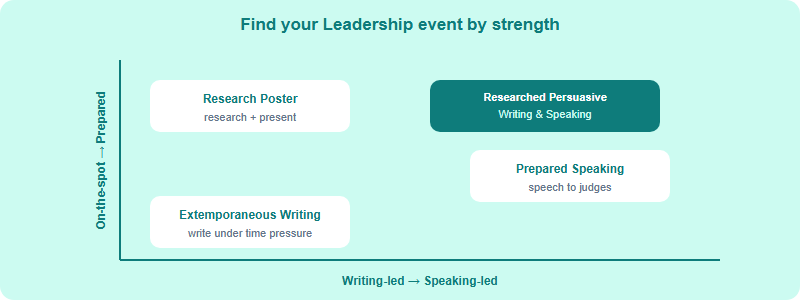
These events share a communication core but differ sharply in whether you write, speak, or both — and in whether you can prepare in advance or must think on your feet.
| Event | What you do (per hosa.org) | Prepared or on-the-spot | Core strength it rewards |
|---|---|---|---|
| Prepared Speaking | Deliver a prepared speech on the annual theme to judges | Prepared in advance | Public speaking & structure |
| Researched Persuasive Writing & Speaking | Research a health issue, write a paper supporting a thesis (for/against the annual topic), and present it orally | Prepared in advance | Argument, writing & delivery combined |
| Research Poster | Pose a research question, conduct your own research, build a poster; now Round 1 (PDF pre-judged) + Round 2 (present to judges) | Prepared, then present | Research design & visual communication |
| Extemporaneous Writing | Write on a given prompt under time pressure | On-the-spot | Fast, structured writing |
Prepared Speaking & Researched Persuasive Writing and Speaking
These two are the speaking core of the track. Prepared Speaking asks you to deliver a prepared speech on the year's theme to a panel — a pure public-speaking event where structure, delivery, and timing carry the marks. Researched Persuasive Writing and Speaking is the more demanding hybrid: per hosa.org, you research a health issue, write documentation supporting a thesis (arguing for or against the provided annual topic), and then present that argument orally. You are judged on both the written paper and the spoken delivery.
How to prepare for the speaking events:
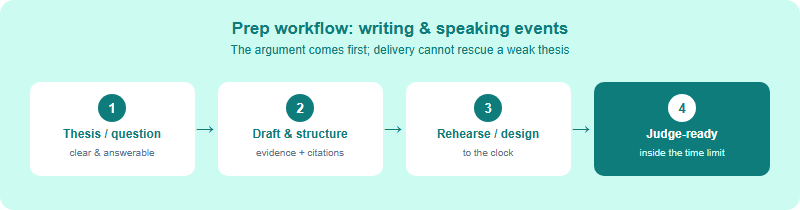
- Build the argument before the performance. For the persuasive event especially, a clear thesis and evidence come first; polished delivery cannot rescue a weak argument.
- Rehearse to the clock. Speaking events are timed. Going over or under time typically costs marks, so rehearse until you land inside the window comfortably — confirm the exact time limit on hosa.org.
- Practise being persuaded to the other side. If the topic can be argued for or against, understanding the opposing case makes your own thesis sharper and your rebuttals stronger.
- Record yourself. For non-native English speakers, recording and reviewing your delivery is the fastest way to fix pace, clarity, and filler words.

Research Poster: the research event that isn't a lab test
Research Poster is a strong choice for a curious, organised student. Per hosa.org, competitors pose a research question about a health-related issue in their community, conduct their own research, build a poster of their findings, and present it to judges. Notably, the event now runs in two rounds: Round 1 is a PDF of the poster that is pre-judged, and Round 2 is the presentation. That structure rewards students who plan and polish a document, then defend it well.
- Start from a real, answerable question. A tightly-scoped question about your own community reads far better than a broad topic you cannot actually investigate.
- Design the poster for a judge, not a wall. Because Round 1 pre-judges the PDF, clarity, structure, and visual hierarchy directly affect your score. Every element should earn its space.
- Prepare to defend it. In Round 2 you present to judges — be ready to explain your methods, limitations, and what your findings mean.
- Confirm the current format. Round structure, poster specifications, and submission rules are set by HOSA and can change — verify on hosa.org.
Extemporaneous Writing: thinking on your feet
Extemporaneous Writing is the on-the-spot member of the family: you are given a prompt and write to it under time pressure, with little or no advance preparation possible. It rewards students who can structure a coherent piece quickly. You cannot pre-write an answer, but you can train the skill — practise producing a clear intro, structured body, and conclusion inside a fixed time, on prompts you have not seen. Confirm the exact prompt style, length, and time limit on hosa.org before you rely on any specific expectation.
Who the Leadership track fits — and an honest caveat
The Leadership track is a genuinely good fit for a specific profile, and an honest mismatch for others:
| Good fit if you… | Look elsewhere if you… |
|---|---|
| Write and argue well in English | Are strongest at pure factual recall on a defined syllabus (consider ATC-style knowledge events) |
| Are comfortable presenting to judges | Want a hands-on clinical skill (consider CCE-style events) |
| Enjoy building a research question or a persuasive case | Freeze under live speaking pressure and cannot rehearse it away |
| Want a communication signal for applications | Prefer working entirely within a team on a project (consider teamwork / BCE-style events) |
One caveat worth stating plainly: a Leadership event is not a shortcut to a stronger application, and no event guarantees an outcome. What it offers is a chance to do real work — research a genuine question, build a rigorous argument, and communicate it well — in a format that plays to a communicator's strengths. Whichever event you pick, the SKT-iHOSA rule holds: read the official guideline and rating sheet first, then build to exactly what scores. If some of your season points toward the finals, our ILC 2026 guide covers the conference itself.
Frequently asked questions
Are HOSA Leadership events individual or team events?
Events such as Prepared Speaking, Researched Persuasive Writing and Speaking, Research Poster, and Extemporaneous Writing are generally individual Leadership events. Confirm the current format and any team options on hosa.org.
Does Research Poster have more than one round?
Yes — per hosa.org it now has Round 1 (a PDF of the poster, pre-judged) and Round 2 (a presentation to judges). Verify the current structure on the official guideline.
Can I prepare in advance for Extemporaneous Writing?
You cannot pre-write the answer, since the prompt is given on the spot. You prepare by practising fast, structured writing on unseen prompts. Confirm format and time limits on hosa.org.
Do Leadership events help a pre-med application?
They can demonstrate real communication and research skills, which matter in medicine — but no event guarantees admission. Choose by fit and confirm details on hosa.org.
Published by the HOSA (SKT-iHOSA) editorial desk, operated by Hanlin Education for China-based international-school students. Official rules are set by the competition and change yearly — confirm current details on hosa.org. Any error will be corrected within 7 working days.

Oct 20, 2026
iHOSA ATC Division I vs II: Allocating Study Time by Weighting Differences
Students in grades 9-10 and 11-12 face different topic weightings in the iHOSA ATC Biology and Chemistry exams. This guide breaks down…
Oct 17, 2026
iHOSA Biology Explanations: Connect a Feedback Loop to a Change in the Body
Mastering negative and positive feedback loops is essential for iHOSA Biology. Learn how to connect physiological mechanisms to observable changes with worked…
Oct 15, 2026
iHOSA Health Education: Test Whether an Audience Understood Your Message
In iHOSA Health Education, testing whether your audience understood your message is not an afterthought—it is the core deliverable. Learn how to…