For a pre-health student deciding between HOSA, DECA and USABO in 2026: HOSA is the health-focused CTSO that signals clinical and healthcare-career commitment; DECA is the business CTSO that signals leadership and the management side of healthcare; and USABO is a pure biology olympiad that signals raw academic depth. They are not interchangeable, and for international students one of them has a hard eligibility ceiling. This guide explains what each truly signals and how to combine them.
The One-Line Verdict
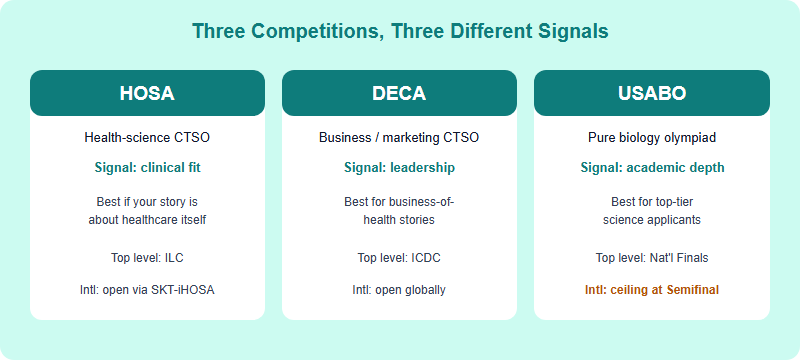
These three are often listed together as “good pre-med activities,” but they answer three different questions an admissions reader asks. HOSA answers “Does this student understand the health professions?” DECA answers “Can this student lead and think about the business of an industry?” USABO answers “How deep is this student’s pure science?” The right choice is the one whose signal matches the story you need to tell—and, for students applying from China, the one you are actually eligible to advance in.
| HOSA | DECA | USABO | |
|---|---|---|---|
| Type | Health-science CTSO | Business / marketing CTSO | Pure biology olympiad |
| Run by | HOSA–Future Health Professionals | DECA Inc. | Center for Excellence in Education (CEE) |
| What it signals | Clinical / healthcare-career fit | Leadership, business of health | Academic depth in biology |
| Format | 100+ events: exams, clinical cases, projects | 60+ events: role-plays, case studies, prepared projects | Tiered exams → lab finals |
| Top level | ILC (International Leadership Conference) | ICDC (April 25–28, 2026, Atlanta) | National Finals (Harvard, Jun–Jul 2026) |
| Intl-student ceiling | Open via SKT-iHOSA China region | Open to global chapters | Semifinal+ needs US citizenship / green card |
HOSA: The Health-Career Signal
HOSA–Future Health Professionals is a Career Technical Student Organization (CTSO) built specifically around the health professions. Its 2025–2026 program lists well over 100 competitive offerings, and the competition ladder runs from regional and state rounds up to the International Leadership Conference (ILC). What makes HOSA distinctive is breadth of format: it tests not just what you know, but how you apply it in a clinical context and how you execute a real public-health project. For a deeper primer, see our guide to what HOSA actually is.
In the SKT-iHOSA China region (operated by Hanlin Education), HOSA’s events sort into three tracks, each aimed at a different applicant profile:
- ATC — Foundational Studies: exam-style events testing core biomedical knowledge. Closest in feel to AP Biology or a college science test.
- CCE — Professional Studies: clinical, case-based events. The strongest pre-med / pre-dent / pre-nursing signal HOSA offers, because it rewards applied diagnostic thinking.
- BCE — Public Welfare Impact: year-long, documented public-health projects. Best for students aiming at public health, health policy, or healthcare social entrepreneurship.
Because the three tracks read very differently on an application, choosing among them is the biggest decision a HOSA applicant makes. We break down how to match a track to your destination program in our ATC vs CCE vs BCE selection guide. The takeaway: HOSA is the right anchor when your story is fundamentally about healthcare—the bedside, the clinic, the community health problem.
DECA: The Business-of-Health Signal
DECA is the other major CTSO students consider, but it is a business organization, not a health one. Per DECA Inc., it prepares members for careers in marketing, finance, hospitality and management, with 60+ high-school events aligned to those career clusters. Its events fall into role-plays and case studies, prepared (project) events, and online simulations. The flagship is the International Career Development Conference (ICDC), held April 25–28, 2026 in Atlanta, Georgia, drawing tens of thousands of students.
So why does a pre-health student look at DECA at all? Because modern healthcare is also an industry—hospital administration, health insurance, biotech commercialization, digital-health startups. A student who wants to write a personal statement about fixing the systems of healthcare, not only treating patients, can use DECA to show business judgment. DECA’s health-adjacent events (such as those touching health services and entrepreneurship) let you demonstrate that you can build a plan, model a budget, and pitch—skills HOSA’s clinical tracks do not directly test.
The honest caveat: if your application is aimed squarely at a BS/MD or a clinical pre-med pathway, DECA alone is a weaker primary signal than HOSA, because an admissions reader sees a business credential and has to infer the health connection. DECA shines as a complement that adds a leadership dimension, not as the centerpiece of a pre-clinical story.

USABO: Deep Signal, Hard Ceiling for International Students
USABO (the USA Biology Olympiad, run by the Center for Excellence in Education) is the purest academic credential of the three. It is structured as a funnel: a 50-minute multiple-choice Open Exam open to high-school students, then a harder Semifinal Exam, then a residential National Finals. The 2026 National Finals are at Harvard University (June 21–July 3, 2026), and the top four finalists form Team USA for the International Biology Olympiad in Vilnius, Lithuania (July 2026). A strong USABO result is an unambiguous “this student’s biology is exceptional” signal.
But here is the fact every international applicant must know before investing a year: per USABO’s own rules, the Open Exam is open to students regardless of citizenship, but advancing to the Semifinal Exam and beyond requires US citizenship or US legal permanent residency (a green card), with proof of a US passport. For a Chinese international-school student without a green card, USABO effectively caps at the Open Exam—you can earn Open Exam recognition (e.g., Honorable Mention / Certificate of Merit tiers), but the headline National-Finals achievements are out of reach. That ceiling is the single biggest reason a China-based pre-health student should not treat USABO as a one-to-one substitute for HOSA. Always re-confirm eligibility on usabo-trc.org, as rules are revised yearly.
| Stage | What it is | Open to non-US students? |
|---|---|---|
| Open Exam | 50-min nationwide multiple-choice screen | Yes — recognition tiers available |
| Semifinal Exam | Harder exam for top Open Exam scorers | No — needs US citizenship / green card |
| National Finals | Residential lab + theory finals (Harvard 2026) | No — same citizenship requirement |
| IBO (Team USA) | International Biology Olympiad | No — US team only |
How They Complement Each Other
The smartest applicants do not pick one and dismiss the rest—they stack them so each covers a different gap, without over-committing. A realistic pre-health profile rarely needs all three; two well-chosen activities usually beat three shallow ones. Use this logic:
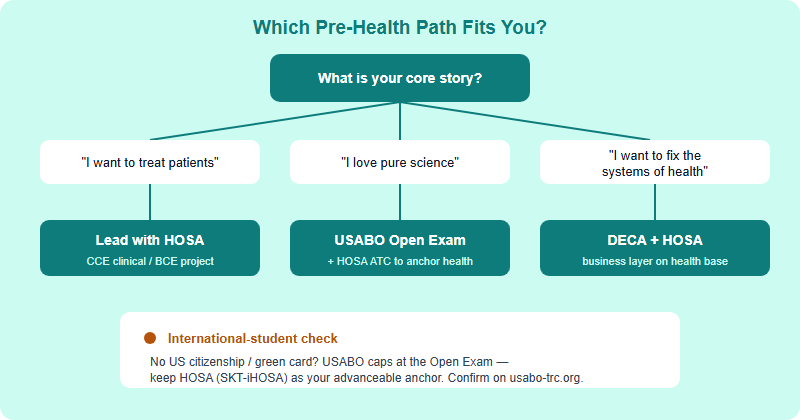
- HOSA as the anchor (clinical commitment). If you want a health career, lead with HOSA—ideally a CCE clinical event for a pre-med story, or BCE if your story is public health. This is the credential that says “I understand the profession.”
- USABO Open Exam as the depth proof (one exam, low time-cost). Even capped at the Open Exam, a solid result adds an objective, externally-scored data point that your biology is strong. It pairs naturally with an ATC-style HOSA event.
- DECA as the leadership layer (only if it fits your story). Add DECA when your narrative is about the systems of health—administration, access, health-tech. Skip it if you have no genuine business angle; a forced credential reads as resume-padding.
A coherent two-activity stack — for example, HOSA (CCE clinical) + USABO Open Exam — tells admissions: “committed to medicine, and academically deep.” Adding DECA only earns its place when you can point to a real interest in how healthcare is run. If ILC is on your radar this year, our HOSA ILC 2026 Indianapolis guide walks through what the top level actually looks like.
How to Decide This Week
Run three quick checks before you commit a prep year. First, name your story in one sentence—if it contains “patients,” “clinic,” or “community health,” HOSA is your anchor; if it is “biology research,” USABO depth; if it is “healthcare systems / access / health-tech,” HOSA + DECA. Second, check eligibility honestly: without a green card, plan USABO only to the Open Exam tier and do not bank on National Finals. Third, protect your time: pick one anchor plus at most one complement; a focused two-activity stack outperforms three half-finished ones. None of these credentials guarantees admission anywhere—they are signals, and signals only work when they are coherent and genuinely yours.
FAQ
Is HOSA or USABO better for pre-med?
Different signals: HOSA shows clinical/healthcare commitment, USABO shows raw biology depth. For most international students, HOSA is the more advanceable anchor and USABO Open Exam is a strong complement.
Can international students compete in USABO?
They can sit the Open Exam, but advancing to the Semifinal, National Finals or IBO requires US citizenship or a green card plus a US passport. Confirm current rules on usabo-trc.org.
Why would a pre-health student do DECA?
DECA is a business CTSO. It fits students whose story is about the systems of healthcare—administration, access, health-tech—rather than bedside care. It works best as a complement to HOSA, not a replacement.
Should I do all three?
Usually no. A focused two-activity stack (e.g., HOSA plus USABO Open Exam) tells a clearer, more credible story than three shallow credentials. Depth beats breadth.
Published by the HOSA (SKT-iHOSA) editorial desk, operated by Hanlin Education for China-based international-school students. We are not the official HOSA, DECA, USABO, or CEE organization. Official rules are set by each competition and change yearly, so confirm current details on hosa.org, the SKT-iHOSA program, deca.org and usabo-trc.org before acting. Confirmed errors are corrected within 7 working days.

Oct 20, 2026
iHOSA ATC Division I vs II: Allocating Study Time by Weighting Differences
Students in grades 9-10 and 11-12 face different topic weightings in the iHOSA ATC Biology and Chemistry exams. This guide breaks down…
Oct 17, 2026
iHOSA Biology Explanations: Connect a Feedback Loop to a Change in the Body
Mastering negative and positive feedback loops is essential for iHOSA Biology. Learn how to connect physiological mechanisms to observable changes with worked…
Oct 15, 2026
iHOSA Health Education: Test Whether an Audience Understood Your Message
In iHOSA Health Education, testing whether your audience understood your message is not an afterthought—it is the core deliverable. Learn how to…