HOSA CCE events are the Professional / clinical track of HOSA — in SKT-iHOSA (the China region operated by Hanlin Education) labelled “Life & Health Professional Studies.” They suit pre-med, pre-dent, pre-nursing and MPH-minded students because they reward applied clinical knowledge and hands-on skill, not just a biology test. This guide explains what the events involve, who each one fits, and how they signal a health-professions direction.
What “CCE” means — and how it differs from ATC and BCE
HOSA’s full US program runs 50+ competitive events. SKT-iHOSA streamlines these into three tracks built for Chinese senior-secondary students. CCE is the clinical one. If you are new to the three-track system, start with our ATC vs CCE vs BCE track-selection guide and the overview of what HOSA is; this article goes one level deeper inside CCE specifically.
| Track | SKT-iHOSA label | What it rewards | Best for |
|---|---|---|---|
| ATC | Foundational Studies | Exam-style knowledge (biology / chemistry) | Students who prefer written, test-based assessment |
| CCE | Life & Health Professional Studies | Applied clinical knowledge + skill / professional judgement | Pre-med, pre-dent, pre-nursing, MPH applicants |
| BCE | Public-welfare / project | Project work, public-health problem-solving | Applied public-health and community-impact applicants |
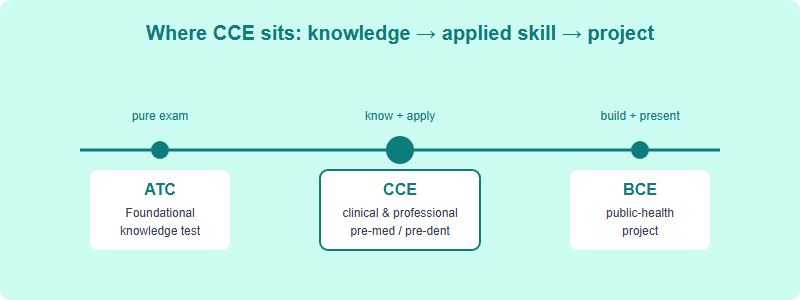
The key distinction: ATC is the closest thing to a pure exam, BCE is the closest thing to a research/impact project, and CCE sits in the middle — it asks you to know clinical content and show you can apply it the way a health professional would. That is precisely why admissions readers and your own future self find it a stronger pre-med signal than a knowledge test alone.
The two event formats inside the clinical track (most guides blur this)
Here is the single most important thing to understand — and the part that even many summaries get wrong: HOSA’s Professional / clinical (Health Professions) events do not all use the same format. Assuming “every clinical event is a written test plus a skills demo” is a common mistake. At the HOSA international level, two distinct formats exist, and you should pick events knowing which you’re walking into.
| Format | How it works | Example events |
|---|---|---|
| Test + skills (two rounds) | Round One is a written, multiple-choice test; top-scoring competitors advance to Round Two, the performance of a selected skill (the skill is given as a written scenario at the start of the round). | Dental Science, Sports Medicine, Pharmacy Science, Medical Assisting, Phlebotomy, Veterinary Science |
| Portfolio + demonstration | No knowledge-test gate. You build a career portfolio, record a video demonstrating a skill tied to your chosen health career, and give a live presentation to judges. You self-select ONE health career to anchor all three pieces. | Clinical Specialty |
Why this matters for you: a student who is strong at memorising and fast under multiple-choice pressure may thrive in Dental Science or Sports Medicine; a student with real clinical exposure, a clear career story and presentation confidence may shine in Clinical Specialty, where there is no test gate and judges reward depth and authenticity. Neither is “easier” — they reward different strengths.
One honesty note for SKT-iHOSA (China region) entrants: the China-region CCE assessment runs as an online assessment (for the current cycle, scheduled Jan 2, 2026, per en.hosa.org.cn), which is not identical to the in-person two-round skills format used at the US International Leadership Conference. So treat the US event guidelines as a window into how each event is designed and what content it covers — but confirm your exact event format, round structure and what you submit on the official SKT-iHOSA program (Webloom) before you prepare. Do not assume the China-region format from the US one.

CCE clinical events, mapped to a health-professions direction
The strongest reason to choose a CCE event is alignment: the event you pick should point at the direction you actually want. Below is a first-party mapping — how common Health Professions events line up with a pre-health pathway. Event availability differs between the full US program and SKT-iHOSA, so verify which events your region offers.
| If your direction is… | Natural CCE-type event | What it asks you to show |
|---|---|---|
| Pre-med (broad / undecided clinical) | Clinical Specialty | Choose a health career, evidence it through a portfolio + skill video + live presentation |
| Pre-dent | Dental Science | Dental knowledge test, then a dental-related skill performance |
| Pre-med leaning sports / rehab / physio | Sports Medicine | Patient-care knowledge in a sports setting, then a hands-on skill |
| Pre-pharmacy | Pharmacy Science | Pharmacy knowledge plus an applied skill component |
| Pre-nursing / patient care | Clinical Nursing / Nursing Assisting (where offered) | Core nursing knowledge and patient-care skills |
| Pre-vet | Veterinary Science | Veterinary knowledge test, then a vet-related skill |
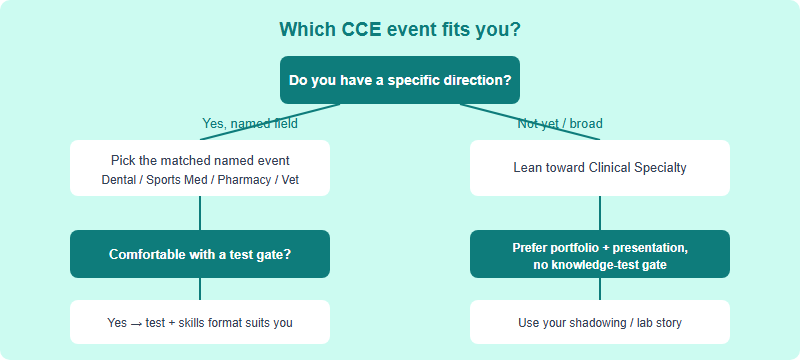
A practical first-party take from coaching China-based applicants: Clinical Specialty is often the most flexible entry point for an undecided pre-med, because you define the career it’s about — meaning your existing shadowing, volunteering or lab exposure becomes the raw material rather than a barrier. If you already have a specific direction (dentistry, sports medicine), the matched named event is the cleaner, more legible signal to an admissions reader who recognises the field.
How CCE maps to a health-professions application
A clinical event is not a magic admissions ticket — and no competition is. What CCE does well is give an admissions reader evidence of three things they look for in a pre-health applicant:
- Direction, not just interest. Choosing Dental Science over a generic biology test, or anchoring a Clinical Specialty portfolio in a chosen career, shows you have started to point somewhere specific.
- Applied competence. The skills round (or the demonstration video) is proof you can do something with knowledge, not only recall it — closer to what clinical training actually demands.
- Sustained, structured effort. A full season — preparing through to the global stage — reads differently from a one-day event. SKT-iHOSA runs Division I (grades 9–10) and Division II (grades 11–12) on the same season timeline, both qualifying for the global stage but competing and recognised separately, so there is a clear multi-year path.
If your end goal includes the international stage, read our HOSA ILC 2026 Indianapolis guide — the US International Leadership Conference holds Competitive Events from Wednesday, June 17 to Friday, June 19, 2026 (hosa.org). Knowing the ceiling of the pathway helps you choose a CCE event you’d be glad to carry that far.
Choosing your CCE event: a short, honest checklist
- Match the event to your direction first, format second. The signal is strongest when the event names the field you’re aiming at.
- Know your assessment style. Strong under timed multiple-choice → lean test-plus-skills events. Strong at storytelling, portfolios and live presentation → Clinical Specialty.
- Confirm what your region actually runs. SKT-iHOSA’s CCE assessment is online (Jan 2, 2026 this cycle); the US ILC events are in-person with skills rounds. Verify your exact event, format and submissions on the official program before preparing — do not assume.
- Register the right way. SKT-iHOSA entrants register through the Webloom platform; check current registration steps and deadlines on the official program rather than relying on last year’s process.
- Build evidence year over year. Use Division I as the foundation and Division II to deepen, so the event becomes part of a coherent pre-health story.
CCE FAQ
What is the CCE track in HOSA?
CCE is HOSA’s Professional / clinical track — in SKT-iHOSA labelled “Life & Health Professional Studies.” It is built for pre-med, pre-dent, pre-nursing and MPH-minded students.
Do all CCE clinical events have a written test?
No. Many (e.g. Dental Science, Sports Medicine) use a written test then a skills round, but Clinical Specialty uses a portfolio, skill video and live presentation with no test gate. Confirm per event on hosa.org.
Which CCE event is best for an undecided pre-med?
Clinical Specialty is often the most flexible, because you choose the health career it centres on and build it from your own shadowing or lab experience.
How do China-region students register for CCE?
SKT-iHOSA entrants register through the Webloom platform; the current-cycle online assessment is scheduled for Jan 2, 2026. Always confirm dates and steps on the official program.
Published by the HOSA (SKT-iHOSA) editorial desk, operated by Hanlin Education for China-based international-school students. Official rules are set by the competition and change yearly, so confirm current details on hosa.org and the SKT-iHOSA program. We are not the official HOSA organisation; confirmed errors are corrected within 7 working days.

Oct 20, 2026
iHOSA ATC Division I vs II: Allocating Study Time by Weighting Differences
Students in grades 9-10 and 11-12 face different topic weightings in the iHOSA ATC Biology and Chemistry exams. This guide breaks down…
Oct 17, 2026
iHOSA Biology Explanations: Connect a Feedback Loop to a Change in the Body
Mastering negative and positive feedback loops is essential for iHOSA Biology. Learn how to connect physiological mechanisms to observable changes with worked…
Oct 15, 2026
iHOSA Health Education: Test Whether an Audience Understood Your Message
In iHOSA Health Education, testing whether your audience understood your message is not an afterthought—it is the core deliverable. Learn how to…