
Bringing HOSA to an international school in China starts with one thing: a chapter — a school-based unit, led by a faculty advisor, through which students join HOSA and enter competitive events. For China-based schools, the practical route runs through SKT-iHOSA, the China-region pathway operated by Hanlin Education. This playbook is for the advisor and the student leaders doing the work: how chapters function, which roles to fill, and how to build a team that survives past its founding year. Membership and registration mechanics are set officially — confirm them on hosa.org and through the SKT-iHOSA channel.
What a HOSA chapter is — and who runs it
A HOSA chapter is the organisational home for members at a school. In HOSA — Future Health Professionals (per hosa.org), students compete primarily within their division (for international-school students this is typically the secondary/high-school level — confirm the correct division for your students officially). The chapter is normally anchored by a faculty advisor: a teacher who sponsors the club, holds the institutional relationship, and supervises registration and participation. Around that advisor sits a student leadership team.
The exact requirements to charter or affiliate a chapter, the membership steps, and any fees are set by the organisation and the China-region operator — do not assume them from how other clubs or competitions work. Your first action is to contact the SKT-iHOSA channel to confirm the current process for a China-based school, and to read the membership section on hosa.org. For the wider context of what HOSA is and where its events sit, our What Is HOSA overview is the starting point.
The founding roles to fill
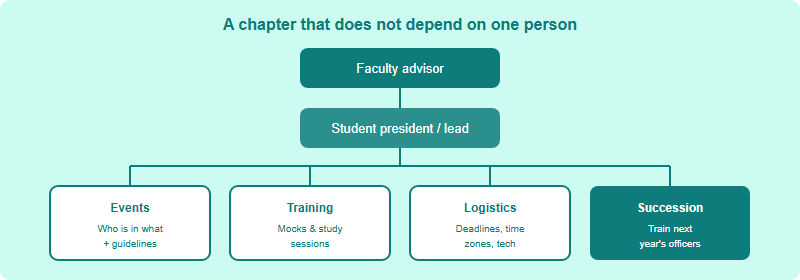
A chapter that depends on one heroic student collapses when that student graduates. Distribute the load from day one. These are the functional roles that, in our editorial experience supporting China-cohort teams, keep a chapter running — title them however your school prefers:
| Role | Owns | Why it matters |
|---|---|---|
| Faculty advisor | Institutional relationship, registration oversight, supervision | Required anchor; the chapter cannot exist without a sponsoring adult |
| Student president / lead | Calendar, meetings, the link between members and advisor | Keeps momentum between competition peaks |
| Events coordinator | Tracking which member is in which event & their guideline | Stops students preparing the wrong syllabus or missing a round |
| Training / study lead | Running mock tests, study sessions, peer teaching | Converts interest into actual preparation |
| Records / logistics | Deadlines, time-zone conversions, tech checks, rosters | Avoidable losses are usually logistics failures, not knowledge gaps |
| Succession lead (Year-2 onward) | Recruiting and training next year’s officers | Turns a one-year club into a multi-year programme |

A founding-year timeline
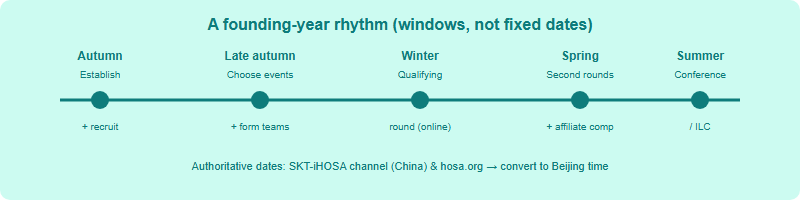
Chapters that launch well tend to follow a rhythm tied to the season rather than improvising. The dates below are deliberately described as windows, not fixed days — the authoritative China-region calendar comes from the SKT-iHOSA channel, and the global event rules from hosa.org. Build your school’s plan against those, converted to Beijing time:
- Autumn — establish & recruit. Secure the advisor and school approval, confirm the registration process through SKT-iHOSA, and recruit members. This is the membership window in many seasons; missing it can cost a whole year, so confirm the cut-off early.
- Late autumn — choose events & form teams. Match members to events using the official guidelines. Teamwork events need their groups settled early. Our ATC vs CCE vs BCE guide helps members pick the right track.
- Winter — prepare for the qualifying round. Many knowledge events open with an online test in the winter window. Run weekly mocks at the real pace and confirm test-day technology requirements.
- Spring — second rounds & affiliate-level competition. Advancing members move to later rounds. Logistics (rosters, deadlines, conversions) dominate here.
- Early summer — conference / ILC. The top of the progression is an in-person conference. See the ILC 2026 guide for what that level involves.
Treat every posted time as “confirm the time zone.” A single mis-converted deadline is the most common, most avoidable way a new chapter loses members from the bracket. The cost of a logistics slip is not just one student — it is the credibility of a first-year chapter in front of the school that approved it, which is why the records and logistics role earns its place on the founding team.
Building a team that lasts past Year 1
The hardest part of a chapter is not founding it — it is surviving the founders’ graduation. SKT-iHOSA’s editorial view, from supporting China-cohort teams, is that durable chapters do four things deliberately. None of these guarantees competitive results — they build an institution, not a trophy:
- Recruit one year down. A chapter run entirely by seniors dies in June. Deliberately bring in younger members and give them real responsibility so leadership transfers, not evaporates.
- Write things down. A simple shared document of “how we register, which guidelines, which deadlines, what went wrong last year” is the cheapest insurance against repeating mistakes. Institutional memory is a competitive advantage.
- Peer teaching beats lecturing. Members who prepared an event last year teaching this year’s entrants both reinforces the teacher’s mastery and scales preparation without depending on one adult. It is also how the strongest knowledge spreads.
- Separate the club from the competition. Run regular meetings — case discussions, guest talks, study groups — that have value even outside competition season. A club that only exists for two weeks a year does not retain members; one that is a community does.
What to confirm before you commit
Before you announce a chapter to your school, get clear answers to these from the official sources — never from assumption or from a senior’s memory:
- Eligibility & division. Which division your students belong to and the exact membership requirements (confirm on hosa.org).
- Registration route & any fees. The current China-region process and costs (confirm through the SKT-iHOSA channel; do not invent a fee).
- The season’s key dates. Registration cut-off, any online-test window, second-round and conference dates — in Beijing time.
- Advisor requirements. What the organisation requires of a faculty advisor, so your sponsoring teacher knows the commitment.
Get those four confirmed and you have removed the failure modes that sink most new chapters. The rest — the recruiting, the studying, the team culture — is the work you actually want to be doing.
Frequently asked questions
Do we need a teacher to start a HOSA chapter?
A chapter is normally anchored by a faculty advisor who sponsors the club and oversees participation. Confirm the exact advisor requirements on hosa.org and the registration route through the SKT-iHOSA channel.
How do students in China actually join and register?
For China-based schools the pathway runs through SKT-iHOSA, operated by Hanlin Education. The current membership and registration steps and any fees are set officially — confirm on the SKT-iHOSA channel and hosa.org.
How many students do we need to start?
Requirements for chartering or affiliating a chapter are set by the organisation, not by assumption. Confirm the minimum and the process officially before recruiting against a target.
How do we keep the chapter alive after the founders graduate?
Recruit younger members early, document your processes, use peer teaching, and run meetings with value outside competition season. Durability comes from succession planning, not from one strong cohort.
Published by the HOSA (SKT-iHOSA) editorial desk, operated by Hanlin Education for China-based international-school students. Official rules are set by the competition and change yearly — confirm current details on hosa.org. Any error will be corrected within 7 working days.

Oct 20, 2026
iHOSA ATC Division I vs II: Allocating Study Time by Weighting Differences
Students in grades 9-10 and 11-12 face different topic weightings in the iHOSA ATC Biology and Chemistry exams. This guide breaks down…
Oct 17, 2026
iHOSA Biology Explanations: Connect a Feedback Loop to a Change in the Body
Mastering negative and positive feedback loops is essential for iHOSA Biology. Learn how to connect physiological mechanisms to observable changes with worked…
Oct 15, 2026
iHOSA Health Education: Test Whether an Audience Understood Your Message
In iHOSA Health Education, testing whether your audience understood your message is not an afterthought—it is the core deliverable. Learn how to…