The HOSA competition year is not a single date — it is a chain of deadlines that runs from autumn registration through a winter online test to spring/summer conferences. For China-based international-school students competing through SKT-iHOSA, the single biggest avoidable mistake is treating HOSA as a spring event and starting too late. This article maps the year month by month so you can build a realistic prep runway. Exact dates change every year and differ between the U.S. and the China region — treat the SKT-iHOSA channel as authoritative for China dates and hosa.org for global rules, and confirm both.
Why HOSA has two calendars, not one
HOSA is a global organisation: members progress through local, affiliate (state/region), and international stages, and the International Leadership Conference (ILC) sits at the top of that chain (per hosa.org). China-based students do not enter through a U.S. state affiliate — they enter through the SKT-iHOSA China-region pathway operated by Hanlin Education. That means two calendars run in parallel:
- The global event calendar on hosa.org — which governs the rules, the event guidelines, and the ILC itself.
- The SKT-iHOSA China-region calendar — which governs when you register, when any China-region online assessment runs, and how China results feed forward.
These windows do not have to line up. The U.S. online-testing window and a China-region assessment window can fall in different weeks. So the rule is simple and non-negotiable: never copy a date from a U.S. blog and assume it applies to you. Pull China dates from the SKT-iHOSA channel and rule details from hosa.org. If you are new to the structure, our What Is HOSA overview explains the organisation, and the SKT-iHOSA pathway guide explains how the China route works.
The season in four phases
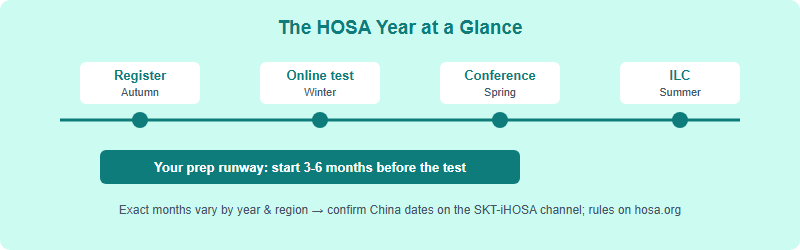
Whatever the exact calendar dates, the sequence is stable year to year. Hold these four phases in your head and you will never be surprised by a deadline:
| Phase | Typical window | What you are doing | What it decides | Confirm on |
|---|---|---|---|---|
| 1 · Register | Autumn (often Sep–Nov) | Join as a HOSA member & lock your event | Whether you can compete at all | SKT-iHOSA channel |
| 2 · Online test | Winter | Sit the timed qualifying exam | Who advances to the next round | Event guideline · hosa.org |
| 3 · Conference round | Spring | Second test, skill demo, or presentation | Final ranking & awards | Event guideline · hosa.org |
| 4 · ILC | Summer (e.g., ILC 2026) | International finals & recognition | International placement | hosa.org · ILC 2026 guide |
Phase 1 — Registration (autumn): the deadline that hides in plain sight
Registration is the deadline students underestimate most, because nothing visible is happening yet. But missing the registration window ends your season before it starts — there is no “late entry” to a test you were never enrolled for. Three things to settle in this phase:
- Become a member and register for a specific event. HOSA membership and event registration are handled through the SKT-iHOSA channel for China-based students. The step-by-step is covered in our SKT-iHOSA Webloom registration walkthrough.
- Choose your event before you register, not after. Changing events later can mean re-learning a different syllabus. Decide deliberately — the ATC vs CCE vs BCE track guide maps the three SKT-iHOSA tracks onto event types.
- Diarise the SKT-iHOSA registration cut-off the day it is published. Do not rely on memory. As a planning anchor only, SKT-iHOSA’s 2026 season was announced as open earlier in the year (see our 2026 registration-open note); the exact 2026-2027 cut-off is set by SKT-iHOSA — confirm it on the official channel.

Phase 2 — The online test (winter): the gate most knowledge events run on
Many of HOSA’s Health Science (knowledge) events open with a timed online test that screens a wide field down to a smaller group (per hosa.org event guidelines). For China-based students this is typically the first hard gate of the year, and it usually falls in winter — months before any in-person conference. That gap is exactly why an early start matters: if you only switch on for a spring event, the winter test has already passed.
A concrete first-party anchor: for the 2027 China season, SKT-iHOSA has published an initial-station format of 45 minutes for 45 single-answer multiple-choice questions, plus 5 tie-breaker questions on the ATC academic track (per SKT-iHOSA; confirm current figures on webloom.cn). That works out to roughly one minute per scored question — a tempo you should rehearse, not discover on test day. The mechanics of this round are broken down in our Online Round 1 test decoder. SKT-iHOSA also reports the ATC papers overlap heavily with mainstream curricula (for Biology, up to roughly 95% with IB, 83% with A-Level, 82% with AP, per SKT-iHOSA), which means your school revision and your test prep are largely the same body of work — a planning gift you should exploit.
Phase 3 & 4 — Conference round (spring) and ILC (summer)
If you advance past the online test, the season shifts from a solo screen to a performance round: depending on the event, that is a second test, a hands-on skill demonstration, or a judged presentation. Final ranking and awards eligibility are decided here, not in the qualifier. The pinnacle is the International Leadership Conference — ILC 2026 is the 50th-anniversary edition in Indianapolis, and our ILC 2026 complete guide covers schedule, logistics, and a China-delegate survival kit.
The planning point: the spring/summer phases demand a different muscle from the winter test. A student who only drilled multiple-choice questions can arrive at a presentation or skill round under-prepared. Budget time in spring for the round-two format your specific event uses — read its guideline’s “Round Two” section the moment you qualify.
Building your personal runway: a backward-planning method
The professional way to plan a HOSA year is to work backwards from the online test, because that is the first scored gate. SKT-iHOSA’s editorial view, from running China-cohort seasons, is that the students who clear the qualifier comfortably started their content review months earlier — not the week before. We promise no outcome (HOSA is selective by design), but this method removes the avoidable losses:
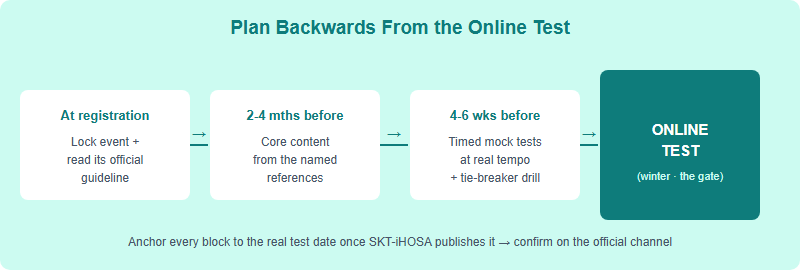
- At registration: lock the event and read its current official guideline end to end — especially the round structure, reference list, and any tie-break rule.
- 2-4 months before the test: work the core content from the named references only. Off-syllabus reading does not score.
- 4-6 weeks before: switch to timed mock tests at the real per-question tempo, and deliberately practise the hardest items (tie-breakers separate clustered students).
- After you qualify: pivot immediately to the round-two format — second test, skill, or presentation — your event uses.
If you are weighing whether to self-study this runway or work with a coach, our self-study vs coaching roadmap compares both honestly, track by track.
Two timing mistakes that quietly end seasons early
Almost every season SKT-iHOSA’s editorial team sees a handful of capable students lose the year not to difficulty but to the calendar. Two mistakes account for most of it, and both are completely avoidable:
- Mistake 1 — “I’ll start after exams.” Because the online test sits in winter, a student who plans to “ramp up in spring” is preparing for a gate that has already closed. The fix is to anchor your start to the test date, not the conference date — the conference is months later, but it is not the first thing you must clear.
- Mistake 2 — assuming the China window equals the U.S. window. Students read a U.S. timeline online, diarise those dates, and miss the SKT-iHOSA registration or assessment window because it falls differently. The fix is to pull every China-region date from the SKT-iHOSA channel and never trust a foreign blog’s calendar for your own deadlines.
Both mistakes share a root cause: treating HOSA as one date instead of a chain. Once you internalise the four phases above and anchor your runway to the winter test, the season stops ambushing you. We make no promises about results — HOSA is selective by design — but a student who simply shows up on time, registered, and prepared at the right tempo has already avoided the losses that sink most late starters. If you want the deeper test-craft for the qualifier itself, our ATC test-strategy guide covers pacing and tie-breakers; for the track decision that precedes all of this, see the ATC vs CCE vs BCE guide.
Frequently asked questions
When does the HOSA season start for China-based students?
Practically, it starts at autumn registration through SKT-iHOSA. The exact China-region dates are set yearly by SKT-iHOSA — confirm them on the official channel.
Is the China online-test window the same as the U.S. one?
Not necessarily. The China-region assessment is operated regionally and may fall in a different week. Treat SKT-iHOSA dates as authoritative for China entrants.
How early should I start preparing?
Plan backwards from the winter online test — commonly three to six months of content review, then four to six weeks of timed mocks. Adjust to your event’s real date.
What happens after I pass the online test?
You advance to a conference round (a second test, skill demo, or presentation, depending on the event), with the ILC as the international pinnacle. Read your event guideline’s Round Two section.
Published by the HOSA (SKT-iHOSA) editorial desk, operated by Hanlin Education for China-based international-school students. Official rules are set by the competition and change yearly — confirm current details on hosa.org. Any error will be corrected within 7 working days.

Oct 20, 2026
iHOSA ATC Division I vs II: Allocating Study Time by Weighting Differences
Students in grades 9-10 and 11-12 face different topic weightings in the iHOSA ATC Biology and Chemistry exams. This guide breaks down…
Oct 17, 2026
iHOSA Biology Explanations: Connect a Feedback Loop to a Change in the Body
Mastering negative and positive feedback loops is essential for iHOSA Biology. Learn how to connect physiological mechanisms to observable changes with worked…
Oct 15, 2026
iHOSA Health Education: Test Whether an Audience Understood Your Message
In iHOSA Health Education, testing whether your audience understood your message is not an afterthought—it is the core deliverable. Learn how to…