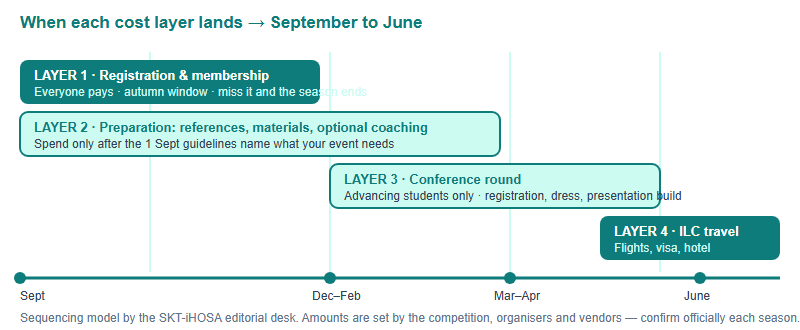
A HOSA season has no single price. It has four layers — registration, preparation, the conference round, and international travel — and each lands at a different point in the year, is set by a different party, and only applies to some students. This guide maps every line so a family can plan the whole year instead of being surprised twice.
Why “how much does HOSA cost” has no single answer
Parents usually ask the question once, in autumn, expecting one number. The honest answer is that the season is a decision tree, not a package. A student who competes in a testing event and does not advance past the online round spends almost nothing beyond registration and books. A student who advances to a judged conference round adds preparation and presentation costs. A student who qualifies for the International Leadership Conference adds international flights, a US visa, accommodation and a chaperone — and adds them in a hurry, in June, at peak season pricing.
Three separate parties set the amounts, which is why no article — including this one — should quote you figures. Registration and conference fees are set by the competition and its conference organisers and are revised each season; travel and visa costs are set by airlines, hotels and consulates; preparation costs are largely set by you. Confirm every amount on the official channels for your own season before you budget. What follows is the structure, which changes far less often than the prices do.
One date anchors the whole plan. HOSA states that the 2026–2027 Guidelines will be released on 1 September 2026. Until they land, you do not definitively know your event’s rules, materials or required references — so any budget built in August is provisional by definition. Build the shape now; fill in the numbers in September.
Layer by layer: the complete money map
The table below lists every cost line a season can generate. Most students never trigger the bottom third of it. Read the “when it lands” column carefully — the sequencing is what catches families out, not the totals.
| Cost line | Who sets it | When it lands | Applies to |
|---|---|---|---|
| Membership / affiliation | Competition & regional operator | Autumn, at registration | Everyone |
| Competitive event registration | Conference organiser | Autumn, inside the registration window | Everyone |
| Reference texts & study materials | You (guided by the event guideline) | September onwards, once guidelines publish | Everyone, varies hugely by event |
| Optional coaching or cohort programme | The provider (including us) | Autumn onwards | Optional — never required to compete |
| Project or event consumables | You | Winter–spring | Mainly BCE project and skills-based events |
| Conference registration (next round) | Conference organiser | After you advance | Advancing students only |
| Event-appropriate professional dress | You, to the published dress rules | Before your first judged round | Anyone facing judges |
| US visa: fees, appointment, travel to consulate | Consular authorities | Start months before you know if you qualify | ILC-bound students |
| International flights | Airlines | June — peak season | ILC-bound students |
| Accommodation and meals | Hotels / conference housing | June | ILC-bound students |
| Chaperone or accompanying adult | You, plus school policy | June | Most under-18 delegates |

The hours map: what each track actually asks of your week
Money is the question families ask; hours are the one that decides whether the season works. The three SKT-iHOSA tracks have genuinely different shapes: ATC is the foundational testing route, CCE the professional/clinical route, BCE the public-welfare project route. Our ATC vs CCE vs BCE comparison explains what each demands academically; below is what each demands of the calendar.
The figures are the editorial desk’s planning estimate for a student aiming to be competitive without wrecking their school term — not an official requirement and not a promise. Use them to test whether the season fits, then adjust to your own school load.
| Phase | ATC (testing) | CCE (clinical) | BCE (project) | What you are actually doing |
|---|---|---|---|---|
| Sept–Nov · build | 2–3 h/wk | 3–4 h/wk | 3–5 h/wk | Reading guidelines, mapping syllabus, forming teams, scoping projects |
| Dec–Feb · test run-up | 4–6 h/wk | 4–5 h/wk | 3–4 h/wk | Timed papers and error logs; skills repetition; fieldwork and data |
| Mar–Apr · conference | 2–3 h/wk | 5–7 h/wk | 6–8 h/wk | Collateral, presentation build, rehearsal in front of real listeners |
| May–June · ILC | 3–5 h/wk | 5–8 h/wk | 5–8 h/wk | Only if advancing — and stacked on top of school exams |
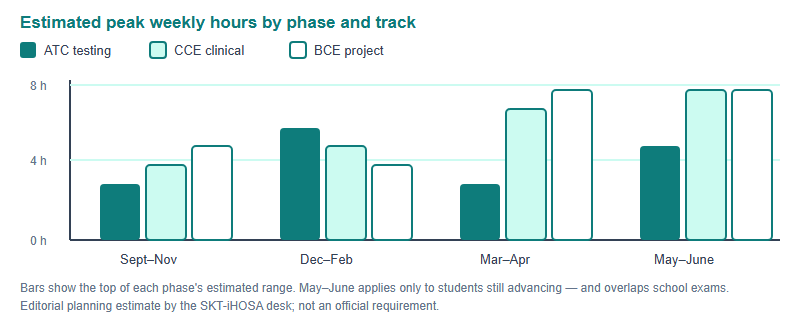
Two planning consequences fall out of that chart. First, a testing-track student and a project-team student should not be given the same revision timetable — their crunch weeks are three months apart. Second, if you are in a project or clinical event, your peak lands in spring, exactly where many international-school calendars stack internal assessments. Check that collision in September, not in March.
The travel decision: ILC 2027 is in Philadelphia, and the runway starts now
HOSA publishes its International Leadership Conference schedule years ahead, which is the single most useful planning gift a family gets. Per hosa.org, the next conferences are:
| Year | Dates | Host city and venue |
|---|---|---|
| 2027 | 22–25 June | Philadelphia, PA — Pennsylvania Convention Center |
| 2028 | 28 June – 1 July | Houston, TX — George R. Brown Convention Center |
| 2029 | 27–30 June | Orlando, FL — Orange County Convention Center |
| 2030 | To be confirmed | To be confirmed |
| 2031 | 25–28 June | Dallas, TX — Kay Bailey Hutchinson Convention Center |
| 2032 | 23–26 June | Orlando, FL — Orange County Convention Center |
Confirm all of these on the official site before booking anything — schedules can be revised. One caution specific to China-based families: those are the HOSA ILC conference dates, not necessarily your delegation’s travel window. The SKT-iHOSA global-round programme can begin or end a day either side of the conference itself, so confirm your own delegation dates with the operator before you book flights. But note what the table lets a Year 10 family do: see that a student who commits now could realistically be aiming at Philadelphia in 2027 and Houston in 2028, and plan a passport accordingly. Our conferences overview sets out how the ILC and the qualification pipeline fit together, and our ILC 2026 Indianapolis guide covers what a conference week itself looks like on the ground — a different host city from 2027, but the same shape of week.
The genuine trap in international travel is not cost — it is sequencing. You learn whether you have qualified relatively late; the documents that let you travel take a long time and are entirely outside the competition’s control. That produces a decision most families get wrong in one of two directions:
- Waiting for certainty. Starting the passport and visa process only after qualifying compresses everything into weeks and puts you at the mercy of appointment availability in June.
- Booking on hope. Buying non-refundable June flights in March, before results, converts an optimistic guess into a real loss.
The middle path is to separate documents from bookings. Get the passport valid and the visa process understood and started early, because those have long lead times and hold value regardless of the outcome — they are equally useful for a summer programme or a campus visit. Hold flights and hotel until results are confirmed, and budget for peak-June pricing when you do. Late June is also when many international-school calendars are already closed for the year, so check leave-of-absence rules with your school in autumn rather than assuming.
The honest return-on-investment conversation
We should be upfront about our position: Hanlin Education operates SKT-iHOSA and sells preparation programmes, so we have a commercial interest in students competing. That is exactly why this section is written in the sceptical direction.
No competition, including this one, can promise a university outcome, and any provider — us included — who implies otherwise should be discounted immediately. Admissions officers read competitions as one signal among many. What a season reliably buys is more concrete and more modest than a trophy: a body of health science knowledge tested under pressure, evidence of sustained commitment, and, on the project and clinical tracks, something you actually built or performed that can be written about honestly. Our piece on what HOSA is and how it is structured sets out that landscape in more detail.
Before committing money, run five questions:
- Does the schedule survive contact with reality? Put the peak-hours phase for your track next to your school’s assessment calendar. If they collide head-on, change event or change year — do not just plan to sleep less.
- What is the layer-1-and-2-only version? Every family should know the cost of a season that ends after the online round, because that is a completely legitimate and common outcome.
- Is any paid preparation buying something you cannot self-supply? Ask any provider for contact hours, group size, who teaches, and what happens if you do not advance. Vague answers are an answer.
- What is the true deadline that ends the season? The registration window, not the exam. Everything else can be recovered; a missed registration cannot — our China pathway page sets out the eligibility and entry points that window applies to.
- If the ILC trip is unaffordable, is the season still worth it? Often, yes — most of the learning happens between September and April. Decide that in advance so a funding limit does not feel like a failure in June.
Finally, revisit the whole plan on 1 September when the 2026–2027 Guidelines publish. Required references, event rules and formats can change from season to season, and a materials budget built on last year’s guideline is the most common way families spend money twice.
Frequently asked questions
How much does a HOSA season cost?
No single figure exists: fees are set by the competition and organisers, and change yearly. Map the cost lines, then confirm amounts officially.
Where and when is the next ILC?
Per hosa.org, ILC 2027 runs 22–25 June at the Pennsylvania Convention Center in Philadelphia, with Houston in 2028. Those are the conference dates; China-based delegates should confirm their own SKT-iHOSA programme window with the operator before booking.
How many hours a week does HOSA take?
Our planning estimate is roughly 2–6 hours weekly for testing tracks and up to 8 in peak weeks for project and clinical events.
Do I have to travel to the US to take part?
No. Registration, preparation and the qualifying round happen long before any travel, and many students compete without ever attending the ILC.
Published by the HOSA (SKT-iHOSA) editorial desk, operated by Hanlin Education for China-based international-school students. Official rules are set by the competition and change yearly — confirm current details on hosa.org. Any error will be corrected within 7 working days.

Oct 20, 2026
iHOSA ATC Division I vs II: Allocating Study Time by Weighting Differences
Students in grades 9-10 and 11-12 face different topic weightings in the iHOSA ATC Biology and Chemistry exams. This guide breaks down…
Oct 17, 2026
iHOSA Biology Explanations: Connect a Feedback Loop to a Change in the Body
Mastering negative and positive feedback loops is essential for iHOSA Biology. Learn how to connect physiological mechanisms to observable changes with worked…
Oct 15, 2026
iHOSA Health Education: Test Whether an Audience Understood Your Message
In iHOSA Health Education, testing whether your audience understood your message is not an afterthought—it is the core deliverable. Learn how to…