
The iHOSA Health Education event asks you to teach a health topic to a real audience and submit a lesson plan. But the rubric does not reward you for simply delivering information. It rewards evidence that your audience understood. This article shows how to build comprehension checks that demonstrate learning, how to avoid checks that merely feel rigorous, and what to do when results reveal gaps.
What “Testing Understanding” Means in the BCE Health Education Format
The iHOSA BCE public-welfare track offers two deliverable formats: a 30-second public-service announcement (PSA) and a Health Education class (Hanlin Course, July 17, 2026). For Health Education, teams submit a lesson plan and, in later rounds, may deliver the class to a live audience. The judging criteria center on whether you identified a health problem, designed an appropriate intervention, and demonstrated that the intervention worked.
Testing understanding is therefore not a bonus step. It is the mechanism by which you show your lesson achieved its purpose. A well-designed check answers two questions: Did the audience learn what I intended? And if not, where did the breakdown occur?
The Anatomy of a Valid Comprehension Check
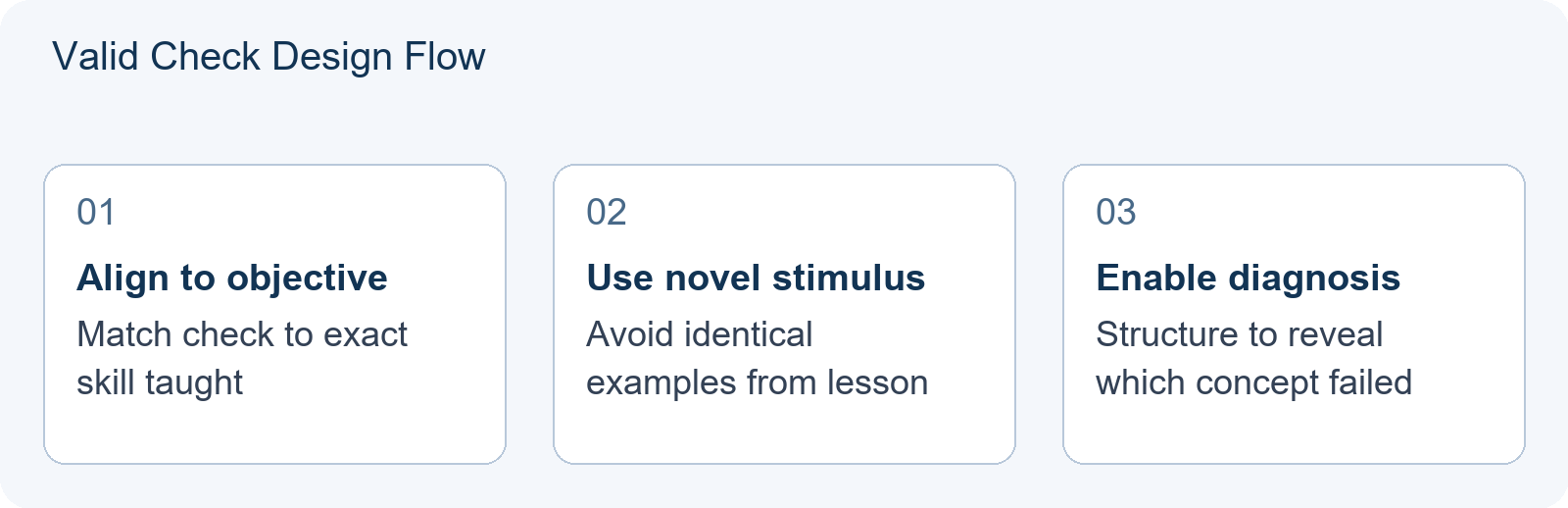
A valid check has three properties: it aligns with your stated learning objective, it measures the intended cognitive level, and it produces actionable data. Let us examine each.
Alignment with the objective. If your lesson aims to teach ninth graders how to calculate total nutrient intake from a nutrition label, your check should ask them to perform that calculation for a given consumption amount, not to list the names of vitamins. The latter tests memorization; the former tests the skill you promised to build.
Appropriate cognitive level. Recall questions ask for facts. Application questions ask students to use facts in a new context. For a lesson on nutrition labels, a recall question might be: “What does DV stand for?” An application question might be: “This package contains 2 servings. If you eat the entire package, how many grams of the nutrient did you consume?”
Actionable data. The check should reveal not just whether the audience understood, but which concepts were unclear. This requires structuring the check so that errors cluster around specific ideas.
Worked Teaching Case: A Nutrition Label Calculation Lesson for Ninth Graders
Let us walk through a complete example, with every step verified. This is a teaching illustration, not an official BCE standard or guaranteed scoring rubric.
Objective: Students will calculate total nutrient intake from a nutrition label given a stated consumption amount.
Teaching illustration label (fictional): “Energy Rings” — 10g protein per serving, 2 servings per package.
Pre-test (diagnostic): Show students the label. Ask: “If you eat half the package, how many grams of protein do you consume? If you eat the whole package, how many grams?” Collect written responses.
Lesson: Teach how to multiply the per-serving amount by the number of servings consumed. Emphasize that the package contains 2 servings, so whole package = 20g, half package = 10g. Use two contrasting labels: one with 2 servings per package, one with 3.5 servings per package, to show the calculation generalizes.
Post-test (comprehension check): Show a new fictional label for “Power Chips” — 8g fiber per serving, 2 servings per package. Ask: “If you eat the entire package, how many grams of fiber do you consume? If you eat half the package, how many grams? Show your calculation.”
Verification of design: The pre-test and post-test use parallel structure but different stimuli, so any gain reflects learning rather than memorization of the first label. The post-test requires application of the multiplication skill—both taught concepts. The “show your calculation” requirement forces explicit reasoning, not guessing.
Scoring rubric for the post-test (teaching illustration, 8 points total):
- Correctly calculates whole package consumption (8g × 2 servings = 16g): 2 points
- Correctly calculates half package consumption (16g ÷ 2 = 8g, or 8g × 1 serving = 8g): 2 points
- Shows clear multiplication or division work for both answers: 2 points
- Uses correct units (grams) for both answers: 2 points
Worked scoring of sample responses:
Student A writes: “Whole package: 8g × 2 = 16g. Half package: 16g ÷ 2 = 8g.”
Verification: Correct whole package calculation (2 points). Correct half package calculation (2 points). Shows work for both (2 points). Uses grams for both (2 points). Total: 8/8.
Student B writes: “16g and 8g.”
Verification: Correct whole package answer (2 points). Correct half package answer (2 points). No visible calculation (0 points). Units explicitly stated (2 points). Total: 6/8. This response reveals the student likely guessed or used mental shortcuts; the check design requires showing work to distinguish understanding from luck. Without visible reasoning, we cannot tell whether the student applied the multiplication rule or simply recognized the numbers.
Student C writes: “Whole package: 8g + 2 = 10g. Half package: 10g ÷ 2 = 5g.”
Verification: Incorrect operation for whole package (0 points). Incorrect operation for half package, though consistent with first error (0 points). Shows work (2 points). Uses grams (2 points). Total: 4/8. This response reveals a specific misconception: adding instead of multiplying. The error pattern suggests the student does not yet connect “per serving” to “total for package.”
Contrasting Case: Where a Superficially Similar Approach Fails
Consider a team that wants to teach nutrition label reading to sixth graders. They design what appears to be a rigorous check: a 10-question multiple-choice quiz on nutrition facts.
The lesson: Teach that vitamins are good, sugar is bad, and fiber is good.
The check: “Which nutrient helps digestion? A) Vitamin C B) Fiber C) Protein D) Iron”
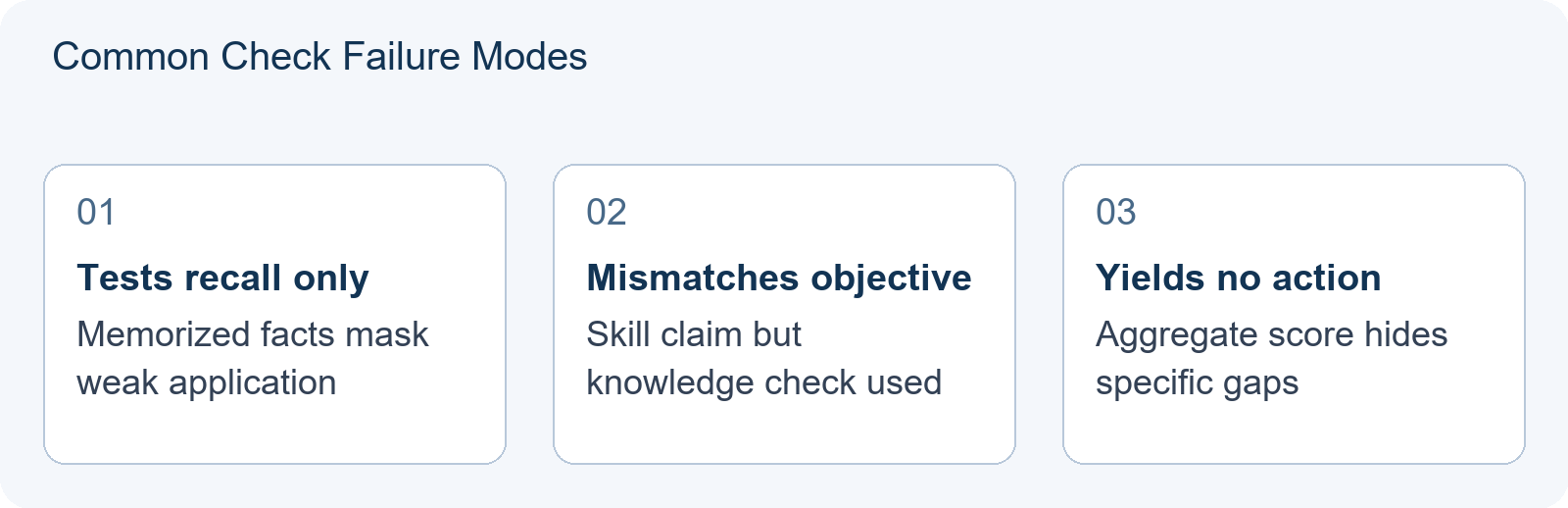
Why this fails: The quiz tests memorized associations, not calculation skill. A student could score 100% yet still be unable to determine how much fiber they consume from a half-eaten package. The check does not measure whether the student can apply the skill, only whether they can recognize correct associations. It also produces no actionable data: if a student misses question 7, the instructor learns nothing about whether the error is in reading the label, performing arithmetic, or understanding serving sizes.
A valid alternative: Present a new label with 10g per serving and 2 servings per package. Ask: “If you eat half the package, how many grams do you consume? Show your work.” This requires the actual skill, not a proxy. It produces granular data on whether errors stem from label reading, arithmetic, or unit confusion.
The lesson for iHOSA teams: Match your check to the skill you claim to teach. If your objective is calculation, your check should require calculation. If your objective is recall, a recall check is appropriate—but be honest about which level you are targeting.


Important Caveats About Pre-Test and Post-Test Designs
Parallel pre-test and post-test designs, like the one above, can suggest whether learning occurred. However, they cannot alone prove that your intervention caused the change. Other factors—students studying independently, practice effects from seeing similar questions, or concurrent lessons in other classes—can confound the results. The pre/post comparison is best understood as one piece of evidence among several, not as definitive proof of intervention effectiveness.
Similarly, when post-test results show errors, these are hypotheses about your lesson design, not certain evidence of teaching failure. A student may have been distracted, may have misread the question, or may bring prior misconceptions your lesson did not address. The appropriate response is to investigate patterns across multiple students and revise accordingly, not to assume the lesson was poorly taught.
Designing Checks for Different Health Education Objectives
Not all Health Education lessons aim for the same outcome. The check must fit the objective type.
Recall objectives: Teach the definition of “daily value.” Check: Ask students to state what DV means. A general recall test is valid for this recall goal.
Calculation objectives: Teach total nutrient intake from labels. Check: Present a new label with stated servings; ask students to calculate intake for a given consumption amount. This requires applying the arithmetic skill.
Decision objectives: Teach how to compare two products using labels. Check: Present two labels with different serving sizes and nutrient densities; ask students to calculate and compare total intake for equivalent consumption. This requires integrating multiple calculations.
For iHOSA BCE submissions, you will typically submit a lesson plan rather than raw data. Include in your plan: the exact wording of your check, the scoring criteria, and a sample of results (anonymized) with your interpretation. The rubric and lesson length in this article are optional teaching illustrations, not official BCE standards; they do not guarantee any particular award or acceptability.
Interpreting Results and Closing the Loop
A comprehension check is only useful if it informs your instruction. Here is how to use results diagnostically.
Pattern analysis: If 60% of students miss the half-package calculation in the nutrition label example, the issue may be in how the concept was taught—perhaps the multiplication step was demonstrated but not practiced with sufficient variation. Alternatively, the question wording may be ambiguous. The error is a hypothesis about design, not proof of failure.
Responsive revision: Add a second practice label with a different serving count. Reteach with explicit emphasis on identifying servings consumed versus servings per package. Then re-administer the check with a third label.
Documentation for iHOSA: In your submitted lesson plan, include a section titled “Assessment Results and Adjustments.” Show the pre-test results, the post-test results, and any mid-lesson changes you made based on formative checks. This demonstrates reflective practice, a criterion that distinguishes strong BCE entries.
Preparing Your Health Education Submission: A Practical Next Step
Before finalizing your lesson plan, verify your comprehension check against this framework:
- Does it measure the exact skill or understanding stated in your objective?
- Does it use a novel stimulus, not identical to your teaching example?
- Does it produce data that pinpoints specific misunderstandings?
- Does your plan include how you will respond if results show partial understanding?
If you cannot answer yes to all four, revise before submission. A strong check is often the difference between a lesson that sounds good and a lesson that demonstrably works.
For related guidance on choosing between the two BCE deliverable formats, see our analysis of iHOSA BCE Deliverable Formats: Choosing Between a PSA and a Health Education Class. If your team is still deciding between the annual theme and a self-proposed topic, our iHOSA BCE: Annual Theme or Self-Proposed Project? A Team Decision Framework for the Public-Welfare Track framework may help. For broader context on how BCE projects are evaluated beyond simple attendance counts, refer to iHOSA BCE Project Evaluation: Measuring a Change Beyond Attendance Numbers.
The iHOSA BCE Health Education event is not a performance of teaching. It is a demonstration that teaching produced learning. Build your comprehension check with the same care you give your lesson content, and you will have evidence worth submitting.
Frequently Asked Questions
Can I use a simple pre-post quiz for my iHOSA Health Education submission?
A pre-post design can be useful, but parallel pre-post alone cannot prove your intervention caused any change. Other factors like independent study or practice effects can confound results. Use pre-post as one piece of evidence, and consider adding a contrasting case or multiple measurement points to strengthen your argument.
How many comprehension check items should I include in my lesson plan?
Quality matters more than quantity. One well-designed application question with a clear scoring rubric is stronger than ten recall items. Include enough items to cover each sub-skill in your objective, typically two to four for a 45-minute lesson. The rubric in this article is an optional teaching illustration, not an official BCE standard.
What if my audience performs poorly on the comprehension check?
Poor performance is a hypothesis about your lesson design, not certain evidence of teaching failure. Document it honestly and show responsive teaching: describe what you learned from the results, how you adjusted your lesson, and what happened when you retested. This demonstrates professional reflection. There is no guarantee that any particular approach will earn a specific award.

Oct 20, 2026
iHOSA ATC Division I vs II: Allocating Study Time by Weighting Differences
Students in grades 9-10 and 11-12 face different topic weightings in the iHOSA ATC Biology and Chemistry exams. This guide breaks down…
Oct 17, 2026
iHOSA Biology Explanations: Connect a Feedback Loop to a Change in the Body
Mastering negative and positive feedback loops is essential for iHOSA Biology. Learn how to connect physiological mechanisms to observable changes with worked…
Oct 13, 2026
iHOSA Psychology Revision: Distinguish a Concept Definition From Its Application
Many students lose marks in the iHOSA Behavioral Health exam by reciting textbook definitions instead of applying concepts to scenarios. This guide…