
How do you connect a feedback loop to a change in the body? You trace a complete causal chain: a stimulus disturbs a variable away from its set point, a sensor detects the change, a control center compares the input to the set point and signals an effector, and the effector produces a response that either reverses or amplifies the original change. For iHOSA Biology competitors, this is not a memorization exercise. The 2027 online objective assessment tests whether you can identify the sensor, control center, effector, and response in novel physiological scenarios, and whether you can distinguish negative from positive feedback in project explanations. This article provides a verified framework, two worked teaching illustrations with checked logic, a contrasting case showing common failure modes, and a diagnostic exercise you can use immediately.
The Architecture of a Biological Feedback Loop
To explain a change in the body, deconstruct the system into five functional components. In iHOSA Biology contexts, questions often ask you to identify which part of the loop failed or which component initiated the response. The standard model includes:
- Stimulus: The change in the internal or external environment (e.g., blood glucose rising after a meal).
- Sensor (Receptor): The structure that detects the stimulus (e.g., beta cells in the pancreas detecting high glucose).
- Control Center: The processor that compares the input to a set point and determines the appropriate response (e.g., the hypothalamus or endocrine glands acting as integrators).
- Effector: The muscle or gland that carries out the action (e.g., skeletal muscles shivering, sweat glands secreting).
- Response: The actual change in the body that alters the stimulus (e.g., body temperature rising, glucose levels dropping).
According to the 2027 iHOSA Biology syllabus information provided by Hanlin, cell life principles and genetics constitute significant portions of Division I and II exams. Understanding how cellular sensors (like membrane receptors) interact with systemic effectors is therefore essential. When writing an explanation, ensure each step logically follows the previous one. Do not skip the “control center” phase, even if it seems implicit, because distinguishing between simple reflex arcs and complex hormonal regulation is a key differentiator in competitive biology.
Negative Feedback: Counteracting Deviation
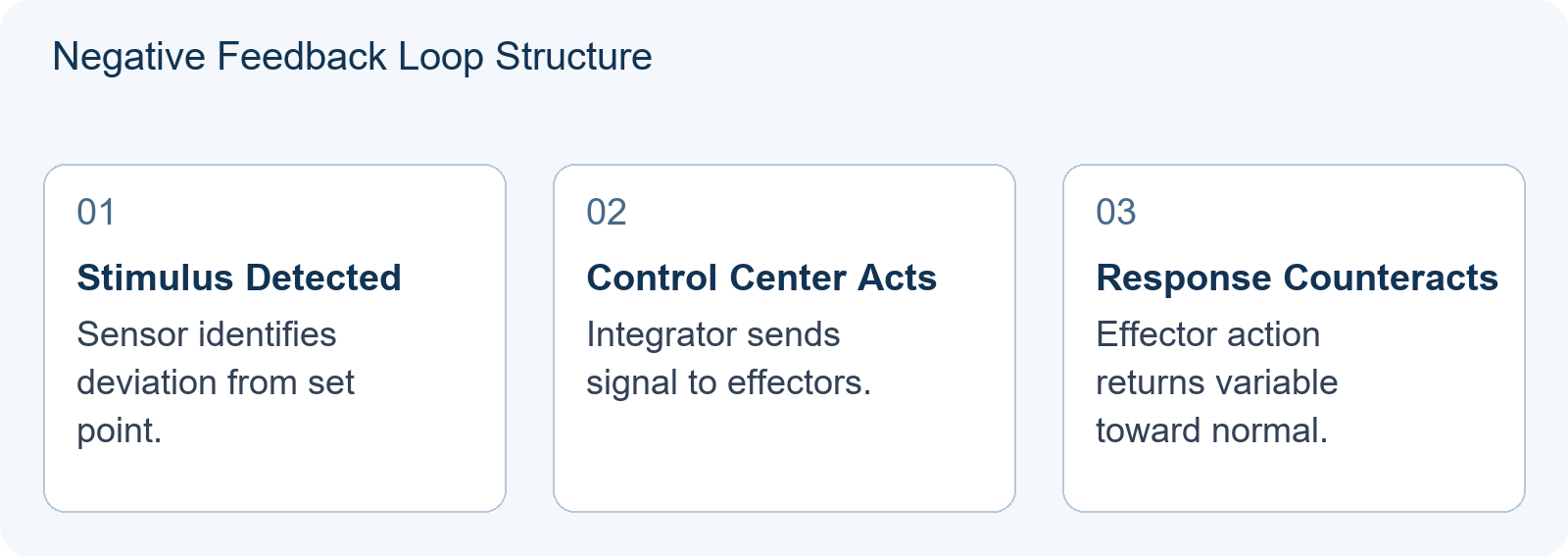
Negative feedback is the primary mechanism for maintaining homeostasis. It works by counteracting the direction of the initial change. If a variable goes too high, the system brings it down; if it goes too low, the system brings it up. This is the most common type of question in iHOSA objective tests because it applies to nearly all physiological systems, including thermoregulation, osmoregulation, and blood pH balance.
A robust explanation of negative feedback must explicitly state the set point and the deviation. For example, consider blood calcium levels. If calcium drops below the set point, parathyroid glands detect this change. They release parathyroid hormone (PTH), which acts on bones, kidneys, and intestines to increase calcium absorption and release. As calcium levels rise back toward normal, the stimulus for PTH release decreases, shutting off the loop. This self-limiting nature is what defines it as negative feedback. Students often fail to mention the cessation of the signal, leading to incomplete answers. Recognizing that the response counteracts the deviation—not that all responses are inversely proportional in some mathematical sense—is critical for accurate multiple-choice answers.
Positive Feedback: Amplifying Change
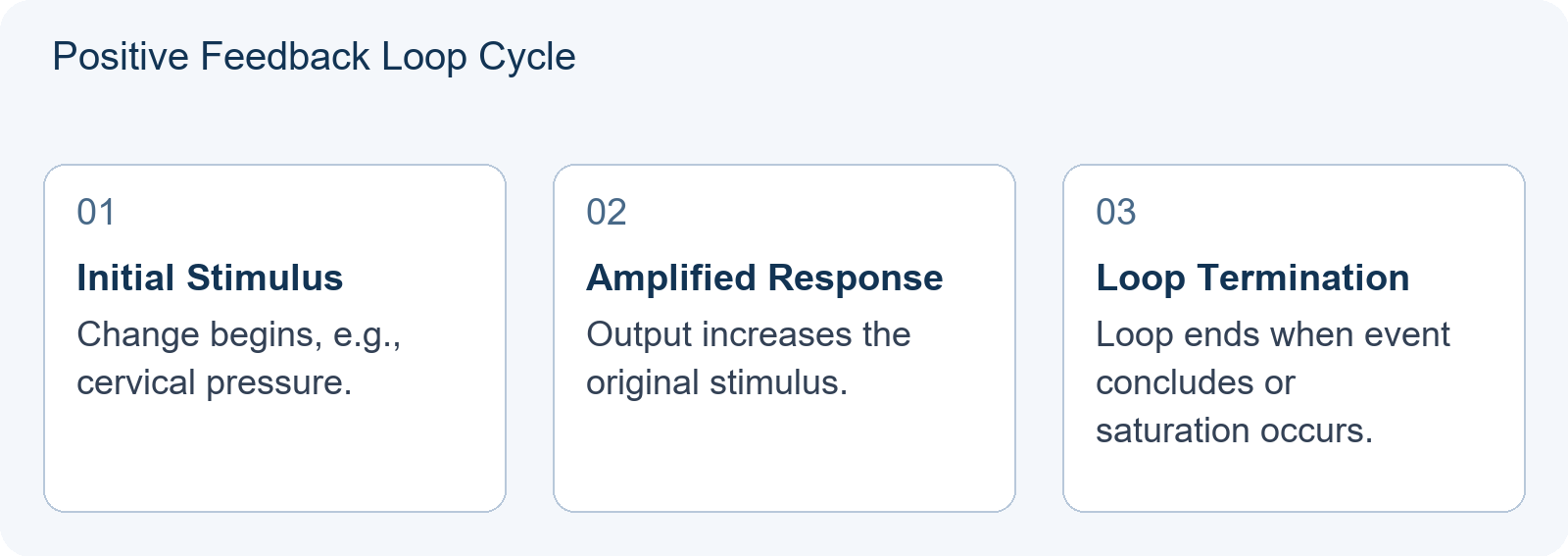
Unlike negative feedback, positive feedback amplifies the initial change, driving the system away from equilibrium until a specific endpoint is reached. These loops are less common in steady-state physiology but vital in processes like childbirth (oxytocin release during labor) and blood clotting. In iHOSA projects or advanced test questions, confusing positive with negative feedback is a frequent error.
To correctly identify positive feedback, look for a cycle where the response increases the intensity of the stimulus. For instance, during uterine contractions, the pressure on the cervix stimulates nerve impulses to the brain, which signals the pituitary gland to release oxytocin. Oxytocin causes stronger contractions, which increases cervical pressure further, leading to more oxytocin release. This continues until the baby is born, at which point the stimulus (cervical pressure) ceases, breaking the loop. When explaining this, emphasize that positive feedback is inherently unstable and requires termination—whether by an external event or by finite availability/saturation of some component. This distinction demonstrates a deeper understanding of physiological dynamics than simply labeling it as “a loop.”
Worked Teaching Illustration: Thermoregulation in Cool Conditions
Note: This is a hypothetical teaching illustration designed to demonstrate logical structure, not an official contest problem.
Let us apply the framework to a concrete scenario: A student steps from a warm classroom into a cool autumn evening at 10°C. How do we connect the feedback loop to the change in the body?
- Stimulus: Ambient temperature falls below skin temperature, causing heat loss through radiation and convection; core body temperature begins decreasing.
- Sensor: Peripheral thermoreceptors in the skin and central thermoreceptors in the hypothalamus detect the drop in temperature.
- Control Center: The hypothalamus integrates this information and compares it to the set point (approximately 37°C, though not fixed at exactly this value for all circumstances). It activates warming pathways.
- Effector: Skeletal muscles are stimulated to shiver; cutaneous blood vessels constrict (vasoconstriction).
- Response: Shivering generates metabolic heat; reduced blood flow to the skin surface minimizes heat loss. Core temperature increases toward the set point.
- Loop Closure: As temperature normalizes, the hypothalamus reduces the drive to shiver and constrict vessels.
This structured approach ensures no steps are missing. In an iHOSA context, if asked to “explain the change,” you would narrate this sequence, highlighting the role of the hypothalamus as the comparator. This level of detail satisfies requirements for scientific rigor and clarity.


Contrasting Case: Where Superficial Explanations Fail
A common failure mode in student responses is attributing a change solely to voluntary behavior or ignoring the physiological mechanism. Consider a contrasting case: A student claims, “I felt cold, so I put on a jacket, and now I am warm.” While behavioral adaptations like jacket removal or addition can be components of thermoregulation, if the question asks for the biological feedback loop mechanism, this answer is incomplete. The physiological loop involves sensors, control centers, and effectors as described above.
Another failure is misidentifying the effector. For example, stating that “the brain shivers” is incorrect; the brain controls the skeletal muscles that shiver. Precision in terminology matters. In the context of iHOSA preparation, the emphasis on connecting molecular/cellular events to macroscopic bodily changes parallels the need in other science subjects to connect particle models to observable properties. A superficial explanation might say “the body gets cold and warms up,” but a rigorous one explains the specific sensors, the hypothalamic integration, and the effector responses. Without this detail, the causal link is weak. This depth is expected in higher-level competition responses.
Diagnostic Application: Identifying the Break
To prepare for objective testing, practice diagnosing where a feedback loop fails. Here is a short diagnostic exercise based on standard pathophysiology concepts relevant to the curriculum.
Scenario: A patient has a condition where their body temperature drops dangerously low despite being in a moderate environment.
Task: Identify potential broken components in the negative feedback loop.
Analysis:
- Stimulus: Low body temperature (present).
- Sensor: Hypothalamic thermoreceptors (may be present but dysfunctional, or peripheral sensors may fail).
- Control Center/Effector Link: The hypothalamus may fail to activate warming pathways, or the signal may not reach effectors.
- Effector Action: Skeletal muscles may not shiver; blood vessels may fail to constrict properly.
- Result: Body temperature remains low; the loop never closes.
Understanding these distinctions allows you to answer multiple-choice questions about etiology and mechanism accurately. This diagnostic skill is directly transferable to the iHOSA online objective assessment, which tests theoretical foundations. For more on experimental design and control groups, see iHOSA Biology Data: Separating a Control Result From an Experimental Effect.
Implications for BCE Project Design
While the ATC track focuses on individual knowledge, the BCE track requires applying this science to public health. If your team chooses a Health Education deliverable, such as a class on heat-related illness prevention, your ability to explain feedback loops clearly is paramount. You must translate the complex mechanism described above into accessible language for a general audience without losing scientific accuracy.
For example, instead of discussing hypothalamic integration, you might use an analogy: “Your body has a thermostat in your brain. When it senses you are getting too hot or too cold, it sends signals to your skin, muscles, and glands to cool you down or warm you up.” This simplification retains the causal logic of the feedback loop while making it understandable. The 2027 iHOSA guidelines emphasize that BCE projects should demonstrate social impact and clear communication. Thus, mastering the underlying biology enables better public outreach. Ensure your project materials cite reliable sources, as academic integrity is a core value of HOSA-Future Health Professionals. For deliverable format decisions, refer to iHOSA BCE Deliverable Formats: Choosing Between a PSA and a Health Education Class.
Preparation Strategy for the Online Round
The iHOSA preliminary round includes a 45-minute online objective assessment with 45 single-choice questions plus tie-breakers. Based on the 2027 syllabus information, Biology content covers Cell Life Principles, Genetics, Evolution, and Zoology. To excel in questions requiring feedback loop analysis:
- Review Set Points: Know the normal ranges for key variables (temperature around 37°C though not fixed at exactly this, pH around 7.4, glucose fasting levels, water potential).
- Map Effectors: Create a table linking hormones/neural signals to their specific target organs and actions.
- Practice Causal Chains: Write out full sentences describing the sequence from stimulus to response for various scenarios.
- Differentiate Loops: Drill examples of positive vs. negative feedback to avoid classification errors, paying attention to how each loop terminates.
Focus on understanding mechanisms rather than rote memorization of facts. This approach builds the analytical skills needed for both the test and future research projects.
Frequently Asked Questions
Is feedback loop analysis tested in the iHOSA Biology exam?
Yes, understanding homeostasis and physiological regulation is a core component of the Biology syllabus, particularly within Cell Life Principles and Animal Physiology topics covered in Division I and II.
How does this relate to the BCE public-welfare track?
Clear explanation of biological mechanisms is essential for designing effective health education classes or PSAs, ensuring that public-facing messages are scientifically accurate and understandable.
What is the difference between Division I and II expectations?
Division I and II both cover cell life principles, genetics, and animal physiology, with Division II adding evolution and adjusting topic weightings; refer to the official 2027 syllabus for exact percentages.

Oct 20, 2026
iHOSA ATC Division I vs II: Allocating Study Time by Weighting Differences
Students in grades 9-10 and 11-12 face different topic weightings in the iHOSA ATC Biology and Chemistry exams. This guide breaks down…
Oct 15, 2026
iHOSA Health Education: Test Whether an Audience Understood Your Message
In iHOSA Health Education, testing whether your audience understood your message is not an afterthought—it is the core deliverable. Learn how to…
Oct 13, 2026
iHOSA Psychology Revision: Distinguish a Concept Definition From Its Application
Many students lose marks in the iHOSA Behavioral Health exam by reciting textbook definitions instead of applying concepts to scenarios. This guide…