
Almost every HOSA health-science test event rests on the same foundation: how the human body is built, what each system does, how it is regulated and what happens when regulation fails. Most students revise only the first two layers, which is why they recognise every term on the paper and still lose marks. This is a system-by-system map, a four-layer depth model and a retrieval schedule that survives a school term.
What a short multiple-choice paper actually rewards
For the iHOSA 2027 season, online round one is a 45-minute paper of 45 multiple-choice questions plus five tiebreaker questions, with the ATC track offered in biology, chemistry and psychology. That arithmetic sets the constraint: roughly a minute per question, with no time to reconstruct anything from first principles.
A format like that rewards a particular kind of knowledge. Not the ability to recite a definition when prompted, but the ability to recognise which system a scenario belongs to and then retrieve the relevant relationship instantly. The examinable topic list for any given event is set by the organiser and published in the event guidelines, so confirm the current scope on hosa.org rather than assuming last season's coverage. What does not change is the underlying structure of human biology, and that is what you can safely build now, before the new guidelines appear.
One diagnostic before you plan anything. Take any body system and, without notes, write for three minutes: what it is made of, what it does, how it is controlled, and one way it fails. If you produce four solid paragraphs, your problem is speed. If paragraphs three and four are thin, your problem is depth — and no amount of extra flashcards on paragraph one will fix it.
Eleven systems, three functional families
Learning eleven systems as eleven separate units is slow and fragile. Grouping them by what they are for makes the relationships between them obvious, and relationships are where the harder questions live.
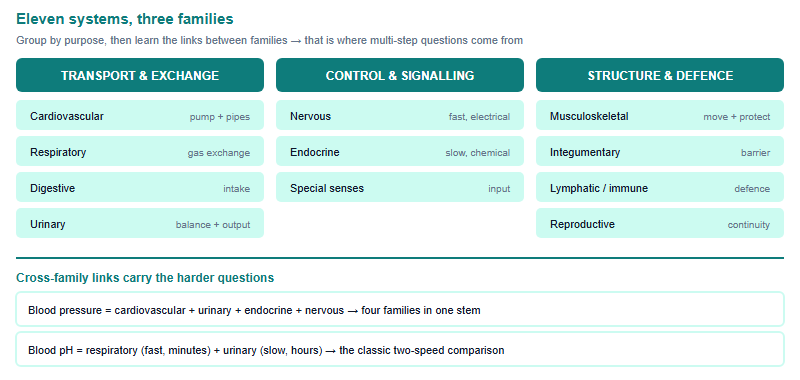
Neither the families nor this exact set of eleven rows is an official taxonomy: standard anatomy references list skeletal and muscular as separate systems and treat the special senses as part of the nervous system, so use this as a memory scaffold and follow the split used in your own textbook and event guideline. Their value is that they make an obvious prediction: any question that feels hard is probably asking you to cross a family boundary. Once you expect that, you stop hunting for an obscure fact and start asking which two systems are being connected.


Four layers per system, and where students stop too early
For each system, hold four layers. Almost everyone builds layers one and two from school. Layers three and four are where marks are won, because they are the layers that generate scenarios rather than definitions.
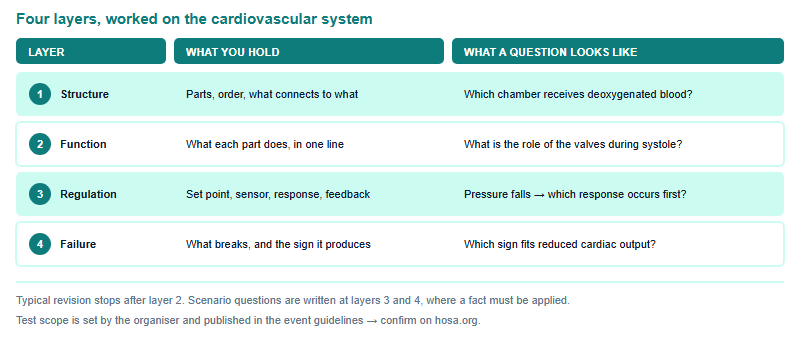
A practical way to force layer three is to write every regulatory story as a four-part chain: disturbance → sensor → response → effect on the disturbance. If you cannot name the sensor, you do not yet understand the loop, and a question that changes the disturbance will catch you. Layer four then follows almost for free: most classic signs are simply what happens when one link in that chain is broken.
The eleven-row worksheet below is how you apply that model at scale. Build the table yourself rather than copying one. The act of filling the middle column from memory is the study; the finished table is only the receipt. Below is the skeleton with one anchor idea and one common confusion per system, so you can check whether your version is missing a row.
| System | Anchor concept to hold | Where students commonly slip | Cross-link worth knowing |
|---|---|---|---|
| Cardiovascular | Pressure, flow and resistance in one circuit | Confusing oxygenation with side of the heart | Kidney control of blood volume |
| Respiratory | Gas exchange depends on surface area and gradient | Treating breathing rate as the only variable | Fast correction of blood pH |
| Digestive | Mechanical then chemical breakdown, then absorption | Mixing up where each enzyme acts | Liver, metabolism and nutrient supply |
| Urinary | Filter, reabsorb, secrete, concentrate | Forgetting that most filtrate is reclaimed | Long-term blood pressure and pH |
| Nervous | Signals are fast, targeted and electrical | Blurring central and peripheral divisions | Drives endocrine release |
| Endocrine | Signals are slow, broadcast and chemical | Naming hormones without naming targets | Glucose, growth, stress responses |
| Special senses | Stimulus converted into a nerve signal | Learning anatomy without the transduction step | Reflex arcs |
| Musculoskeletal | Levers, contraction and load | Skipping how contraction is triggered | Calcium balance and blood cell formation |
| Integumentary | Barrier plus temperature regulation | Ignoring its role in homeostasis | First line of immune defence |
| Lymphatic / immune | Non-specific defence, then specific memory | Merging innate and adaptive responses | Fluid return to the circulation |
| Reproductive | Hormonal cycles controlling gamete production | Memorising stages without the feedback loops | Endocrine control, development |
A six-week schedule that fits around school
The failure mode of body-system revision is that it feels productive: you read, you highlight, you recognise everything. Recognition is not retrieval. The schedule below is built so that most of your contact time is spent producing answers rather than reading them, and so that systems are revisited after you have started to forget them.
- Weeks 1–2 — build. Four systems per week, layers one and two only, one A4 sheet per system, written from memory then corrected against a textbook. Cap at 40 minutes per system. If it takes longer, your sheet is too detailed.
- Week 3 — regulate. Return to all systems built so far and add layer three as feedback chains. This is the week that changes scores; do not compress it.
- Week 4 — break things. Add layer four. For each loop, ask what happens if the sensor fails, if the response is blocked, or if the effect is exaggerated. Write the resulting sign next to it.
- Week 5 — interleave. Mixed sets that deliberately jump between families. Shuffling is the point: a set of twenty questions all on the heart trains a pattern you will not have on test day.
- Week 6 — time. Full-length timed sets under the real constraint. Mark them the same day, and sort every error into one of three bins: never knew it, knew it but too slow, knew it but misread the stem. Each bin has a different fix, and only the first one is solved by more content.
The error triage in week six matters more than the score. Students who read a percentage and revise everything again are the ones who plateau. If two-thirds of your errors are in the third bin, your remaining problem is reading precision, not biology, and another fortnight of anatomy will not move it.
How this fits the wider season
Content depth built this way is portable. It supports test-based events in the ATC track, gives you the vocabulary to describe a clinical procedure accurately in CCE work, and stops a BCE public-health project from making physiological claims it cannot defend. If you have not yet settled which track you are entering, read the ATC, CCE and BCE comparison before you finalise a revision plan, because the three tracks reward different proportions of recall and application. If HOSA's structure is new to you, start with the HOSA overview.
Two final cautions. Do not build your plan around a topic list you found in a forum or an old file; scope is set annually by the organiser and published in the event guidelines, so confirm on hosa.org. And do not treat any study map, including this one, as a predictor of what will appear on a paper. It is a way of holding human biology so that whatever appears can be retrieved in about sixty seconds.
Frequently asked questions
How many questions are on the iHOSA 2027 online round one?
Forty-five multiple-choice questions in 45 minutes, plus five tiebreaker questions, with ATC offered in biology, chemistry and psychology. Confirm details on the official channels.
Should I memorise every structure name?
No. Hold structure names only where they carry a function or a clinical sign. Regulation and failure layers earn more marks per hour of study.
Is my IB or AP biology course enough preparation?
School courses cover much of the content but rarely drill retrieval at speed. Keep the course as your source and add timed, interleaved practice.
Where do I find the examinable topics for my event?
In that event's current guideline, published by HOSA and updated each season. Check hosa.org rather than relying on previous years' lists.
Published by the HOSA (SKT-iHOSA) editorial desk, operated by Hanlin Education for China-based international-school students. Official rules are set by the competition and change yearly — confirm current details on hosa.org. Errors are corrected within 7 working days.

Oct 20, 2026
iHOSA ATC Division I vs II: Allocating Study Time by Weighting Differences
Students in grades 9-10 and 11-12 face different topic weightings in the iHOSA ATC Biology and Chemistry exams. This guide breaks down…
Oct 17, 2026
iHOSA Biology Explanations: Connect a Feedback Loop to a Change in the Body
Mastering negative and positive feedback loops is essential for iHOSA Biology. Learn how to connect physiological mechanisms to observable changes with worked…
Oct 15, 2026
iHOSA Health Education: Test Whether an Audience Understood Your Message
In iHOSA Health Education, testing whether your audience understood your message is not an afterthought—it is the core deliverable. Learn how to…