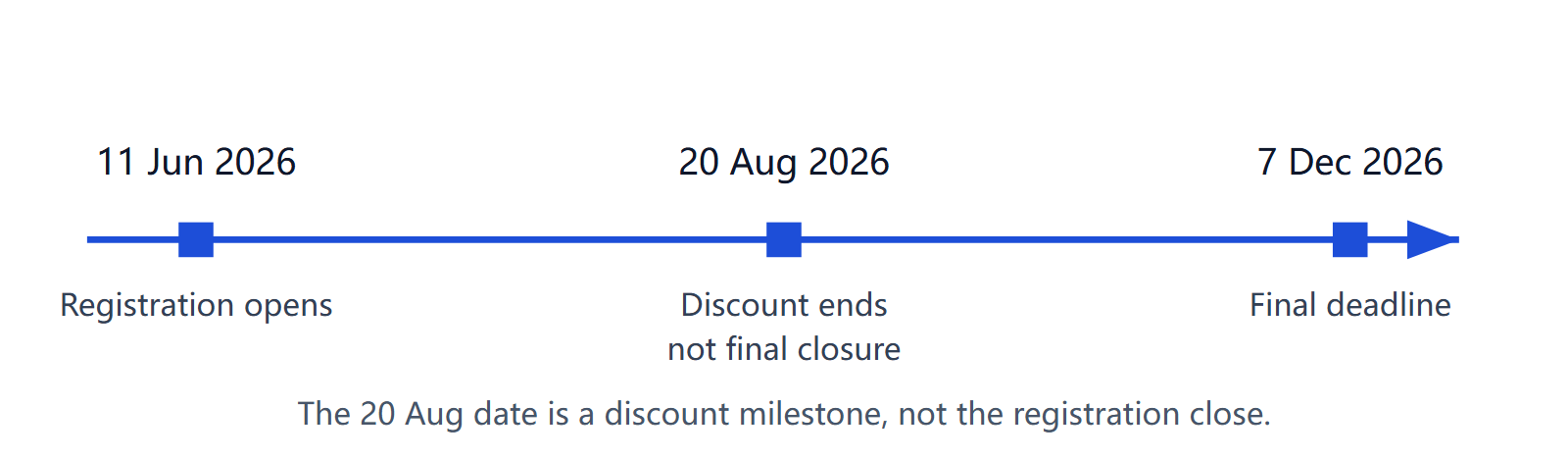
Yes. You can still register for the 2027 iHOSA season. The official China apply page shows registration opened on 11 June 2026 and lists 7 December 2026 as the final registration deadline. The 20 August date was the pre-registration discount deadline, not the final registration deadline. If you are in Grade 9, 10, 11, or 12 and are deciding now, the practical question is not whether the door is closed; it is whether you should choose ATC or BCE and begin preparing before the final deadline.
The three dates that matter now
Use the table below as the working date set. The key correction is simple: 20 August 2026 was the end of the pre-registration discount, not the end of registration.
| Milestone | Date | What it means |
|---|---|---|
| Registration opens | 11 June 2026 | New and returning students could begin official registration. |
| Pre-registration discount ended | 20 August 2026 | Early-bird reduction ended; registration did not close. |
| Final registration deadline | 7 December 2026 | Last day to register for the 2027 iHOSA season, based on the current apply page. |
These dates are drawn from the official iHOSA China apply page (hosa.org.cn/apply), as read on 23 September 2026. Because registration details can change, check the same page before payment.
What the current apply page actually lists
The current apply page states that registration for the 2027 iHOSA season opened on 11 June 2026 and closes on 7 December 2026. It is intended for students currently enrolled in Grades 9–12. New students register and complete personal information; returning students use an existing account and then proceed to payment.
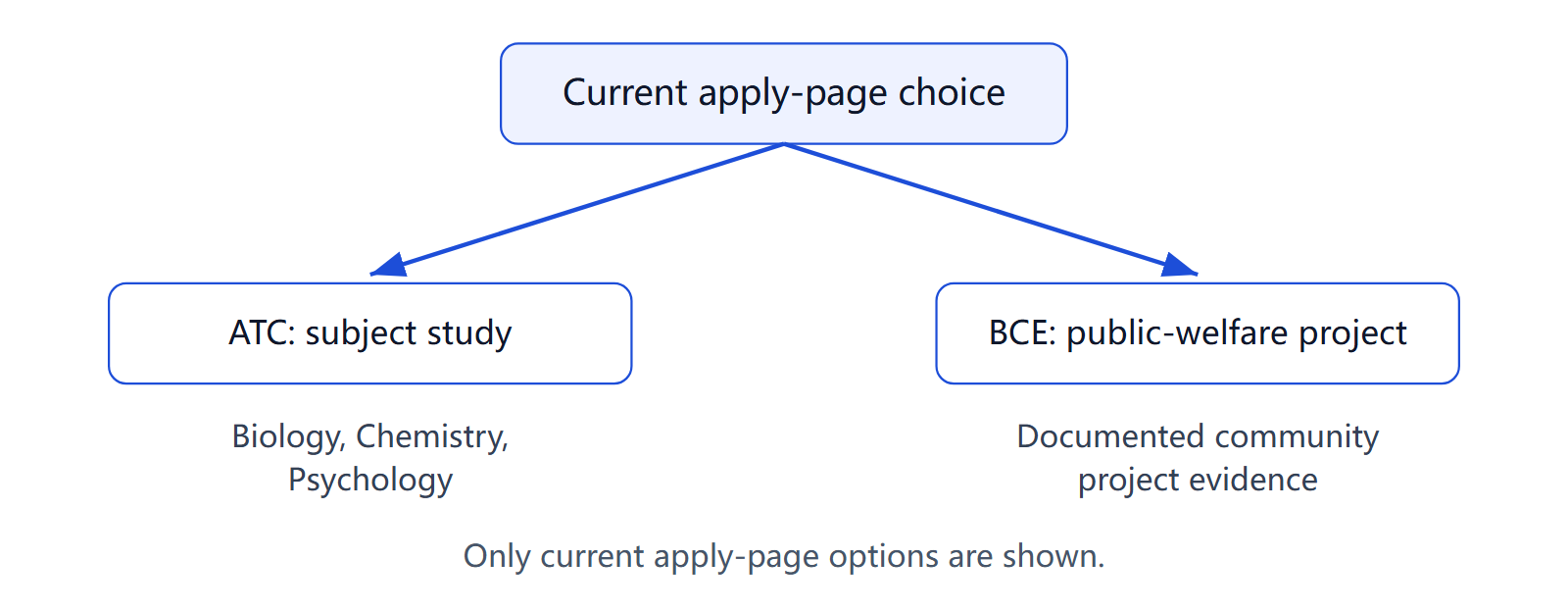
The same page currently lists two category families: ATC study options in biology, chemistry, and psychology, and BCE public-welfare project options. It does not list every possible HOSA activity worldwide. It lists the China-region registration choices that are open now. If a category is not listed, do not assume that it can be selected during the current checkout process.
This is why the old premise—“registration closed on 20 August”—is false. That date ended a discount window. It did not remove the ability to register before 7 December.
Do not confuse the China iHOSA route with U.S. HOSA membership
Another common mistake is applying the U.S. membership model to China. The official HOSA membership page (hosa.org/membership) says individual memberships are not available and students join through a chapter. That is a separate route.
The China iHOSA route is handled through the China apply page and has its own registration window, account steps, and category listing. A student in China should not conclude that registration is impossible because the U.S. membership page says individual membership is unavailable. Likewise, a student should not assume U.S. chapter rules, fees, or deadlines apply to the China route. Use the China apply page for China registration decisions.
Decision path: choose ATC or BCE before you register
Because the current apply page lists ATC and BCE, the main decision for most families is which of those two fits the student’s strengths and available time. Do not leave this choice until the last day. The better path depends on whether the student wants subject-based study or a public-welfare project.
- Choose ATC if the student wants a subject-study path. ATC is suitable when the student already has coursework or strong interest in biology, chemistry, or psychology. The preparation emphasis is understanding scientific vocabulary in English, making fast decisions, and reviewing errors systematically. If the student’s school timetable already supports one of the subjects, that subject is usually the most efficient choice.
- Choose BCE if the student wants a public-welfare project path. BCE is suitable when the student can access a real community, school, or family-health setting and can document a project over time. The preparation emphasis is defining a reachable problem, securing permission, collecting baseline evidence, taking action, and recording what changed.
- If the choice is unclear, compare by evidence. For ATC, ask whether the student can sustain timed study. For BCE, ask whether the student can complete a real project without compressing every step into the final weeks. The event-choice guide by grade and subject can help families compare fit: choose an event by grade and subject.

ATC preparation: what to do between now and December
ATC preparation should not be treated as memorizing a secret syllabus. The visible subjects—biology, chemistry, and psychology—overlap with school science, so the highest-value work is usually speed, terminology, and accuracy under pressure.
- Pick the subject with the strongest school support. If the student is already studying biology, chemistry, or psychology in a strong academic program, that subject will need less new content and more exam-language practice.
- Build an English terminology log. Many students know a concept in Chinese but hesitate when the English stem uses a different phrasing. Record terms that cause delay, then review them in short daily sets.
- Practice timed decisions. The goal is not endless reading. It is learning to choose, eliminate, and verify quickly. A short timed block followed by error analysis is more useful than a long passive study session.
- Use structured study maps where relevant. For students interested in health-science depth, the anatomy and physiology study map can support related scientific vocabulary: anatomy and physiology study map.
The point is simple: ATC rewards a student who can turn knowledge into a fast, reliable English decision.
BCE preparation: start the project before registration pressure builds
BCE is different because a strong public-welfare project cannot be compressed into a few weekends. The current apply page describes BCE as a public-welfare project category, so the preparation question is operational: can the student carry out a real, documented health-related project before the registration window closes and project time becomes compressed?
- Choose a reachable problem. A project in a school club, community center, family health setting, or local public-health topic is more credible than an ambitious idea with no access.
- Secure permission early. If the project involves minors, patients, school spaces, or community organizations, the student needs clear approval from the responsible adults or institutions.
- Collect baseline evidence. Before doing the intervention, record what is currently true: survey results, observation notes, knowledge gaps, or existing behavior patterns.
- Design a measurable action. The project should have a clear output, such as a workshop, campaign, resource, or behavior-support activity, and a way to judge whether it helped.
- Document the process. Keep dated notes, photos where appropriate, and evidence of planning. This matters more than a polished poster created at the end.
For examples of project evidence and data thinking, see BCE project data.
What about CCE?
Some earlier planning materials discuss CCE alongside ATC and BCE. For the current decision, however, the apply page lists only ATC and BCE. Therefore, do not assume CCE is currently selectable. If a student is interested in CCE-style preparation, confirm current registration options through official channels before building a plan around it.
That does not make CCE-related skills useless. The durable skill is calm, clear communication in English while being observed. Students can practice explaining a health-science idea, a reasoning step, or a project decision to a teacher, parent, or younger student. But this preparation should be treated as general skill-building until an official registration option is confirmed.
A practical checklist before 7 December 2026
For a Grade 9–12 family deciding now, the next steps should be concrete:
- Confirm eligibility. The current page specifies students currently enrolled in Grades 9–12.
- Decide between ATC and BCE. Use the student’s subject strength, available time, and access to a project setting.
- Create or log into the correct account. New students register and complete personal information; returning students use the existing account.
- Complete the payment step before the final deadline. Do not wait until the evening of 7 December, because account or payment issues can take time to resolve.
- Start preparation immediately. Registration secures the administrative step; preparation determines what the student can demonstrate later.
For the broader China route, the China SKT-iHOSA pathway overview is a useful starting point: China SKT-iHOSA pathway.
Three mistakes to avoid before 7 December
- Treating 20 August as closure. The date ended the discount. It did not end registration. A family that stops checking after that date may miss the remaining window.
- Using the wrong route. The U.S. chapter membership model is not the China registration route. China applicants should use the China apply page and its account/payment steps.
- Registering without a preparation plan. Completing the application is only the administrative step. ATC needs timed subject practice; BCE needs project access and documentation. Decide which path you can actually sustain before payment.
Common questions
Can I still register for iHOSA after the early-bird deadline?
Yes. The early-bird pre-registration discount ended on 20 August 2026, but the current apply page lists 7 December 2026 as the final registration deadline for the 2027 iHOSA season.
What is the iHOSA 2027 registration deadline?
The final registration deadline is 7 December 2026. Registration opened on 11 June 2026, and the pre-registration discount ended on 20 August 2026.
Are CCE, ATC, and BCE all available on the current China apply page?
The current apply page lists ATC and BCE. It does not list CCE as a current registration option, so confirm current registration options on official channels before planning around CCE.

Oct 20, 2026
iHOSA ATC Division I vs II: Allocating Study Time by Weighting Differences
Students in grades 9-10 and 11-12 face different topic weightings in the iHOSA ATC Biology and Chemistry exams. This guide breaks down…
Oct 17, 2026
iHOSA Biology Explanations: Connect a Feedback Loop to a Change in the Body
Mastering negative and positive feedback loops is essential for iHOSA Biology. Learn how to connect physiological mechanisms to observable changes with worked…
Oct 15, 2026
iHOSA Health Education: Test Whether an Audience Understood Your Message
In iHOSA Health Education, testing whether your audience understood your message is not an afterthought—it is the core deliverable. Learn how to…