
Registration ran to 20 August and has closed, so the season is now a scheduling problem rather than a decision. The preliminary round falls in mid-to-late December 2026 (per Hanlin's SKT-iHOSA briefing; confirm officially), which gives roughly fifteen to seventeen weeks of term time — the same weeks that hold university application deadlines and end-of-term assessment. This is how to run both.
What the autumn actually contains
The runway is not empty time you get to allocate freely. It is already occupied, and the two heaviest occupants land at exactly the wrong moments: application deadlines cluster early in the term, and school assessment clusters at the end — right where the preliminary sits.
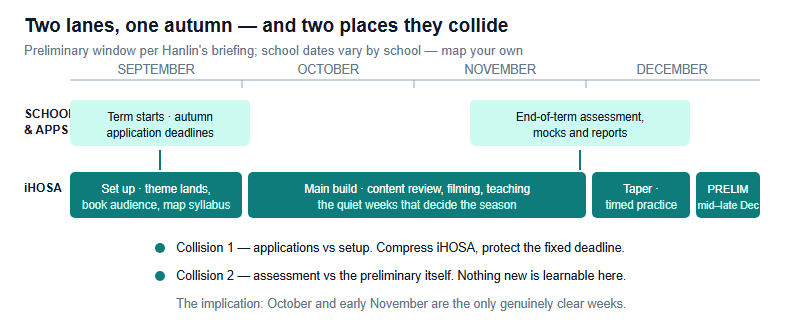
Read the diagram for its uncomfortable conclusion. Once you subtract the application weeks at the front and the assessment weeks at the back, the genuinely clear working time is roughly October to early November. Students who treat that stretch as "still early" discover in December that it was the whole season.
That makes the first fortnight of September disproportionately valuable — not for doing the work, but for fixing the frame the work will hang on. Five things are worth locking before the term develops its own momentum:
- The preliminary date, confirmed officially. Everything else is measured backwards from it, so a guessed date quietly corrupts the entire plan.
- Your school's assessment calendar. Get the actual dates rather than assuming them; the December collision is only manageable if you can see it coming in September.
- Anything that depends on another person. A room, an audience, a staff sponsor's signature. These carry the longest lead times and the least flexibility, and they do not care that you are busy.
- Your weekly floor. The minimum session you will keep even in your worst week. Set it low enough that you will genuinely keep it — an ambitious floor is not a floor.
- One named review date in late October. A fixed point at which you check whether the plan survived contact with the term, and adjust before December rather than during it.
The collision map by year group
The autumn does not land the same way on every student. Your year group determines which collision is the dangerous one, and therefore what you should be willing to sacrifice.
| Year group | The dangerous collision | What to protect absolutely | Realistic iHOSA shape |
|---|---|---|---|
| Year 13 / Grade 12 | Autumn application deadlines land straight on top of the setup weeks | Application deadlines — they are externally fixed and cannot be renegotiated | Near-zero in the deadline weeks; rebuild from late October; taper into December |
| Year 12 / Grade 11 | End-of-term assessment, which often carries predicted-grade weight | The assessment series and your grade trajectory | Steadiest of any group — front-load October, protect the last three weeks |
| Year 11 / Grade 10 | Public-exam coursework and first serious mock season | Coursework deadlines, which are hard-dated | Modest and consistent; treat this season as a rehearsal year |
| Year 9–10 / Grade 8–9, where the division is open to them | Rarely a real collision — the risk is over-committing on enthusiasm | Sleep and one other commitment you already made | The most room to work; use it, but do not fill every evening |
One caution that applies to every row: this is a season you have already paid for and entered, which activates a familiar bias. Sunk cost makes students over-invest in December precisely when December has the least room, and under-invest in October when the time was free. If you catch yourself thinking "I have to make this worth it" in week fourteen, that is the bias talking, not a plan.


Triage: protect, compress, defer
When two commitments peak together, the instinct is to do both at reduced quality. That is the worst available option, because it damages the fixed-deadline item without meaningfully helping the other. Sort every task into one of three buckets instead, and re-sort weekly.
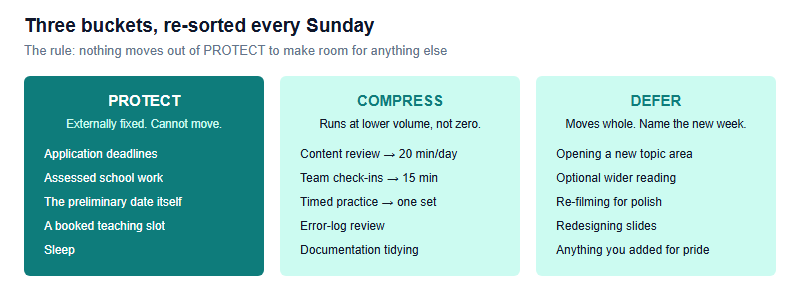
Two rules make the buckets work. Deferred items must be given a named week, not moved to "later" — an undated deferral is a quiet cancellation. And compressed items must keep running at some non-zero level, because restarting a stalled habit costs more than maintaining a small one. Twenty minutes daily through a deadline week beats a fortnight of nothing followed by a panicked weekend.
In practice, the difference between a clear week and a compressed week should be volume, not variety. A clear October week might hold three content sessions of forty minutes, one timed set under exam conditions, and a team meeting. The compressed version of that same week keeps all four activities and shrinks each one: twenty minutes of content on three days, a half-length timed set, and a fifteen-minute team check-in by message instead of in person. The structure survives untouched; only the hours move. That is precisely what makes restarting cheap in November — there is nothing to restart, only something to expand.
Your track decides the shape of the load
The three tracks collide with the school year very differently, which our track comparison covers in more depth. For autumn planning specifically, the distinction that matters is whether your work is divisible.
- ATC (foundational tests) — highly divisible. Content review breaks into twenty-minute units that survive a busy week intact. Crucially, the organiser's own published syllabus mapping puts biology at 82% against AP, 95% against IB and 83% against A-Level, and chemistry at 80%, 65% and 79% respectively (per the organiser's mapping; confirm officially). Read those as workload figures, not just subject-choice figures: where overlap is high, your school course is most of your preparation, and the collision is mild. Where it is lower — chemistry against IB is the standout — more of the work is genuinely additional hours that must be found somewhere.
- CCE (professional and clinical) — partly divisible. Knowledge components behave like ATC; skills and case components need continuous blocks and, often, a partner. Book those blocks into October before the calendar fills.
- BCE (public welfare, team project) — barely divisible, and dependent on other people. A teaching slot lives in someone else's calendar. The annual theme is published in early September, and both the set-theme and self-proposed lanes end in the same deliverables, so the autumn cannot be spent deciding. Fix your dates first; the rest bends around them.
For BCE teams there is a scheduling asymmetry worth exploiting: the parts that depend on other people (a room, an audience, a staff sponsor's signature) should be booked in September even though the work happens later, while the parts that depend only on you can be pushed into whatever gaps remain. Teams that invert this — perfecting a script in September, chasing a room in November — are the ones that arrive without a delivered class.
Three autumn failure patterns
These are the recurring ways a capable student loses an autumn. None of them are about ability.
- The deferred start. "I will begin properly after the October break." This deletes the only clear stretch in the term and pushes everything into the assessment weeks, where it competes with grades that matter more.
- The all-or-nothing week. A student drops iHOSA entirely for an application deadline, then cannot restart. Compression exists precisely to prevent this; a fifteen-minute maintenance session is not tokenism, it is what keeps the thread live.
- Cramming into the collision. Attempting new material in the fortnight before a December preliminary that sits inside assessment season. At that point the paper rewards recall speed and composure, not freshly-met content — the taper should be timed practice and error review, nothing new.
The third pattern deserves a specific remedy, because "revise harder" is not one. On a paper of 45 scored questions in 45 minutes plus five tie-break items (per Hanlin; confirm officially), December practice should be about tempo and recovery rather than coverage. Complete sets at the real per-question pace, then spend longer reviewing the errors than you spent generating them. An error log that names why each item went wrong — misread stem, unknown term, ran out of clock — is worth more in the final fortnight than any new chapter, because it converts mistakes you have already made into marks that are still available.
Keep the far end of the season in view while you triage. The China round follows in March or April 2027 and the global round on 23–26 June 2027 (per Hanlin; confirm dates officially), so December is a gate rather than a finish line — our conference-round guide shows what the later stages look like. From our own cohort last season, five students advanced to the global round (de-identified, per Hanlin; our own tally, and results vary). If you are new to how the whole structure fits together, the HOSA overview is the place to start.
Frequently asked questions
When is the iHOSA preliminary round?
Mid-to-late December 2026 per Hanlin's season briefing. Confirm the exact date officially before building a revision plan around it.
Can I still register for this season?
No. Registration ran to 20 August 2026 and has closed, so this guide is for students and teams already entered.
How many hours a week should the autumn take?
It depends on track and syllabus overlap — high-overlap subjects fold into school work. Set hours against your own calendar, not a fixed number.
Should I pause iHOSA during application season?
Compress rather than pause. Protect the fixed deadlines, shrink to short maintenance sessions, then rebuild volume from late October.
Published by the HOSA (SKT-iHOSA) editorial desk, operated by Hanlin Education for China-based international-school students. Official rules are set by the competition and change yearly — confirm current details on hosa.org. Errors are corrected within 7 working days.

Oct 20, 2026
iHOSA ATC Division I vs II: Allocating Study Time by Weighting Differences
Students in grades 9-10 and 11-12 face different topic weightings in the iHOSA ATC Biology and Chemistry exams. This guide breaks down…
Oct 17, 2026
iHOSA Biology Explanations: Connect a Feedback Loop to a Change in the Body
Mastering negative and positive feedback loops is essential for iHOSA Biology. Learn how to connect physiological mechanisms to observable changes with worked…
Oct 15, 2026
iHOSA Health Education: Test Whether an Audience Understood Your Message
In iHOSA Health Education, testing whether your audience understood your message is not an afterthought—it is the core deliverable. Learn how to…