
Prospective students often search for iHOSA biology vs nutrition to determine which focus area offers better preparation support or application advantages. However, a critical clarification is needed: Nutrition is not an official iHOSA competition track. The official structure consists of two primary participation lines: ATC (Academic) and BCE (Community/Project). While Hanlin offers a dedicated iHOSA Nutrition Tutoring Course to support students interested in dietary science, this is a preparatory resource, not a standalone contest category.
For students aiming at pre-health majors, understanding how to leverage the official ATC Biology track versus supplementary nutrition knowledge is key. This article resolves common misconceptions and provides actionable preparation strategies based on the 2027 season reforms.
Official Tracks vs. Specialized Prep Topics
The iHOSA framework allows students to select 1–3 activities across the ATC and BCE tracks. Each activity type permits only one project entry per student. There is no “CCE Nutrition” slot in the official registration system. Instead, nutrition concepts may appear within broader health-related BCE projects or be studied independently via tutoring courses to enhance academic depth.
| Component | Official Status | Preparation Role |
|---|---|---|
| ATC Biology | Core Academic Track | Direct exam prep; aligns with AP/IB/A-Level curricula. |
| Nutrition Course | Hanlin Tutoring Service | Supplementary knowledge; supports BCE health projects or personal interest. |
| BCE Health Project | Core Community Track | Team-based; applies biological/nutritional knowledge to real-world issues. |
2027 Syllabus Changes: What to Study
The 2027 ATC Biology syllabus has been optimized to reduce out-of-scope content and increase alignment with international curricula. Key changes include:
- AP Match: Increased from 80% to 82%.
- IB Match: Stable at 95%.
- A-Level Match: Increased from 75% to 83%.
- Content Deletions: Specific minor plant biology topics have been removed to streamline study efforts.
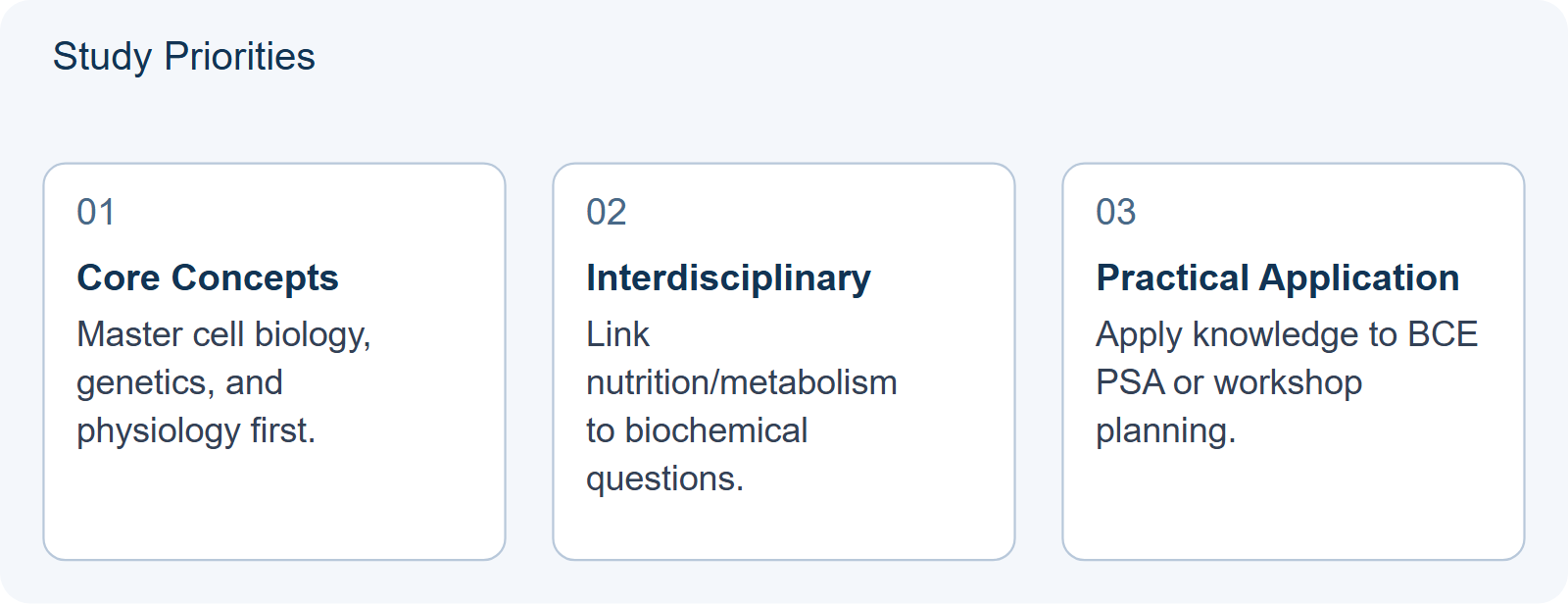
Students should prioritize cell life principles, genetics, evolution, and zoology, as these remain core weighted areas. For Division I (Grades 9–10), cell life principles account for 30%, while Division II (Grades 11–12) shifts weight toward evolution and genetics.
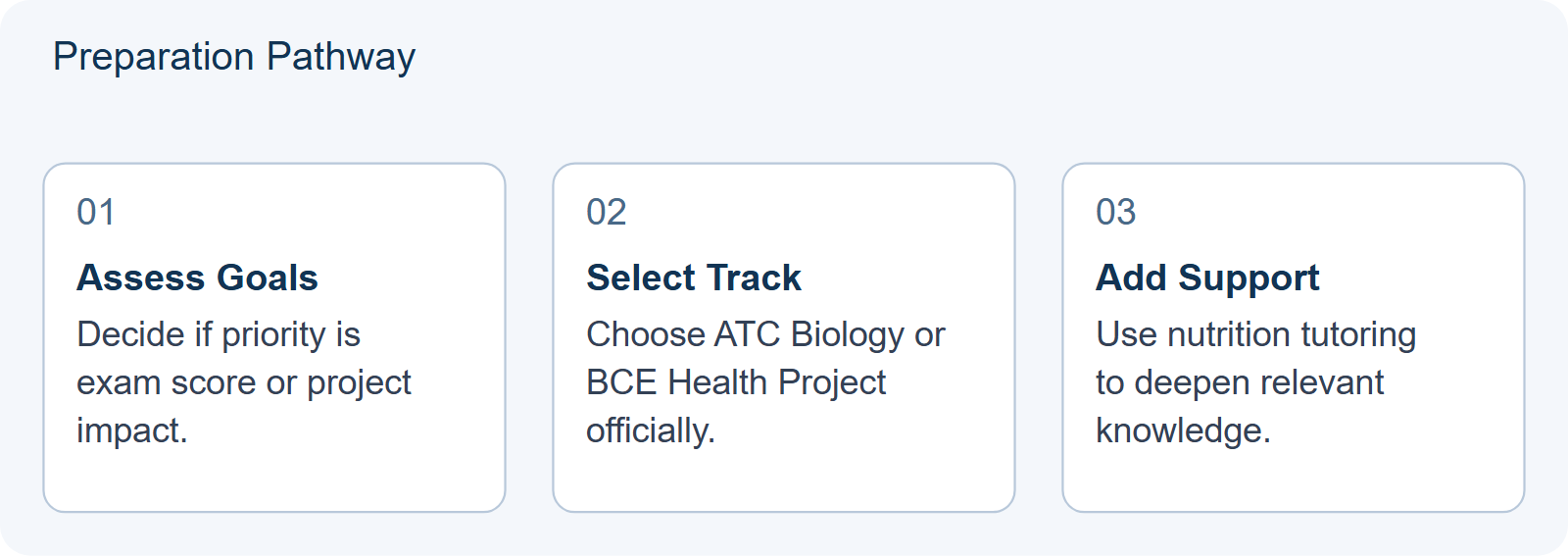
Strategic Preparation: Integrating Nutrition Knowledge
While you cannot register for a “Nutrition” contest, integrating nutritional science into your preparation can strengthen both ATC performance and BCE projects. Here’s how:
1. Enhancing ATC Biology Answers
Nutrition intersects with biochemistry and physiology. Understanding macronutrient metabolism (carbohydrates, lipids, proteins) reinforces molecular biology concepts tested in ATC. Use the Hanlin Nutrition Course to deepen these connections, ensuring you can answer questions on enzyme function and metabolic pathways with greater confidence.
2. Strengthening BCE Projects
BCE projects require identifying community health issues. A strong grasp of nutrition allows teams to design impactful interventions, such as public service announcements on healthy eating or educational workshops on diet-related diseases. This demonstrates applied knowledge, a key differentiator in college applications.

Actionable Study Checklist
To prepare effectively for the December preliminary round, follow this structured approach:
- Review Core ATC Topics: Focus on cell biology, genetics, and animal physiology using updated 2027 syllabus weights.
- Leverage Supplementary Resources: If interested in health sciences, use nutrition tutoring materials to build interdisciplinary expertise.
- Plan BCE Deliverables Early: Decide whether to pursue a 30-second PSA or a health education class. Align your topic with your strengths—biology-heavy for scientific accuracy, nutrition-focused for practical lifestyle advice.
- Practice Past Papers: Utilize Hanlin’s curated resources to simulate the 45-minute online objective test format.
Common Misconceptions Clarified
Misconception: “I can choose Nutrition as my third activity.”
Fact: You must choose from official ATC or BCE activities. Nutrition is a subject area, not a selectable contest slot.
Misconception: “Nutrition knowledge doesn’t help in ATC Biology.”
Fact: Metabolic processes and biochemical foundations are integral to biology exams. Deepening nutrition knowledge indirectly boosts ATC scores.
Conclusion
Choosing between focusing on pure biology or incorporating nutrition depends on your goals. For direct exam success, prioritize ATC Biology syllabus mastery. For holistic pre-health profiles, use nutrition tutoring to enrich BCE projects and demonstrate interdisciplinary competence. Remember, registration closes August 20, 2026. Start preparing now to maximize your impact in the 2027 season.
HYPOTHETICAL/ILLUSTRATIVE: The “Metabolic Pathway” Decision Matrix
To apply the strategic advice regarding integrating nutrition into biology preparation, consider a hypothetical scenario involving two students, Alex and Jamie, who both aim for pre-health majors. They face a critical decision during their third week of preparation: how to allocate limited study hours between deepening ATC Biology exam techniques and exploring supplementary Nutrition concepts. This example illustrates how to weigh these options based on specific learning outcomes rather than general interest.
Alex chooses to focus exclusively on high-yield ATC topics, specifically drilling past paper questions on cell respiration and enzyme kinetics. Alex’s rationale is that since Nutrition is not an official track, time spent on dietary science is inefficient for direct scoring. Consequently, Alex becomes highly proficient in identifying standard exam traps related to ATP production but struggles when a BCE project requires explaining the physiological impact of sugar intake on community health trends. Alex’s preparation remains siloed, maximizing test-taking speed but limiting interdisciplinary application.
In contrast, Jamie adopts an integrated approach. Jamie spends 70% of the time on core ATC syllabus items like genetics and evolution, ensuring alignment with the 2027 weightings. However, Jamie dedicates the remaining 30% to studying macronutrient metabolism through supplementary resources. When reviewing enzyme function for the ATC exam, Jamie actively connects this knowledge to nutritional biochemistry, such as how lactase deficiency affects digestion. This dual-focus allows Jamie to answer complex ATC questions with greater conceptual depth while simultaneously gathering robust scientific evidence for a BCE project on adolescent nutrition awareness.
| Decision Factor | Alex (Pure ATC Focus) | Jamie (Integrated Approach) |
|---|---|---|
| Primary Goal | Maximize objective test score | Balanced academic and applied profile |
| Study Method | Rote memorization of exam patterns | Conceptual linking of biology and diet |
| BCE Project Impact | Limited scientific nuance | Stronger evidence-based interventions |
| Risk | Shallow understanding of physiology | Potential distraction from core syllabus |
The key differentiator in this comparison is not just the amount of time studied, but the type of cognitive processing employed. Alex treats nutrition as irrelevant noise, whereas Jamie treats it as a contextual layer that reinforces biological principles. For students with pre-health interests, the decision changes based on whether they view the competition solely as an exam or as a platform for demonstrating holistic scientific literacy. If your strength lies in abstract theory, sticking to pure ATC may yield higher immediate scores. However, if you struggle to visualize physiological processes, using nutrition examples can make abstract concepts like metabolic pathways more concrete and memorable.
Before finalizing your weekly schedule, use this reusable self-check: Ask yourself, “Does this study session help me solve a multiple-choice question faster, or does it help me explain a biological mechanism more clearly?” If the answer is only the former, you are optimizing for the test format. If it is the latter, you are building the interdisciplinary competence valued in BCE projects and future academic pursuits. A balanced strategy often involves alternating days: one day for rigorous ATC practice under timed conditions, and another for exploring how biological concepts manifest in real-world health scenarios. This prevents burnout and ensures that supplementary knowledge serves as a reinforcement tool rather than a distraction.
Choosing between Biology and Nutrition depends on your preparation style. If you prefer structured study maps, explore Anatomy and Physiology, System by System. For project-based learning, review iHOSA BCE Project Ideas. Additionally, ensure your evidence is robust by consulting Where Your HOSA Evidence Comes From to strengthen your application narrative.
Frequently Asked Questions
Is Nutrition an official iHOSA competition category?
No. Official categories are ATC (Academic) and BCE (Community/Project). Nutrition is a topic covered in tutoring courses but not a standalone contest slot.
Can I use nutrition knowledge in my ATC Biology exam?
Yes. Understanding metabolism and biochemistry helps answer questions on cellular processes and physiological systems, which are part of the ATC syllabus.
How does nutrition fit into BCE projects?
It serves as a foundation for designing health education classes or PSAs focused on diet, wellness, and disease prevention, enhancing project relevance.

Oct 20, 2026
iHOSA ATC Division I vs II: Allocating Study Time by Weighting Differences
Students in grades 9-10 and 11-12 face different topic weightings in the iHOSA ATC Biology and Chemistry exams. This guide breaks down…
Oct 17, 2026
iHOSA Biology Explanations: Connect a Feedback Loop to a Change in the Body
Mastering negative and positive feedback loops is essential for iHOSA Biology. Learn how to connect physiological mechanisms to observable changes with worked…
Oct 15, 2026
iHOSA Health Education: Test Whether an Audience Understood Your Message
In iHOSA Health Education, testing whether your audience understood your message is not an afterthought—it is the core deliverable. Learn how to…