
A strong iHOSA BCE project idea is a chain, not a topic: one audience your team can reach twice, one behaviour you want to change, the barrier that stops it, a 30-second advertisement and a class that each attack that barrier, and a measure you can collect honestly. Below are eight worked examples, two in each self-proposed health direction, with the tests that separate a finishable idea from a slogan.
What the four directions cover, and where they blur
Per Hanlin's 2027 season briefing, a team on the self-proposed BCE route works within one of four directions — physical, mental, social or environmental health — and every BCE team, on either route, produces a 30-second public-service advertisement and a public-health class for a real audience. The organiser's own descriptions decide what fits each direction, so confirm them on the official channels before you commit.
The vocabulary behind the four words is older and more settled. The World Health Organization's constitution defines health as a state of complete physical, mental and social well-being, not merely the absence of disease or infirmity. WHO's environmental-health work covers the conditions around people: clean air, a stable climate, adequate water and sanitation, and protection from harmful radiation and unsafe chemicals. And WHO describes the social determinants of health as the conditions in which people are born, grow, live, work and age, together with their access to power, money and resources.
The practical difficulty is that real topics straddle the lines. Sleep is physical and mental. Loneliness is social and mental. Asthma on high-pollution days is environmental and physical. Our rule is to classify a project by the lever it pulls — the thing it actually changes — rather than the subject it mentions.
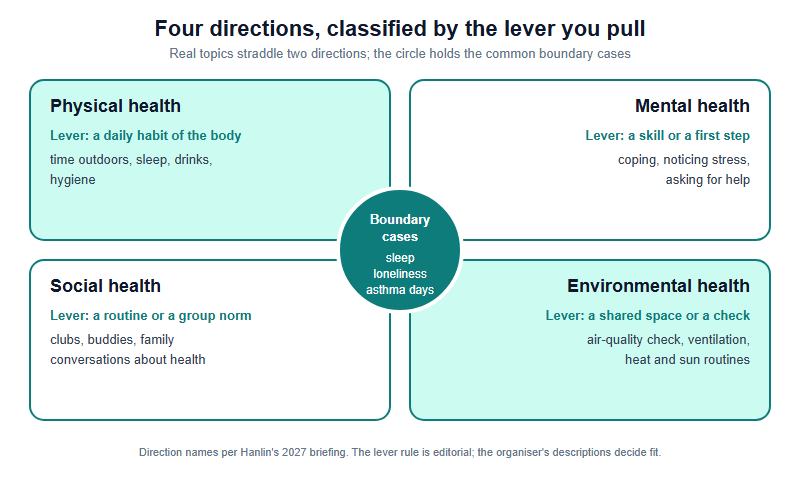
| Direction | The lever a student team can pull | A realistic scope | The common trap |
|---|---|---|---|
| Physical health | A daily habit of the body: movement, sleep, eating, hygiene, time outdoors | One habit, one year group, one setting | Advice every viewer has already heard |
| Mental health | A skill or a first step: coping, noticing stress, asking for help | One skill practised, not a condition explained | Sensitive content with no professional review |
| Social health | Who connects with whom, a group norm, how a family talks about health | One group and one routine that brings people together | Blaming individuals for problems a group creates |
| Environmental health | A feature of a shared space, or a check before exposure: air, ventilation, heat, sun | One room, one team, one routine | A good cause with no route to human health |
Build the chain before you choose the topic
The chain borrows COM-B, the model at the centre of Michie, van Stralen and West's 2011 Behaviour Change Wheel paper in Implementation Science: a behaviour happens when a person has the capability, the opportunity and the motivation for it. Naming which of the three is missing is what turns a topic into a design.
The barrier then tells you what each deliverable is for. A 30-second advertisement is good at motivation and at prompting a behaviour at the right moment, and poor at teaching a skill. A class is good at capability, because learners practise. Opportunity — the time, place, equipment or social permission to act — usually needs a change in the setting, which is often the most valuable thing a public-welfare team can negotiate: a routine the school agrees to, a sign in the right place, a club that opens its door to newcomers. For the craft of each format, see our guide to the two BCE deliverables.
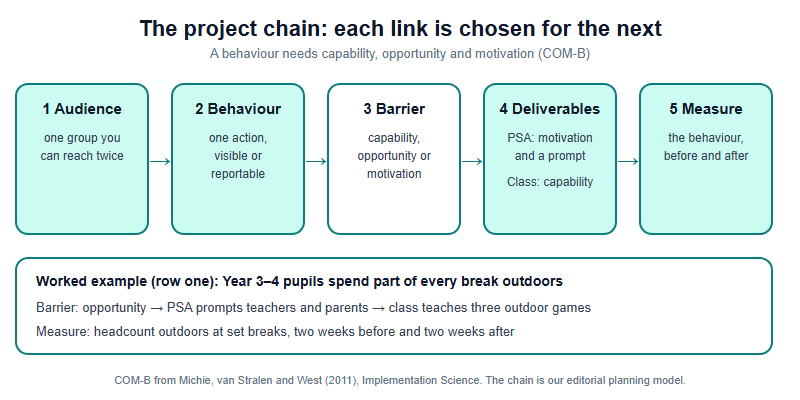
Two consequences follow. The behaviour must be singular: a project that tries to change sleep, diet and exercise at once cannot design deliverables for three different barriers. And the measure should track the behaviour rather than a health outcome, because no student team can observe long-term outcomes within a school term.

Eight worked examples, two per direction
Each row is written at the level of detail a team should reach before committing. None is a template to copy; the value is in the structure. All eight assume permission from your school, and the mental-health rows assume a counsellor reviews the content.
| Direction | Scoped project | Main barrier | PSA job | Class job | Honest measure |
|---|---|---|---|---|---|
| Physical | Year 3–4 pupils spend part of every break outdoors | Opportunity: indoor break habits, few ideas for outdoor play | Prompt teachers and parents to send pupils out | Older students teach three outdoor break games | Headcount outdoors at set breaks, two weeks before and after |
| Physical | Year 7–8 students choose water over a sugary drink at lunch | Motivation: habit and taste | Show the sugar in a drink they actually buy, read from its own label | Label-reading practice with real packaging | A tuck-shop tally agreed with the school, or an anonymous before-and-after count |
| Mental | Year 9 students switch on a notification-free hour before sleep in mock-exam weeks | Capability and habit: unfamiliar settings, reflex checking | Prompt the switch at the moment it matters | Set up the feature together, on real phones | Anonymous check-ins after one and three weeks |
| Mental | Year 12 students recognise when a friend needs more than a friend, and know how to involve an adult | Motivation: fear of betraying trust | Reframe telling an adult as loyalty | Counsellor co-led rehearsal of the first sentence | Before-and-after confidence scale, and knowledge of the referral route |
| Social | New Year 7 international students join one lunchtime club in their first month | Opportunity: not knowing the clubs, or anyone to go with | Show a real first visit, from the doorway in | Older students run a club tour | Club attendance by new students at weeks two and six, with staff |
| Social | Year 10 students check one health claim from a family group chat, together with a relative | Capability and social permission: how to check, and how to raise it kindly | Model a respectful check, not a lecture | Teach a three-question claim check | Anonymous log of claims checked, plus a before-and-after quiz on sample claims |
| Environmental | Sports captains check the official air-quality reading before outdoor training and apply the PE department's rule | Capability, and no routine for checking | The ten-second check before the whistle | Teach captains to read the index from an official source | Captains' check log over four weeks |
| Environmental | A form group runs an agreed ventilation routine between lessons, tracked with a CO2 monitor | Opportunity: cold, noise, no agreed routine | Show the reading change after the routine | Explain what the monitor indicates, and what it does not | Readings at fixed times before and after, with facilities permission |
Row one carries the strongest evidence in the table, and it shows how to use evidence honestly. In a cluster randomised trial in Guangzhou, published in JAMA in 2015, six primary schools added one 40-minute outdoor activity class to each school day. Over three years, cumulative myopia incidence was 30.4% in those schools against 39.5% in six control schools — a 9.1 percentage-point absolute difference, or about a 23% relative reduction. Quote both figures: a relative number on its own makes a modest effect sound dramatic.
That population — young children in Chinese primary schools — is unusually close to a China-based team's primary-section audience, which is exactly what an applicability check asks. Notice what a student team cannot do with it, though. Nobody measures myopia incidence in one term. The trial changed time outdoors, so the honest design borrows the outcome from the published evidence and measures the behaviour itself: how many pupils are actually outside at break.
The same logic governs row eight. The US National Institute of Standards and Technology notes that indoor carbon dioxide concentration can indicate a building's ventilation rate, but that its direct effect on health is unclear and that the popular 1,000 ppm rule of thumb can mislead. So that project claims better ventilation — not better health or better grades — and does not treat one number as a verdict.
Rows three and four sit in the most sensitive direction. Keep that content on skills and help-seeking, never on crisis or method, and have a professional review scripts and lesson plans. HOSA's own 2026–2027 guideline for its Mental Health Promotion event asks every team to identify a Mental Health Consultant to oversee project content and offer guidance, although the local HOSA advisor can fill the role if no mental-health professional is available.
Stress-test the idea before you commit
Run each candidate through six tests. If an idea fails two of them, change it now; September, with the build still ahead, is the cheapest month to change anything.
- Reach. Can you get the same audience twice, before and after? If not, you cannot show change.
- Observation. Is the behaviour visible — a headcount, a tally, a log — or honestly self-reportable without identifying anyone?
- Fit. Does the barrier match the deliverables? A motivation problem answered with a lecture, or a skills gap answered with a 30-second clip, is a mismatch.
- Evidence. Is there published evidence for the outcome in a population like yours? The closer the population, the more weight the evidence can bear.
- Health pathway. Can you draw a line from your lever to human health? A recycling drive or a tree-planting day is a good cause, but without that line it is a weak fit for a health direction; confirm fit with the organiser.
- Safety. Does any content touch suicide, self-harm, eating or body image, or personal data about classmates? If so, redesign around protective factors and get professional review.
Teams on the annual-theme route can run the same six tests on the official theme once it is published; confirm the release on the official channels. If your team has not yet settled between the two routes, our route decision framework covers that choice; the tests here assume it is made.
How a finishable idea reads to a judge, and later to an admissions reader
Questioning a project is, in effect, checking whether its parts agree: whether the evidence supports the behaviour, whether the deliverables target the barrier, and whether the measure tracks what was taught. A chain built this way survives that questioning because each link was chosen for the next. Teams that start from a topic and work forwards tend to discover the gaps only when someone asks.
The same consistency is what makes a project believable in a university application. An admissions reader weighs the activity line against the essay, the recommendation and the rest of the record, and a narrow project with one clear behaviour, a real audience and an honest measure gives each of those sources the same story to confirm. For how BCE fits beside the other tracks, see our ATC, CCE and BCE comparison; for the organisation behind the season, start with the HOSA overview.
Frequently asked questions
Can a self-proposed BCE project fit two health directions?
Many topics do. Classify yours by the lever it changes, then confirm with the organiser how cross-direction topics are placed.
How narrow should a BCE project idea be?
Narrow enough to name one audience, one behaviour and one measure that you can collect twice, before and after you deliver.
Does a BCE team need to prove a health outcome?
No team can measure long-term outcomes in one term. Cite published evidence for the outcome and measure the behaviour yourselves.
Is a sustainability project an environmental health project?
It fits best with a clear route to human health, such as air, water, heat or chemicals. Confirm fit with the organiser before committing.
Published by the HOSA (SKT-iHOSA) editorial desk, operated by Hanlin Education for China-based international-school students. Official rules are set by the competition and change yearly — confirm current details on hosa.org. Any error will be corrected within 7 working days.

Oct 20, 2026
iHOSA ATC Division I vs II: Allocating Study Time by Weighting Differences
Students in grades 9-10 and 11-12 face different topic weightings in the iHOSA ATC Biology and Chemistry exams. This guide breaks down…
Oct 17, 2026
iHOSA Biology Explanations: Connect a Feedback Loop to a Change in the Body
Mastering negative and positive feedback loops is essential for iHOSA Biology. Learn how to connect physiological mechanisms to observable changes with worked…
Oct 15, 2026
iHOSA Health Education: Test Whether an Audience Understood Your Message
In iHOSA Health Education, testing whether your audience understood your message is not an afterthought—it is the core deliverable. Learn how to…