iHOSA's BCE public-welfare track — the team, project route rather than an individual test — lets a team of three to six students enter on either the annual theme, released each September, or a self-proposed project. Both are valid; the right one depends on your team's makeup, timeline and appetite for originality. This guide is a decision framework, not an announcement of what changed. Route details are per Hanlin (SKT-iHOSA); confirm current rules on the official channels.
BCE in one paragraph: what makes it different
Where the ATC track is a solo, timed exam and the CCE track is professional/clinical, the BCE (public-welfare) track is a team project that produces a real deliverable rather than a test score. If you are still deciding between the three, our ATC vs CCE vs BCE track guide compares them, and the What Is HOSA overview sets the wider context. What is unique to BCE, and what this article is about, is that once you choose the track you face a second decision most students underestimate: which route — the official annual theme or a self-proposed project. That choice shapes everything from how you staff the team to how much time you will need.
The two routes, side by side
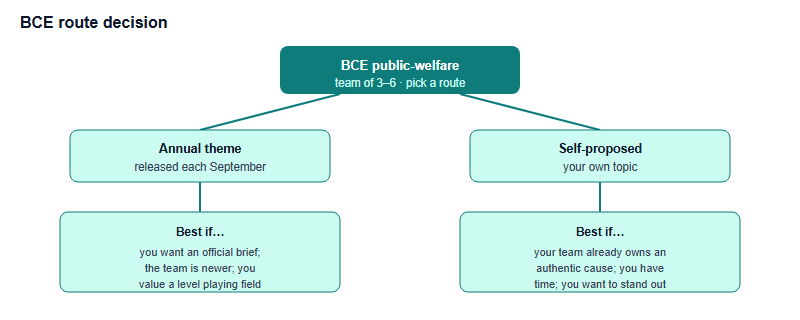
Both routes are entered by a team of three to six students, and (per Hanlin) both are judged with the same standing rather than one being a “lesser” option. What differs is where your topic comes from and what that implies for your team:
| Dimension | Annual theme route | Self-proposed route |
|---|---|---|
| Topic source | Official prompt, released each September | Your team chooses its own public-health topic |
| Originality risk | Lower — everyone works the same brief | Higher — you must find and frame a strong topic yourselves |
| Runway needed | Starts when the theme drops; a defined window | Can start earlier if your cause already exists |
| Best-suited team | Newer teams; those who want a clear brief to react to | Teams with a genuine, pre-existing cause and time to build |
| Main pitfall | Blending in with a crowded field on the same prompt | Choosing a topic that is too broad to finish well |
Decide by your team, not by the prize
The most common mistake is choosing a route on gut feeling — “self-proposed sounds more impressive” — before looking honestly at the team you actually have. A BCE team is three to six students, and its composition should drive the decision far more than the perceived prestige of either route. Run this quick audit before you choose:
- Do you already share a cause? If two or three of you have genuinely cared about a specific health issue for a while — not invented for the competition — the self-proposed route lets you build on real momentum. If the cause would be manufactured from scratch, the annual theme gives you a stronger starting point.
- How experienced is the team? A first-time team benefits from the structure of an official brief; there is enough to learn in delivering a project well without also carrying the burden of finding the topic. A team that has competed before can handle the extra freedom of self-proposing.
- How much time can you realistically commit? Self-proposing adds a whole phase — researching, framing and validating a topic — before you even begin building. If your team's calendar is already tight, the annual theme removes that phase.
- Who does what? Map your members to roles before you commit. A team with no one comfortable presenting, or no one who can turn research into a clear deliverable, has a capability gap to fix regardless of route.
The honest version of this decision is unglamorous: pick the route your current team can execute to a high standard, not the route that sounds more ambitious in the abstract. A well-executed annual-theme project beats a half-finished original one every time.

Scope a project a 3–6 person team can actually finish
Whichever route you choose, the failure that sinks the most BCE teams is scope — taking on a topic so large that a small team cannot finish it to a high standard in the time available. Scoping is a skill, and it is the same skill on both routes. A workable structure:
- Narrow the topic until a small team can own it. “Improve mental health” is a slogan, not a project. “Reduce exam-season sleep loss among Year 11 boarders at our school” is something three to six students can research, act on and measure.
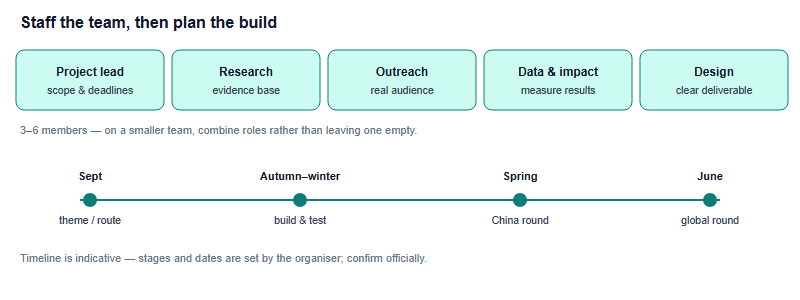
- Give every member a role, and cover gaps by combining roles. On a three-person team, one person may own both research and data; the point is that no essential function — evidence, a real audience, a clear deliverable — is left with nobody.
- Plan backward from the rounds. The annual theme drops in September, so an annual-theme team knows exactly when its build phase starts. A self-proposed team should set its own equivalent start date and protect it.
Common failure modes we see
From working with China-based teams, the same avoidable mistakes recur on the BCE track — and none of them is about talent. Watch for these:
- Choosing self-proposed for prestige, then stalling on the topic. Teams that pick the “impressive” route without a real cause often burn their first weeks unable to agree on what to do — time the annual-theme teams spent building.
- A cause with no audience. Public-welfare work needs real people to reach; a project that never leaves the group chat has no impact to show. Decide early who you are actually serving.
- All research, no deliverable. Strong evidence that never becomes a clear, finished output does not land. Assign someone to own the deliverable from day one.
- Passenger members. A six-person team where two people do nothing is weaker than a focused team of three. Size the team to the people who will genuinely contribute.
The through-line is discipline, not brilliance: a team that scopes tightly, staffs every role, and reaches a real audience will out-perform a more talented team that never finishes. Once you advance, the season builds toward the international stage — our ILC 2026 complete guide shows what that top level looks like.
A simple decision rule
If you want the choice in one line: take the annual theme unless your team already owns a genuine cause and has the time to build it well — in which case go self-proposed. The annual theme is the safer default for newer or time-pressed teams; the self-proposed route is the reward for teams with real momentum. Either way, the winning move is the same — scope small, staff every role, reach a real audience, and finish. Confirm the current BCE rules, team size and route details on the official channels before you commit, because they can change from season to season.
Frequently asked questions
How big is a BCE team?
Per Hanlin (SKT-iHOSA), a BCE public-welfare team is three to six students. Size it to the people who will genuinely contribute, and confirm the current rule officially.
When is the annual theme released?
The official annual theme is released each September. A self-proposed team can start earlier if its cause already exists. Confirm current dates officially.
Is the self-proposed route judged more harshly?
Per Hanlin, both routes carry the same standing; neither is a lesser option. Choose by your team's readiness, not by a perceived scoring advantage.
Annual theme or self-proposed — which should we pick?
Default to the annual theme unless your team already owns a real cause and has time to build it well. A finished theme project beats a half-finished original.
Published by the HOSA (SKT-iHOSA) editorial desk, operated by Hanlin Education for China-based international-school students. Official rules are set by the competition and change yearly — confirm current details on hosa.org. Any error will be corrected within 7 working days.

Oct 20, 2026
iHOSA ATC Division I vs II: Allocating Study Time by Weighting Differences
Students in grades 9-10 and 11-12 face different topic weightings in the iHOSA ATC Biology and Chemistry exams. This guide breaks down…
Oct 17, 2026
iHOSA Biology Explanations: Connect a Feedback Loop to a Change in the Body
Mastering negative and positive feedback loops is essential for iHOSA Biology. Learn how to connect physiological mechanisms to observable changes with worked…
Oct 15, 2026
iHOSA Health Education: Test Whether an Audience Understood Your Message
In iHOSA Health Education, testing whether your audience understood your message is not an afterthought—it is the core deliverable. Learn how to…