Many of HOSA’s knowledge-based competitive events open with an online Round 1 test — a timed, multiple-choice exam that screens a large field down to a smaller group invited to a second round. For China-based international-school students competing through SKT-iHOSA, Round 1 is usually the first hard gate of the season: pass it and you progress; miss it and the year ends early. This guide explains how the qualifying round functions, what it gates, and how to plan around it. Exact rules vary by event and year — always confirm on hosa.org.
What “Round 1” actually is
HOSA’s Competitive Events Program spans five broad categories — Health Science, Health Professions, Emergency Preparedness, Leadership, and Teamwork events (per hosa.org). A large share of Health Science events — the knowledge-test events such as Medical Terminology, Pathophysiology, Human Growth & Development, Medical Math, and similar — are decided wholly or partly by a written/online examination. In a typical structure, that exam is administered first (Round 1) to determine which competitors advance to a Round 2 (which may be a second test, a skill, or a presentation, depending on the event).
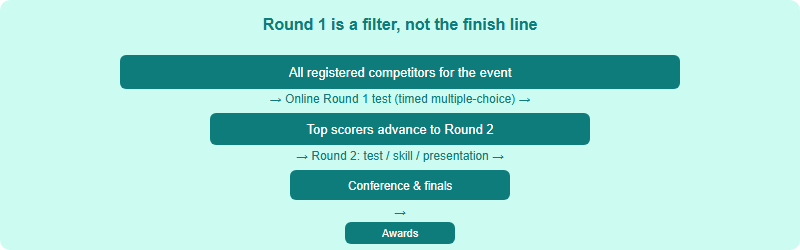
The mental model to hold is simple: Round 1 is a filter, not the finish line. It exists to rank a wide entry pool objectively before scarce second-round slots are allocated. Whether a specific event has one test or two, how many advance, and the exact passing logic are all set in that event’s official guidelines — so the first thing you should do for your chosen event is open its current guideline document on hosa.org and read the “Round” section line by line. If you are still deciding which event to enter, our ATC vs CCE vs BCE breakdown explains how the three SKT-iHOSA tracks map onto these event types.
Where Round 1 sits in the season
The reason Round 1 deserves its own article is timing. In the U.S. progression, members typically move chapter/local → regional or area → state/affiliate-level → International Leadership Conference (ILC). Knowledge tests are often scheduled in the winter window, well before any in-person conference, which is why an “Initial Assessment” or online test can feel like it sneaks up on students who only mentally prepared for a spring competition. For SKT-iHOSA participants, the China-region calendar (registration, any online assessment, and how results feed the next stage) is operated regionally — treat the SKT-iHOSA channel’s published dates as authoritative for China-based competitors, and treat hosa.org as authoritative for the global event rules. Do not assume the China window matches the U.S. window; confirm both.
| Stage | What happens | What it decides | Where to confirm |
|---|---|---|---|
| Registration | Enrol as a HOSA member and register for a specific event | Eligibility to sit Round 1 at all | SKT-iHOSA channel (China) · hosa.org (rules) |
| Round 1 (online test) | Timed multiple-choice exam on the event’s topic | Who advances to Round 2 | Event guideline on hosa.org |
| Round 2 | Second test, skill, or presentation (event-dependent) | Final ranking / awards eligibility | Event guideline on hosa.org |
| Conference / ILC | In-person finals & recognition (e.g., ILC 2026) | International placement | hosa.org · ILC 2026 guide |

What the online test usually examines
Knowledge-test events draw from a defined body of content listed in each event’s guideline — often anchored to named reference texts, terminology sets, or curriculum domains. The recurring competitor mistakes we see at SKT-iHOSA are not about intelligence; they are about format unfamiliarity. Build your preparation around the four realities of an online qualifier:
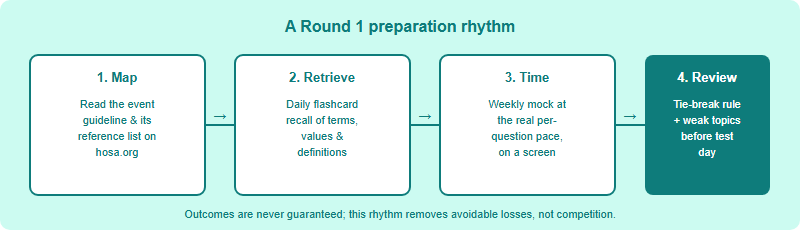
- It is time-pressured. Most HOSA tests run on a per-question pace that punishes re-reading. The published time limit and question count for your event are in its guideline — divide one by the other and practise at that tempo, not slower.
- It rewards recognition speed, not deep derivation. Recall of terms, structures, normal values, and definitions tends to dominate. Flashcard-style retrieval beats re-reading chapters.
- The syllabus is bounded. Tests are written to the guideline’s reference list. Studying off-list material is effort that does not score. Anchor to the official references named for your event.
- Ties and tie-breakers matter. Where many strong students cluster, the event’s tie-break rule can decide who advances. Read it before test day so you know which sections carry extra weight.
A concrete first-party anchor (SKT-iHOSA 2027 China season). For the 2027 China cycle, SKT-iHOSA has published an initial-station format of 45 minutes for 45 single-answer multiple-choice questions, plus 5 tie-breaker questions (per SKT-iHOSA; confirm the current figures on webloom.cn). Two planning implications follow directly. First, you are working at roughly one minute per scored question, so the recognition-speed discipline above is not optional. Second, because 5 items are explicitly reserved for tie-breaking, a cluster of students sitting on the same scored total really is separated by the hardest questions — practise those deliberately rather than skipping them. This format sits on the ATC academic track, whose 2027 China subjects are Biology, Chemistry and Psychology; SKT-iHOSA reports the ATC papers overlap heavily with mainstream curricula — for Biology, up to roughly 95% with IB, 83% with A-Level and 82% with AP (per SKT-iHOSA) — which is why curriculum revision doubles as test preparation.
For the SKT-iHOSA Foundational-test track specifically (the ATC route — biology/chemistry-style examinations), this format discipline is the whole game. Our What Is HOSA overview sets out where these events fit in the wider programme.
A first-party preparation rhythm for China-based students
SKT-iHOSA’s editorial view, from running China-cohort preparation, is that the students who clear Round 1 comfortably do three unglamorous things consistently. We do not promise any outcome — HOSA is competitive and selective by design — but this rhythm removes the avoidable losses:
Three operational notes that specifically trip up China-based candidates:
- Test-day technology. An online test depends on a stable connection and a supported browser/device. Confirm the exact platform and any system check requirements through the SKT-iHOSA channel before the day, and have a backup connection ready.
- Time zones. If a window is published in a U.S. time zone, convert it to Beijing time yourself and double-check — a single-hour error has ended seasons. Treat any posted time as “confirm the zone” until you have verified it.
- One event, deep — or two, shallow? Round 1 rewards depth. For a first season, most SKT-iHOSA students do better entering fewer events and clearing the qualifier than spreading thin across many. See our track guide for how to choose.
Common myths about the qualifying round
Because the online round is the least visible part of HOSA, misinformation spreads. Three corrections, all of which you should verify against your own event’s current guideline rather than take on faith:
- “Everyone who registers competes in person.” Not necessarily — for events with a qualifying test, the online round determines who advances. Registration buys you a seat at Round 1, not at the finals.
- “The test is the same every year.” Guidelines, reference lists, and formats are revised on a yearly cycle. Prepare from the current year’s document, not a senior’s old notes.
- “There is a fixed pass mark.” Advancement is frequently rank-based against the field, not a fixed percentage — so a ‘good’ score is one good enough relative to other competitors that cycle. The exact logic is event- and affiliate-specific; confirm on hosa.org.
Frequently asked questions
Does every HOSA event have an online Round 1 test?
No. Knowledge-test (Health Science) events commonly use a written/online exam, but skill and presentation events are structured differently. Check your specific event’s guideline on hosa.org.
What is the SKT-iHOSA initial-station test format?
For the 2027 China season, SKT-iHOSA publishes a 45-minute online test of 45 single-answer multiple-choice questions plus 5 tie-breaker questions, on the ATC academic track (Biology, Chemistry, Psychology). Per SKT-iHOSA — confirm current figures on webloom.cn.
How many competitors advance past Round 1?
It varies by event, affiliate, and year, and is often rank-based rather than a fixed cut score. The advancement rule is set in the official event guideline — confirm on hosa.org.
When is the online test held for China-based SKT-iHOSA students?
The China-region calendar is operated regionally. Treat the SKT-iHOSA channel’s published dates as authoritative and convert any U.S.-posted times to Beijing time.
Can I retake Round 1 if my internet fails?
Make-up and technical-issue policies are set by the organiser and are not something to assume. Confirm the current policy through the SKT-iHOSA channel and hosa.org before test day.
Published by the HOSA (SKT-iHOSA) editorial desk, operated by Hanlin Education for China-based international-school students. Official rules are set by the competition and change yearly — confirm current details on hosa.org. Any error will be corrected within 7 working days.

Oct 20, 2026
iHOSA ATC Division I vs II: Allocating Study Time by Weighting Differences
Students in grades 9-10 and 11-12 face different topic weightings in the iHOSA ATC Biology and Chemistry exams. This guide breaks down…
Oct 17, 2026
iHOSA Biology Explanations: Connect a Feedback Loop to a Change in the Body
Mastering negative and positive feedback loops is essential for iHOSA Biology. Learn how to connect physiological mechanisms to observable changes with worked…
Oct 15, 2026
iHOSA Health Education: Test Whether an Audience Understood Your Message
In iHOSA Health Education, testing whether your audience understood your message is not an afterthought—it is the core deliverable. Learn how to…