
HOSA runs a distinct family of behavioral and mental-health events, and it is one of the most overlooked corners of the catalogue for pre-med students. It spans three very different formats: Behavioral Health, a written knowledge test on psychology and mental health; Mental Health Promotion, a team event built around a real community campaign; and the Emotional Well-Being Challenge, a recognition event with a pre-judged submission. This guide decodes what each one is, who it fits, and how China-based international-school students competing through SKT-iHOSA should think about the cluster. Event formats and rules change yearly — always confirm the current guideline on hosa.org.
Why the mental-health cluster is worth a serious look
Most students browsing HOSA gravitate to the obvious pre-med names — anatomy, medical terminology, clinical skills. The behavioral and mental-health events sit slightly off that main road, which is exactly why they can be a smart choice. Behavioral and mental health is one of the fastest-growing areas of medicine, public health, and health policy, and a student who competes here signals a genuine interest that most applicants never demonstrate. If you are still forming a picture of how HOSA is organised, our What Is HOSA overview maps where competitive events sit within the wider programme.
There is also a practical SKT-iHOSA angle. Students who are strong on psychology, who read widely, or who care about student wellbeing but do not see themselves as pure lab scientists often find these events a better fit than a hard biochemistry test. The cluster rewards a mix of reading, empathy, and communication — a profile that is common but under-served in the standard event menu.
The three events, side by side
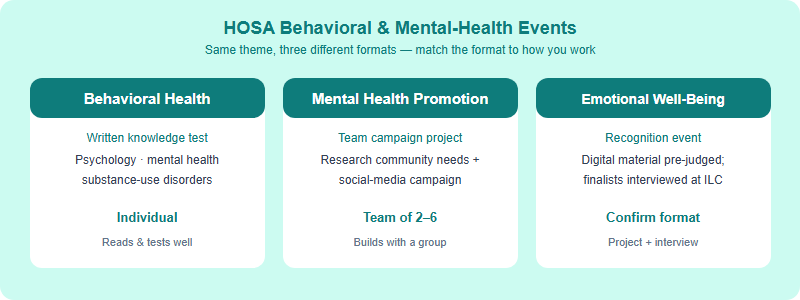
The single most important thing to understand is that these three events do not share a format. One is a solo exam, one is a team project, and one is a pre-judged submission with an interview. Choosing well means matching the format to how you work, not just the topic to what you like.
| Event | HOSA category (per hosa.org) | Format shape | Solo / team | Best fit |
|---|---|---|---|---|
| Behavioral Health | Health Science (knowledge) | Written test on psychology, the mind, mental health & substance-use disorders | Individual | Strong readers who test well and enjoy psychology |
| Mental Health Promotion | Emergency Preparedness | A team researches community mental-health needs and builds a social-media campaign | Team of 2–6 | Students who want to build a real campaign with a group |
| Emotional Well-Being Challenge | Recognition event | Digital material pre-judged virtually; finalists interviewed at ILC | Confirm on hosa.org | Students with a strong wellbeing project and a clear audience |
Behavioral Health: the solo written test
Behavioral Health is a knowledge event: per hosa.org, it asks members to build knowledge and skills around psychology, the mind, mental health, and substance-use disorders. In practice that means it behaves like the other written Health Science tests in the SKT-iHOSA ATC (Foundational, examination-style) lane — you study a defined body of content and sit a multiple-choice exam. Our ATC vs CCE vs BCE track guide explains how the foundational-test lane works across the whole programme.
What makes Behavioral Health distinctive as a study target:
- The content is genuinely learnable from reading. Core psychology, mental-health conditions, and the basics of substance-use disorders are well-documented, which suits students who read fluently in English but do not have a wet-lab background.
- Terminology precision matters. As with any HOSA knowledge test, questions reward exact vocabulary — the difference between related terms, classifications, and definitions. Build a glossary as you study.
- Confirm the reference list. HOSA events specify the source material a test is built from. Do not guess — find your event’s official guideline and study against the references it names.
The exact number of questions, time limit, reference textbooks, and whether a second round applies are all set by HOSA and can change from year to year. Treat any figure you see second-hand as provisional and confirm it on hosa.org.

Mental Health Promotion: the team campaign
Mental Health Promotion is a completely different animal. Per HOSA’s official event guideline, it is a team of 2 to 6 members who research the mental-health needs in their school or community and develop a social-media campaign addressing the risk and protective factors tied to those needs. This is a project event, closer in spirit to the SKT-iHOSA BCE (public-welfare, project-based) lane than to any exam.
That format has real consequences for how you prepare:
| Because it is… | You need to… |
|---|---|
| A team of 2–6 | Recruit a reliable group early and divide roles (research, design, writing, presentation) |
| Built on real community needs | Gather genuine evidence about your own school/community rather than inventing a generic problem |
| A social-media campaign | Produce actual campaign material and be able to explain your risk / protective-factor reasoning |
| Judged against a rubric | Read the official rating sheet first and build the campaign to score every listed line |
For China-based teams, the campaign angle is an opportunity: a mental-health promotion project rooted in the real pressures of an international-school environment — exam stress, transitions abroad, bicultural identity — is far more compelling to judges than a generic template, and it is a genuinely useful thing to build regardless of how the competition goes.
Emotional Well-Being Challenge: the recognition route
The Emotional Well-Being Challenge (EWBC) sits in HOSA's recognition-event family rather than the head-to-head competitive lane. Per hosa.org, its digital material is pre-judged virtually before the International Leadership Conference, and finalists are interviewed at ILC. Presentations are designed to help a specific audience improve their social-emotional wellness, and top selections have historically earned recognition and scholarships in partnership with SAMHSA (the U.S. Substance Abuse and Mental Health Services Administration).
Practical notes:
- It is submission-first. Because the digital material is pre-judged, the quality of what you upload matters enormously — this rewards students who plan and polish a project rather than perform live.
- Audience is everything. A well-being project that names a specific audience and shows it improved their wellness reads far stronger than a vague awareness piece.
- Confirm eligibility, deadlines, and partners each year. Recognition-event rules, submission windows, scholarship arrangements, and any partner organisations are defined by HOSA and can change — verify the current EWBC guideline on hosa.org before relying on any specific detail here.
How to choose within the cluster
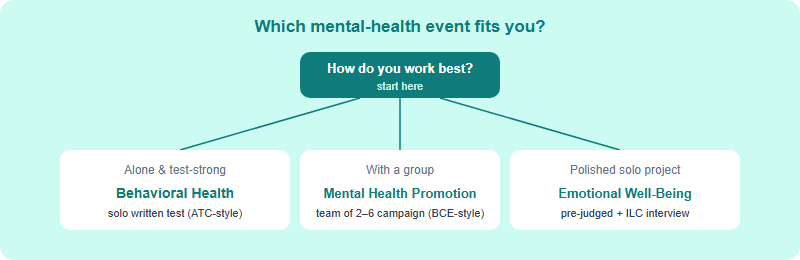
Use format, not topic, as your deciding filter. All three events share a subject you clearly like — so the real question is how do you do your best work?
- You test well and prefer to work alone → Behavioral Health (the written test) is your natural fit, and it slots cleanly into an ATC-style study plan.
- You want to build something real with a group → Mental Health Promotion (team of 2–6) lets you turn interest into a campaign, and it plays to BCE-style project skills.
- You have a polished individual wellbeing project and an audience → the Emotional Well-Being Challenge rewards a strong pre-judged submission.
Whichever you pick, the SKT-iHOSA advice is the same as for any event: read the official guideline and rating sheet before you start preparing, so you build toward exactly what scores. If you are weighing this cluster against other tracks, the track-selection guide puts ATC, CCE, and BCE side by side.
Frequently asked questions
Is Behavioral Health a written test or a project?
Per hosa.org, Behavioral Health is a knowledge event assessed by a written test covering psychology, mental health, and substance-use disorders. Confirm the current format on the official guideline.
How many people are on a Mental Health Promotion team?
HOSA's official guideline states a team of 2 to 6 members who research community mental-health needs and build a social-media campaign. Verify team size for the current year on hosa.org.
What is the Emotional Well-Being Challenge?
It is a HOSA recognition event whose digital material is pre-judged virtually, with finalists interviewed at ILC. Exact rules and any scholarship partners are set by HOSA — confirm on hosa.org.
Do these events suit students who like psychology more than lab science?
Often yes — the cluster rewards reading, empathy, and communication. But match the format (solo test vs team project) to how you work, and confirm eligibility on hosa.org.
Published by the HOSA (SKT-iHOSA) editorial desk, operated by Hanlin Education for China-based international-school students. Official rules are set by the competition and change yearly — confirm current details on hosa.org. Any error will be corrected within 7 working days.

Oct 20, 2026
iHOSA ATC Division I vs II: Allocating Study Time by Weighting Differences
Students in grades 9-10 and 11-12 face different topic weightings in the iHOSA ATC Biology and Chemistry exams. This guide breaks down…
Oct 17, 2026
iHOSA Biology Explanations: Connect a Feedback Loop to a Change in the Body
Mastering negative and positive feedback loops is essential for iHOSA Biology. Learn how to connect physiological mechanisms to observable changes with worked…
Oct 15, 2026
iHOSA Health Education: Test Whether an Audience Understood Your Message
In iHOSA Health Education, testing whether your audience understood your message is not an afterthought—it is the core deliverable. Learn how to…