
HOSA's Teamwork events — HOSA Bowl, Biomedical Debate, and Creative Problem Solving among them — reward something the solo tests do not: coordination. A team of strong individuals who never rehearsed together loses to a well-drilled group of the same ability. This playbook decodes how these events actually run, how to build and divide a roster, and how China-based SKT-iHOSA teams should prepare across a time-zone gap. Team sizes, topics, and formats are set by HOSA and change yearly — confirm every detail on the official guideline at hosa.org.
Why team events are a different sport
Teamwork events belong to their own category within HOSA's Competitive Events Program (per hosa.org). The competition tests knowledge, but the medal is decided by how well a small group researches together, divides labour, and performs under time pressure as a unit. That makes team events a genuinely different challenge from the individual knowledge and skill events — and a great fit for students who thrive collaboratively. If you are still deciding whether a team event is right for you at all, our companion piece on ATC vs CCE vs BCE track selection covers the choose-a-track decision; this article assumes you have chosen team and want to know how to win it.
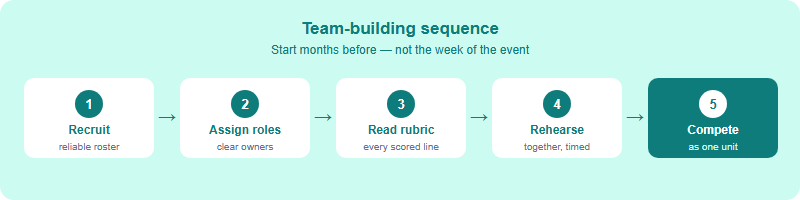
Within SKT-iHOSA, project-and-team formats live closest to the BCE (public-welfare, project-based) lane in spirit, though the specific events here range from buzzer quizzes to structured debate. The common thread is that a reliable roster is your first competitive advantage — assembled months before, not the week of.
The three flagship team events, decoded
Each of these events tests knowledge through a different mechanism. Understanding the mechanism tells you how to train.
| Event | Team size (per hosa.org) | What the team actually does | The muscle it builds |
|---|---|---|---|
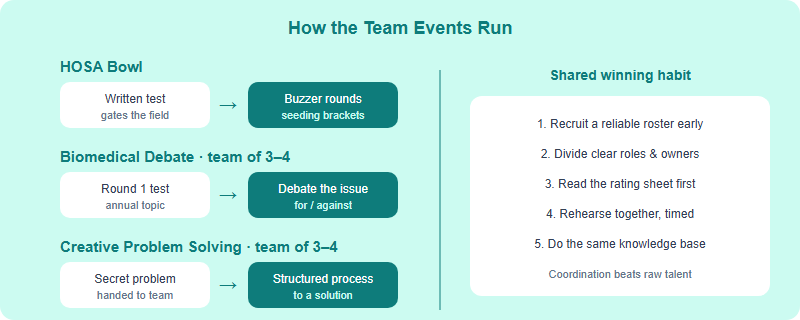
| HOSA Bowl | Team event (confirm size on hosa.org) | A written test gates the field, then buzzer / quiz-bowl rounds against other teams using seeding brackets | Broad recall + fast, coordinated buzzing |
| Biomedical Debate | Team of 3–4 | Research the annual biomedical topic; members sit a Round 1 written test, then debate the issue (for / against) | Evidence, argument & verbal communication |
| Creative Problem Solving | Team of 3–4 | Apply a structured problem-solving process to a secret hypothetical health / HOSA problem | Process, role division & thinking under pressure |
HOSA Bowl: broad knowledge, fast coordination
HOSA Bowl is a quiz-bowl-style team event. Per hosa.org materials, a written test is part of the event, and seeding-chart brackets are used — and, in our coaching experience, teams with a strong written-test base tend to do better in the buzzer rounds, because deeper knowledge translates directly into faster, more confident answers. The event rewards breadth: broad health-science recall across many topics, not one deep specialty.
- Assign coverage areas. Rather than everyone studying everything, have team members own specific domains so your collective recall is wide and there are no blind spots.
- Practise buzzing, not just knowing. Bowl is a speed game. Simulate buzzer rounds so the team learns who answers what, and how to avoid two members buzzing on the same question.
- Build the written-test base first. Because the test correlates with buzzer success, a strong shared knowledge base is the foundation everything else sits on.

Biomedical Debate: evidence and argument in a team of 3–4
Biomedical Debate is a team of 3–4 (per hosa.org) that researches the annual biomedical topic, sits a Round 1 written test on it, and then debates the issue — arguing for or against as assigned. It is designed to make members proactive future health professionals who can evaluate, discuss, and think critically about a complex biomedical question, and refine their verbal communication. This is the most communication-heavy team event.
How to prepare a debate team:
- Prepare both sides. Because you may be assigned affirmative or negative, research and rehearse arguments for and against. A team that only prepared one side is exposed.
- Anchor claims in evidence. The event rewards critical evaluation of a real biomedical issue — bring specific evidence, not opinion, and be ready to rebut.
- Rehearse the written test together too. The Round 1 test counts, so the team's shared command of the annual topic matters as much as its speaking.
Creative Problem Solving: process under pressure
Creative Problem Solving is a team of 3–4 (per hosa.org) that is handed a secret hypothetical health or HOSA-related problem and must apply a structured problem-solving process to create a solution. Because the problem is unseen, you cannot pre-write an answer — you can only train the process and the teamwork that lets you deploy it quickly.
- Learn and drill the problem-solving steps. The event is explicitly about the process; a team that can name and follow each step will out-perform a smarter team that improvises.
- Pre-assign roles for the room. Decide in advance who facilitates, who records, who watches the clock, and who presents — so no time is wasted organising when the problem drops.
- Practise on unseen prompts. Rehearse with problems nobody has seen so the team gets comfortable being uncomfortable and applying the framework live.
Building a China-based team that actually holds together
The operational reality for SKT-iHOSA teams is that your roster and your rehearsal discipline decide more than any individual's brilliance. A few first-party lessons that recur across cohorts:
| Risk for a China-based team | Practical fix |
|---|---|
| A member drops out mid-season | Recruit slightly deeper than the minimum and set expectations early; confirm allowed team-size ranges on hosa.org |
| Everyone studies the same thing | Divide domains / roles so coverage is complete and effort is not duplicated |
| The team never rehearses together | Schedule recurring timed practice; coordination is the whole point of a team event |
| Time-zone gap with US-based rounds | Check appointment times and the ILC schedule early and plan sleep / logistics around them — confirm on hosa.org |
| Nobody read the rubric | Read the official rating sheet before preparing anything and build to every scored line |
None of this replaces knowledge — a team still has to know the content. But among teams of similar ability, the one that recruited early, divided roles, read the rubric, and rehearsed together as a unit is the one that places. If your team is choosing between events, start from the What Is HOSA overview and the track guide, then pick the mechanism (buzzer, debate, or problem-solving) that best matches how your group works. And if some of you are heading to the finals, our ILC 2026 guide covers the conference logistics.
Frequently asked questions
How many members are on a HOSA Biomedical Debate or Creative Problem Solving team?
Per the official HOSA guidelines, both Biomedical Debate and Creative Problem Solving are team events; confirm the current-year team size on hosa.org.
Does HOSA Bowl have a written test?
Yes — per hosa.org, a written test is part of HOSA Bowl and correlates with buzzer-round success, alongside seeding-chart brackets. Verify the current format on the official guideline.
Can you prepare an answer for Creative Problem Solving in advance?
No — the problem is a secret, unseen prompt. You prepare by drilling the structured problem-solving process and team roles, not a fixed answer. Confirm details on hosa.org.
Are team events better than individual events for pre-med?
Neither is inherently better; team events reward collaboration and communication, individual events reward depth. Choose by how you work best, and confirm eligibility on hosa.org.
Published by the HOSA (SKT-iHOSA) editorial desk, operated by Hanlin Education for China-based international-school students. Official rules are set by the competition and change yearly — confirm current details on hosa.org. Any error will be corrected within 7 working days.

Oct 20, 2026
iHOSA ATC Division I vs II: Allocating Study Time by Weighting Differences
Students in grades 9-10 and 11-12 face different topic weightings in the iHOSA ATC Biology and Chemistry exams. This guide breaks down…
Oct 17, 2026
iHOSA Biology Explanations: Connect a Feedback Loop to a Change in the Body
Mastering negative and positive feedback loops is essential for iHOSA Biology. Learn how to connect physiological mechanisms to observable changes with worked…
Oct 15, 2026
iHOSA Health Education: Test Whether an Audience Understood Your Message
In iHOSA Health Education, testing whether your audience understood your message is not an afterthought—it is the core deliverable. Learn how to…