HOSA Emergency Preparedness events are the hands-on, response-focused branch of HOSA's competitive program: think CERT Skills, CPR/First Aid, Emergency Medical Technician, Epidemiology, Life Support Skills, MRC Partnership, and Public Health. Unlike the pure knowledge-test track, most of these events reward students who can perform a skill under time pressure — a very different prep path from a biology exam. Confirm which of these run in your cohort on the official site.
What counts as an Emergency Preparedness event
HOSA groups its competitive events into several families. The Emergency Preparedness family is built around emergency response, disaster readiness, and population-health investigation. According to hosa.org, the events in this category include the following.
| Event | Core focus | Typical demand |
|---|---|---|
| CERT Skills | Community Emergency Response Team training | Team disaster-response tasks |
| CPR/First Aid | Cardiopulmonary resuscitation & first-aid response | Timed hands-on skill |
| Emergency Medical Technician | Pre-hospital emergency care | Scenario + skills stations |
| Epidemiology | Disease investigation & public-health analysis | Knowledge test / analysis |
| Life Support Skills | IDEA-qualified emergency intervention | Skills demonstration |
| Mental Health Promotion | Mental wellness & crisis awareness | Project / awareness work |
| MRC Partnership | Medical Reserve Corps volunteer coordination | Project + partnership |
| Public Health | Population health & disease prevention | Project / presentation |
If you are new to HOSA, start with our overview of what HOSA Future Health Professionals is before you commit to any one event. This category sits alongside — not inside — the SKT-iHOSA ATC, CCE and BCE track framing; whether a given emergency event maps to a China-cohort track is something to confirm before you register.
Skills events vs knowledge events: pick by how you learn
The single most useful distinction inside this category is skills-demonstration versus knowledge-analysis. A CPR/First Aid or EMT competitor is graded largely on performing a procedure correctly and in order; an Epidemiology competitor is graded largely on reasoning through data and disease scenarios. They demand different prep, different personalities, and different equipment access.
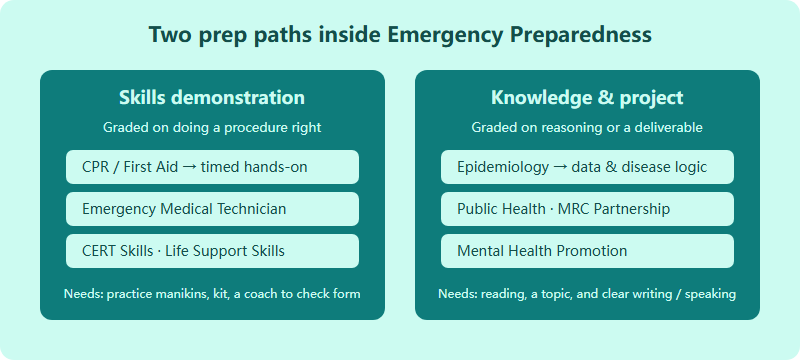
For international students in China, this distinction is practical, not abstract. Skills events assume you can rehearse a physical procedure repeatedly — ideally with a certified instructor, a manikin, and the right kit. If your school lacks that equipment, an Epidemiology or Public Health event may be a more realistic first entry, because the raw material is reading, data, and structured argument.

Who each event actually suits
Below is an editorial read on fit — not an official ranking. Use it as a starting hypothesis, then confirm the current year's event details and eligibility on hosa.org.
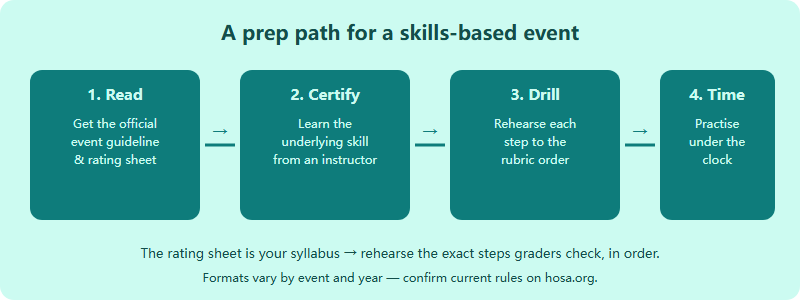
- CPR/First Aid — the classic on-ramp. Concrete, certifiable (the underlying certification is useful in its own right), and satisfying for students who like clear right-and-wrong steps.
- Emergency Medical Technician — ambitious and pre-hospital-focused; strong signal for future paramedicine, emergency medicine, and nursing applicants who can access serious hands-on training.
- Epidemiology — the analytical standout. If you like the detective side of medicine — outbreaks, transmission, data — this pairs beautifully with a future in public health or research.
- Public Health & MRC Partnership — project-flavoured and community-facing; good for students who want to build something and document impact rather than sit a test.
- CERT Skills & Life Support Skills — disaster-response and intervention focus; team-oriented and physically engaged.
One honest caveat for the China cohort: not every HOSA event is necessarily offered in every region or cohort each year, and skills events in particular can depend on assessor and equipment availability. Treat the list above as HOSA's national catalog and verify your own cohort's menu before you build a plan.
How the rounds generally work — and where the test still matters
Many HOSA events open with an online qualifying test before any conference-level component. In the iHOSA framework, the online Round One is a 45-minute test with 45 multiple-choice questions plus 5 tiebreaker questions (for the ATC foundational cluster covering biology, chemistry and psychology). Emergency Preparedness events may combine a knowledge component with a skills or project component; the exact split, references, and rating sheets are set per event and per year — read your specific event's official guideline and confirm on the official site rather than assuming it mirrors another event.
The admissions angle: what an emergency event signals
For a pre-health applicant, an Emergency Preparedness event can read differently from a biology exam event. A CPR/First Aid or EMT result signals tested, hands-on competence and composure — qualities that are hard to fake in a personal statement. An Epidemiology or Public Health result signals analytical and population-level thinking, which pairs naturally with research or public-health-oriented applications. Neither guarantees any admissions outcome, and no single activity should carry an application; the value is in a coherent story where the event supports a genuine interest.
If you are weighing HOSA against a lab-science olympiad or a business-oriented program, the emergency track is a reminder that HOSA's breadth is its advantage: it can hold a clinical-skills competitor and a data-analyst competitor under one roof. For context on how the season and the conference-level rounds fit together, our ILC 2026 guide walks through what the international conference actually involves.
Frequently asked questions
Which Emergency Preparedness event is easiest to start with?
Many students begin with CPR/First Aid because the underlying skill is concrete and certifiable. Confirm current availability and format for your cohort on hosa.org.
Do these events need special equipment?
Skills events (CPR, EMT, CERT) generally assume access to manikins, kits, and an instructor; knowledge events like Epidemiology mainly need reading and analysis. Verify requirements per event.
Is there still an online test for skills events?
Many HOSA events open with an online qualifying round before a conference component, but the exact structure is set per event each year — confirm on the official site.
Can China-based international students enter these events?
International students compete through the SKT-iHOSA pathway, but which specific events run each year can vary — check your cohort's current event menu with the organiser.
Published by the HOSA (SKT-iHOSA) editorial desk, operated by Hanlin Education for China-based international-school students. Official rules are set by the competition and change yearly — confirm current details on hosa.org. Errors are corrected within 7 working days.

Oct 20, 2026
iHOSA ATC Division I vs II: Allocating Study Time by Weighting Differences
Students in grades 9-10 and 11-12 face different topic weightings in the iHOSA ATC Biology and Chemistry exams. This guide breaks down…
Oct 17, 2026
iHOSA Biology Explanations: Connect a Feedback Loop to a Change in the Body
Mastering negative and positive feedback loops is essential for iHOSA Biology. Learn how to connect physiological mechanisms to observable changes with worked…
Oct 15, 2026
iHOSA Health Education: Test Whether an Audience Understood Your Message
In iHOSA Health Education, testing whether your audience understood your message is not an afterthought—it is the core deliverable. Learn how to…