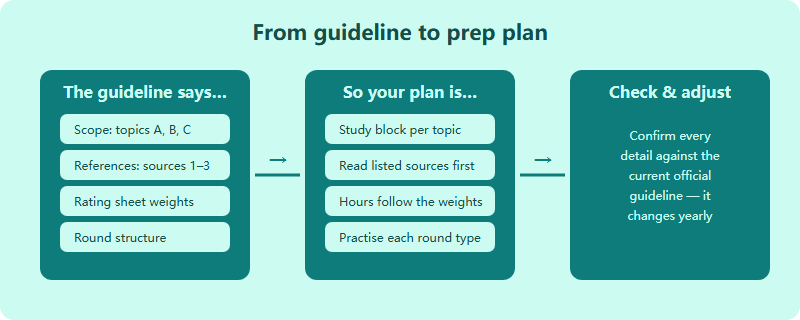
The single highest-leverage thing you can do before preparing for any HOSA event is to read that event's official guideline properly. The guideline is not fine print — it tells you what will be tested, which references to study, how the rounds run, and how points are awarded. This article shows how to read one and reverse-engineer it into a prep plan. Always work from your own event's current guideline on hosa.org, because details change yearly.
Why the guideline beats any prep shortcut
Students routinely start prep by searching “how to win [event]” and collecting random resources. That is backwards. Every HOSA competitive event has an official guideline document published by the organisation, and it is the authoritative source for what actually counts. Two competitors with equal knowledge but unequal guideline-reading will get very different scores, because one studied the wrong things.
If you have not chosen an event yet, start with our overview of what HOSA Future Health Professionals is and the SKT-iHOSA ATC / CCE / BCE track framing, then come back here to decode the specific event you land on.
The parts of a guideline you must find
Guideline documents are not identical across events, and formats are revised over time, so treat the list below as the map of what to look for rather than a fixed template — confirm the exact sections in your event's current document. In general, look for these components.
| Section to find | The question it answers | What to do with it |
|---|---|---|
| Event overview / summary | What is this event really about? | Confirm it matches your strengths and goals |
| Eligibility & division | Am I allowed to enter, and in which division? | Check grade/level before investing time |
| Round structure | Is there an online test, a skill, a presentation, or a mix? | Decide where your prep hours go |
| Knowledge test scope | What topics can the test cover? | Turn each topic into a study block |
| References / reading list | Which sources are questions drawn from? | Study these first, not random material |
| Rating sheet / rubric | Exactly how are points awarded? | Rehearse to the point weightings |
| Attire, materials, deadlines | What are the logistics and cut-offs? | Put every date on a calendar |

Read the references list before you study anything
The most common wasted effort in HOSA prep is studying material the event never draws from. Many knowledge events specify the sources questions are based on. If your event lists references, those references are your syllabus — not a textbook a friend recommended. Read the list first, secure the sources, and only then build study blocks. If the guideline does not fully specify sources, that is itself information: prepare broadly around the stated scope and confirm anything ambiguous on the official site rather than guessing.
For context, the iHOSA online Round One for the ATC foundational cluster is a 45-minute test of 45 multiple-choice questions plus 5 tiebreaker questions, covering biology, chemistry and psychology. Even with a known structure like that, the guideline's scope statement tells you how to split your hours across the three subjects — don't assume an even split without checking the current scope.
Let the rating sheet set your hours
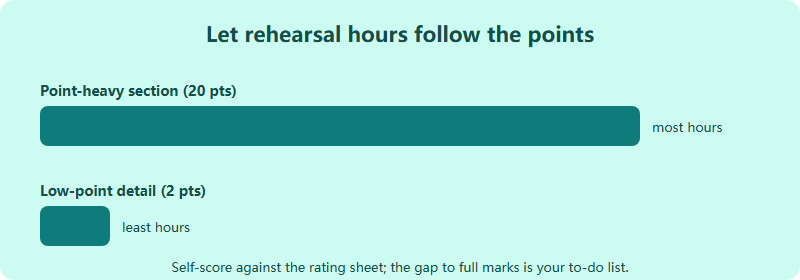
If your event has a rating sheet or rubric, it is the closest thing to an answer key you will ever get. It shows which components carry the most points — and therefore where your practice hours pay off most. A simple, honest way to allocate time is to weight your prep roughly toward the highest-scoring components rather than the parts you personally enjoy.
- Find the point-heavy sections. The categories worth the most points deserve the most rehearsal, even if they feel less fun.
- Rehearse in the graded order. For skills and presentations, the rubric often implies a sequence — practise the steps in that order so nothing is missed under pressure.
- Self-score against the rubric. Grade your own mock run using the actual rating sheet; the gap between your score and full marks is your to-do list.
- Do not over-optimise low-point items. Perfecting a 2-point detail while a 20-point section is shaky is a classic misallocation.
Turn the guideline into a dated calendar
Once you have decoded scope, references, round structure, and weights, convert them into dates. Work backwards from the season's key deadlines and confirm each date on the official site — do not rely on last year's calendar.
| Guideline input | Calendar action |
|---|---|
| Registration & submission deadlines | Anchor points — everything else is scheduled backwards from these |
| Online round date | Set a target date to finish first-pass content review before it |
| References list | Block reading weeks per source, hardest first |
| Rating-sheet weights | Assign rehearsal hours in proportion to points |
| Conference component | Reserve final weeks for timed, full-run rehearsal |
This method is what separates efficient competitors from busy ones. It also protects you from the biggest risk in any competition prep: preparing hard for the wrong thing. When you are ready to see how the decoded rounds culminate at the international level, our ILC 2026 guide shows what the conference stage looks like in practice.
Frequently asked questions
Where do I find the official guideline for my event?
Event guidelines are published by HOSA on hosa.org. Always use the current-season version, since scope, references and rating sheets are revised yearly.
What if my event doesn't list specific references?
Prepare broadly around the stated scope and confirm anything ambiguous on the official site rather than guessing from other events' sources.
How do I use the rating sheet for a test-only event?
Use the scope statement instead: turn each listed topic into a study block and weight your hours toward the broadest topics. Verify the scope on the official guideline.
Do guidelines differ for international students?
International students compete through the SKT-iHOSA pathway; confirm your cohort's specific event rules, dates and format with the organiser, as they can differ from the national defaults.
Published by the HOSA (SKT-iHOSA) editorial desk, operated by Hanlin Education for China-based international-school students. Official rules are set by the competition and change yearly — confirm current details on hosa.org. Errors are corrected within 7 working days.

Oct 20, 2026
iHOSA ATC Division I vs II: Allocating Study Time by Weighting Differences
Students in grades 9-10 and 11-12 face different topic weightings in the iHOSA ATC Biology and Chemistry exams. This guide breaks down…
Oct 17, 2026
iHOSA Biology Explanations: Connect a Feedback Loop to a Change in the Body
Mastering negative and positive feedback loops is essential for iHOSA Biology. Learn how to connect physiological mechanisms to observable changes with worked…
Oct 15, 2026
iHOSA Health Education: Test Whether an Audience Understood Your Message
In iHOSA Health Education, testing whether your audience understood your message is not an afterthought—it is the core deliverable. Learn how to…