Choosing your iHOSA 2027 ATC subject well can save you months of wasted revision. Because the ATC academic track — biology, chemistry and behavioural health/psychology — has been re-aligned to the AP, IB and A-Level syllabuses, the smartest move is to pick the subject that overlaps your own course the most, then study only the gap. This guide turns the published overlap figures into a subject-by-subject plan. Figures are per Hanlin (SKT-iHOSA); confirm current details on the official channels.
What choosing your ATC subject actually decides
The ATC (Foundational Studies) track is iHOSA's individual, exam-style route: you sit a timed objective test rather than build a team project. If you are new to how ATC sits next to the clinical (CCE) and public-welfare (BCE) routes, our ATC vs CCE vs BCE track guide maps all three, and the What Is HOSA overview explains the wider organisation. Within ATC, your subject choice decides three things at once:
- How much of your prep doubles as school revision. A high-overlap subject means the hours you spend also reinforce your AP, IB or A-Level exams — the same body of work counts twice.
- How much new, off-syllabus content you must learn. A low-overlap subject leaves a bigger gap to close from scratch, which costs time you may not have.
- Where your marginal effort goes. Once you know your overlap, you can stop re-reading what you already know and spend your hours on the slice that is genuinely new.
In other words, the subject decision is really a time-budget decision. Pick the subject that lets your existing course carry the most weight, and you enter the season with a head start instead of a deficit.
Overlap by subject and curriculum: the numbers that should drive your pick
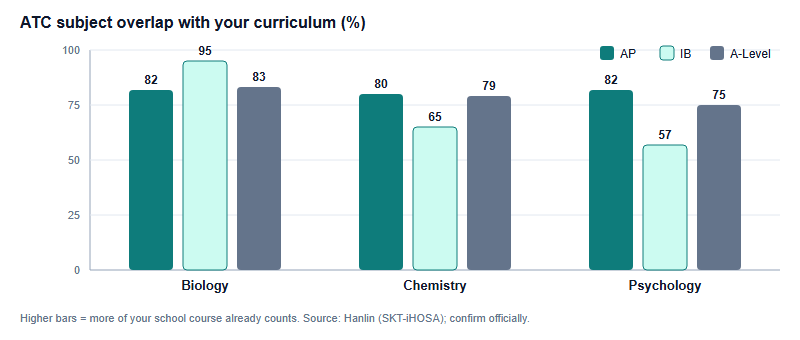
For the 2027 season, Hanlin (SKT-iHOSA) has published how closely each ATC subject overlaps each mainstream curriculum. Treat these as a guide to direction and scale rather than a fixed contract — the exact syllabus is set by the organiser and confirmed officially — but the pattern is clear and useful:
| ATC subject | AP overlap | IB overlap | A-Level overlap | Your best-overlap curriculum |
|---|---|---|---|---|
| Biology | 82% | 95% | 83% | IB (very high across all three) |
| Chemistry | 80% | 65% | 79% | AP / A-Level |
| Behavioural Health / Psychology | 82% | 57% | 75% | AP |
How to read the numbers by your curriculum
The same table points to a different answer depending on the course you already take. Read down your own column, not across:
- If you take IB: biology is the standout. At roughly 95% overlap it is far ahead of chemistry (65%) and psychology (57%), so an IB student who is comfortable in biology gets the largest free reinforcement by choosing it. Picking IB psychology for ATC, by contrast, means learning a large new slice from scratch — only worth it if psychology is a genuine passion or your strongest subject.
- If you take AP: the three subjects sit close together (biology 82, chemistry 80, psychology 82). Overlap will not decide it for you, so choose by strength and interest instead — the subject you score highest in and enjoy revising will carry you further than a marginal percentage.
- If you take A-Level: biology (83) and chemistry (79) both overlap well, with psychology a little lower (75). An A-Level student should usually lead with their strongest science; the small gap between biology and chemistry is easily outweighed by which one you actually find easier.
One caution: overlap is not the only input. A subject you find genuinely interesting will get more focused hours than a marginally higher-overlap subject you dread. Use the numbers to break ties and to warn you off a low-overlap choice you were not committed to — not to override a strong, motivated preference.

From overlap to a study plan: a four-step method
Knowing your overlap is only useful if it changes what you study. The method below converts a percentage into a plan — the whole point is to stop re-reading what you already know and spend your marginal hours on the new slice and on test tempo.
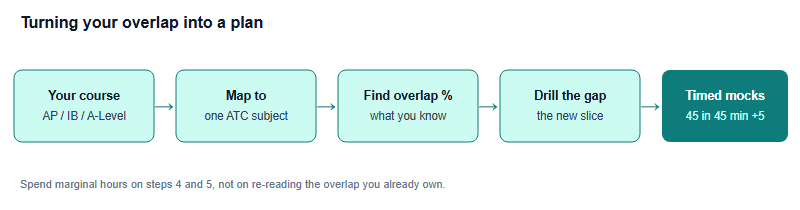
- Map your course to one ATC subject. Line up your syllabus against the ATC subject you have chosen. Most chapters will match; that is your overlap.
- Mark the overlap as “maintain, not relearn.” For a 90%-overlap pairing, the large majority of the paper is content you meet in class anyway. Keep it warm with light review; do not spend fresh weeks re-teaching yourself topics you already sit exams on.
- Isolate the non-overlap gap and attack it first. The 5–35% that your course does not cover is where marks are quietly lost. List those topics explicitly and learn them from the named references before anything else.
- Rehearse the format under time. The ATC round is fast; you must practise the tempo, not just the content (see the next section).
Closing the non-overlap gap: where marks are actually won
Every ATC subject leaves a slice your school course does not touch — larger for low-overlap pairings, smaller for high-overlap ones, but never zero. Two disciplines make the difference here:
- Name the gap on paper. Do not carry it in your head. Write the exact list of topics that appear in the ATC references but not in your syllabus, and tick them off as you learn them. A written gap list is the single most useful prep artefact most students never make.
- Work from the named references, not from random reading. Off-syllabus reading feels productive but does not score. Anchor the gap work to the material the competition actually draws from, and confirm the current reference list on the official channels each season, because it can change.
For a deeper look at pacing and the tie-breaker items specifically, our competition guides and the wider iHOSA resource set are worth reading once you have settled your subject. The stronger your gap work, the more the timed round rewards you.
What you are preparing for on test day
The ATC assessment is an individual, timed objective test. Per Hanlin (SKT-iHOSA), the 2027 online round runs as 45 single-answer multiple-choice questions in 45 minutes, plus 5 tie-breaker questions, across the ATC subjects (biology–chemistry–psychology). Confirm the current format officially, as it can be revised year to year.
| Element | Detail (per Hanlin, confirm officially) | What it means for prep |
|---|---|---|
| Scored questions | 45 single-answer MCQs | Roughly one minute each — rehearse a steady tempo |
| Time limit | 45 minutes | No room to agonise; train quick recognition |
| Tie-breakers | 5 additional questions | They separate clustered students — practise the hardest items, do not skip them |
| Format | Individual, online, objective | Solo recall under time, not a team or project skill |
The practical takeaway: a strong subject choice plus a tight gap list gets you the content; timed mock practice at the real tempo gets you the marks. Do both, and your ATC prep stops competing with your school exams and starts reinforcing them.
Frequently asked questions
Which ATC subject overlaps my course the most?
For IB students, biology (about 95%) is far ahead. For AP and A-Level students the three subjects are closer, so pick by strength. Confirm the current figures officially.
Should I choose my ATC subject only by overlap?
No. Use overlap to break ties and avoid low-overlap choices you are not committed to, but a subject you are genuinely strong in and enjoy will earn more focused hours.
What is the ATC test format for 2027?
Per Hanlin (SKT-iHOSA), the online round is 45 single-answer MCQs in 45 minutes plus 5 tie-breakers. Always confirm current details on the official channels.
Does ATC prep really count as school revision?
Largely, yes — for a high-overlap subject most of the paper is content you meet in class. Spend fresh time on the non-overlap gap and on timed practice.
Published by the HOSA (SKT-iHOSA) editorial desk, operated by Hanlin Education for China-based international-school students. Official rules are set by the competition and change yearly — confirm current details on hosa.org. Any error will be corrected within 7 working days.

Oct 20, 2026
iHOSA ATC Division I vs II: Allocating Study Time by Weighting Differences
Students in grades 9-10 and 11-12 face different topic weightings in the iHOSA ATC Biology and Chemistry exams. This guide breaks down…
Oct 17, 2026
iHOSA Biology Explanations: Connect a Feedback Loop to a Change in the Body
Mastering negative and positive feedback loops is essential for iHOSA Biology. Learn how to connect physiological mechanisms to observable changes with worked…
Oct 15, 2026
iHOSA Health Education: Test Whether an Audience Understood Your Message
In iHOSA Health Education, testing whether your audience understood your message is not an afterthought—it is the core deliverable. Learn how to…