
In a timed HOSA testing event you are being examined twice at once: on health science content, and on how fast you can read clinical English under pressure. Most China-based students train only the first. This guide covers the second layer — medical word roots, question-stem parsing, and the per-question clock — with drills that run alongside your normal revision.
The layer nobody schedules revision for — and the 60-second clock
Ask a student who missed a mark on a knowledge test what went wrong and you will almost always hear a content answer: “I hadn’t covered the endocrine system.” Sometimes that is true. But when you sit with the paper afterwards and go item by item, a large share of the lost marks look different. The student knew the biology. They ran out of clock on question 31. They read “all of the following EXCEPT” as “all of the following”. They stalled for twenty seconds on thrombocytopenia because they had memorised the Chinese term and never the English one.
That is the language layer, and it behaves nothing like a content gap. A content gap is fixed by studying a chapter. A language gap is fixed by drilling a process until it costs you no time at all. The two need separate slots in your week, and the second one is almost always the slot nobody books.
This matters most in the testing side of HOSA. If you are still deciding which side of the competition you sit on, our ATC vs CCE vs BCE track comparison lays out the difference between the foundational testing route, the professional/clinical route and the public-welfare project route. The advice below is aimed squarely at students whose season runs through a multiple-choice paper — and, in a lighter way, at anyone who has to read a clinical scenario quickly in front of judges.
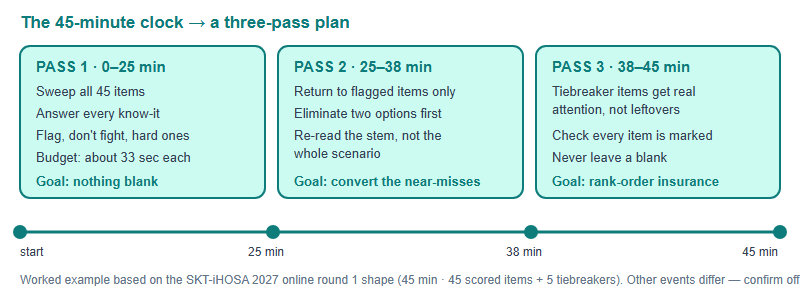
So do the clock maths before you do the biology. Per Hanlin (SKT-iHOSA), the 2027-season online first round runs 45 minutes for 45 scored multiple-choice items plus 5 tiebreaker items, on the ATC foundational subjects — biology, chemistry and psychology. Formats differ by event and by season, so confirm your own event’s timing and item count on the official channels before you build a plan around it. But take that shape as a worked example, because the arithmetic is brutal and clarifying.
Forty-five minutes over 45 scored items is 60 seconds per question — and that is before the tiebreakers. Sixty seconds has to cover reading the stem, reading the options, retrieving the fact, and marking an answer. If a single item eats three minutes, you have silently borrowed two minutes from two other questions you would have answered correctly. The most expensive mistake in a timed paper is not a wrong answer; it is an unanswered question at the bottom of the page that you could have got right in forty seconds.
So the first skill is not knowledge. It is triage: deciding, within about ten seconds of reading a stem, whether this item is a know-it, a work-it, or a leave-it, and behaving accordingly.
Build a morpheme engine, not a vocabulary list
Chinese students often prepare English medical vocabulary the way they prepare a language exam wordlist: term on the left, Chinese gloss on the right, memorise, repeat. It works for the terms on the list and fails completely on the term that isn’t. In a health science paper, the term that isn’t on your list is guaranteed to appear.
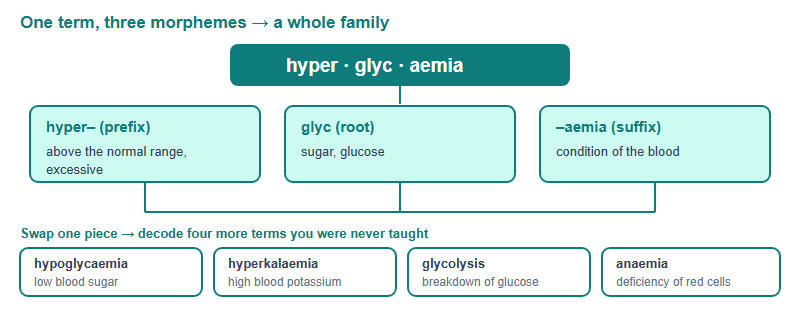
The alternative is to learn the machinery instead of the output. Clinical English is built from a small, closed set of Greek and Latin morphemes — prefixes, roots and suffixes — that recombine endlessly. Learn roughly sixteen of them properly and you can decode several dozen terms you have never seen, in about two seconds each, without translating anything.
| Morpheme | Type | Meaning | Terms it unlocks |
|---|---|---|---|
| hyper– | prefix | above, excessive | hypertension, hyperglycaemia, hyperkalaemia |
| hypo– | prefix | below, deficient | hypotension, hypoglycaemia, hypothermia |
| tachy– / brady– | prefix | fast / slow | tachycardia, tachypnoea, bradycardia |
| dys– | prefix | difficult, painful, abnormal | dyspnoea, dysphagia, dysplasia |
| cardi/o | root | heart | cardiology, myocardium, endocarditis |
| nephr/o, ren/o | root | kidney | nephron, nephritis, renal failure |
| hepat/o | root | liver | hepatitis, hepatomegaly, hepatic |
| leuk/o | root | white | leukocyte, leukaemia, leukopenia |
| –itis | suffix | inflammation | nephritis, hepatitis, arthritis |
| –aemia / –emia | suffix | blood condition | anaemia, hypoxaemia, leukaemia |
| –penia | suffix | deficiency | leukopenia, thrombocytopenia |
| –megaly | suffix | enlargement | cardiomegaly, splenomegaly |
| –pnoea / –pnea | suffix | breathing | apnoea, dyspnoea, tachypnoea |
| –ectomy / –otomy | suffix | removal / incision | appendectomy, nephrectomy, tracheotomy |
Fourteen entries in that table generate more than forty terms — and the generative ratio keeps climbing as you add roots. That is why a morpheme engine beats a wordlist: the list ends, the engine doesn’t. Note that both British and American spellings circulate in health science material (anaemia / anemia, dyspnoea / dyspnea); recognise both and don’t lose a second deciding which one is “correct” in an exam.

Read the stem like a clinician, not like a reader
The second language skill is stem parsing. Health science items are rarely simple recall; they are written to check whether you can locate the actual question inside a paragraph. Non-native readers lose marks here in a very specific way — they read for meaning (which is slow and thorough) instead of reading for the instruction (which is fast and targeted).
The fix is a habit: read the last line of the stem first, then go back for the scenario only if you need it. Then hunt for the qualifier word. Six qualifier families cause most of the damage.
| Stem wording | What it is actually asking | Typical ESL failure |
|---|---|---|
| “All of the following EXCEPT” | Find the one that does not belong | Marks the first true statement and moves on |
| “LEAST likely” / “NOT” | Invert the whole search | Negative is skimmed past at speed |
| “BEST initial action” / “FIRST” | Ordering, not correctness | Picks a correct-but-later step |
| “MOST likely cause” | Probability, not possibility | Picks a rare but technically possible cause |
| “primarily” / “mainly” | The dominant mechanism | Picks a real but secondary contributor |
| “in this patient” / “in this scenario” | Apply the vignette details | Answers the textbook-general version |
Drill this the cheap way: take a set of practice items and, without answering a single one, spend ten minutes circling the qualifier in every stem and writing the question in five plain words. If you do not have material to drill on, we keep our own gathered pack of practice items and medical-terminology lists for China-based students — ask us for it, or start from our resources page. You are not studying content; you are installing a reflex. Ten minutes a day for two weeks will do more for a timed paper than another chapter of revision.
Break the translation loop
The most expensive habit a bilingual student brings into a timed English paper is the silent round trip: read English → translate to Chinese → retrieve the fact in Chinese → translate the option back to English. Each loop costs a few seconds. Across forty-five items it costs you the paper.
Breaking the loop is a storage problem, not a willpower problem. If you learned the cardiac cycle in Chinese, the fact is filed in Chinese and English retrieval will always route through translation. Three practical countermeasures:
- Revise output-side in English. Read in whatever language you like, but write your summaries, flashcard answers and diagram labels in English only. Retrieval practice is what fixes the storage language.
- Keep one bilingual bridge column, then retire it. A Chinese gloss is useful when a concept is genuinely new. Cover it after two weeks; if you still need it, the concept is not learned.
- Practise at exam speed, not at study speed. Comfortable reading is around 30–40 seconds per item; you need the version that survives at 60 seconds with a clock running. Those are different skills and only one of them is tested.
If your track is CCE or another judged, clinical route rather than a pure paper, the same principle applies with the volume turned up — you also have to speak the terminology to a judge. Our guide to what HOSA is and how the competition is structured explains where each route sits in the season.
An eight-week language plan that runs beside your content revision
None of this should replace subject revision. It should sit next to it in 20-minute blocks. The plan below assumes you already have a content schedule and just need somewhere to put the language work.
| Weeks | Language focus (20 min/day) | Weekly checkpoint |
|---|---|---|
| 1–2 | Morpheme engine: 8 prefixes/suffixes per week, decode-only drills (no Chinese) | Decode 20 unseen terms in 2 minutes |
| 3–4 | Stem parsing: circle the qualifier, restate the question in five words | 30 stems restated with zero misreads |
| 5–6 | Timed blocks of 15 items at 60 seconds each; log every error by type | Error log shows cause, not just score |
| 7–8 | Full-length simulations under the real clock, including the tiebreaker block | Nothing left blank; pass 1 finishes on time |
The error log is the part students skip and the part that does the work. Give it five columns: item number, my answer, correct answer, cause, fix. Cause must be one of five — content gap, misread stem, unknown term, pacing, careless. After two weeks the distribution tells you what to train. A log that is 60% “unknown term” means your content revision is fine and your morpheme engine isn’t built yet; a log that is 60% “pacing” means you need pass-one discipline, not more biology.
One last note on tiebreakers. Where a format includes separate tiebreaker items — as the 2027 SKT-iHOSA online round does, per Hanlin — treat them as real questions with real consequences, because they exist precisely to separate students who scored the same. The temptation is to arrive at them exhausted with ninety seconds left. Build them into pass three deliberately, and confirm how your own event applies them on the official channels. Rules are set by the competition and change from season to season; the reflexes in this guide do not — and they keep paying out at every level above the qualifying round, as our ILC complete guide shows.
Frequently asked questions
How long should I spend per question?
On a 45-minute, 45-item paper the average is 60 seconds. Aim for about 33 seconds on the first sweep so you bank time for hard items.
Should I memorise Chinese glosses for medical terms?
Use them only for genuinely new concepts, then retire them. Storing facts in Chinese forces a slow translation loop during an English paper.
Do tiebreaker items count towards my score?
They exist to separate equal scores rather than to pad totals. Treat them seriously and confirm how your event applies them on the official channels.
Is vocabulary work really worth taking time from biology?
Yes, if your error log shows unknown terms or misread stems. Keep it to 20 minutes a day beside, not instead of, content revision.
Published by the HOSA (SKT-iHOSA) editorial desk, operated by Hanlin Education for China-based international-school students. Official rules are set by the competition and change yearly — confirm current details on hosa.org. Any error will be corrected within 7 working days.

Oct 20, 2026
iHOSA ATC Division I vs II: Allocating Study Time by Weighting Differences
Students in grades 9-10 and 11-12 face different topic weightings in the iHOSA ATC Biology and Chemistry exams. This guide breaks down…
Oct 17, 2026
iHOSA Biology Explanations: Connect a Feedback Loop to a Change in the Body
Mastering negative and positive feedback loops is essential for iHOSA Biology. Learn how to connect physiological mechanisms to observable changes with worked…
Oct 15, 2026
iHOSA Health Education: Test Whether an Audience Understood Your Message
In iHOSA Health Education, testing whether your audience understood your message is not an afterthought—it is the core deliverable. Learn how to…