
If your HOSA season ended before you wanted it to, the useful question is not “was I good enough” but “which gate did I stall at, and why”. A season fails at exactly one of four points, and each has a different fix. August is the right month to run that post-mortem, because the new guidelines land on 1 September and your decisions have to be made before then.
First, name the gate — because the fixes are not interchangeable
Most students summarise a disappointing season in one sentence: “I didn’t do well enough on the test.” That sentence hides four completely different situations, and treating them the same is why second seasons so often look like first seasons.
The season is a sequence of gates. You register and confirm eligibility; you sit a qualifying round; if you advance, you compete in a judged conference round; and from there the path leads to the international stage. HOSA lists State Conferences and the International Leadership Conference among its competition venues, and publishes the rules for each level in its General Rules and Regulations and event guidelines. The exact structure and level names vary by region and season, so confirm your own pathway on the official channels — but the shape below holds well enough to diagnose from.
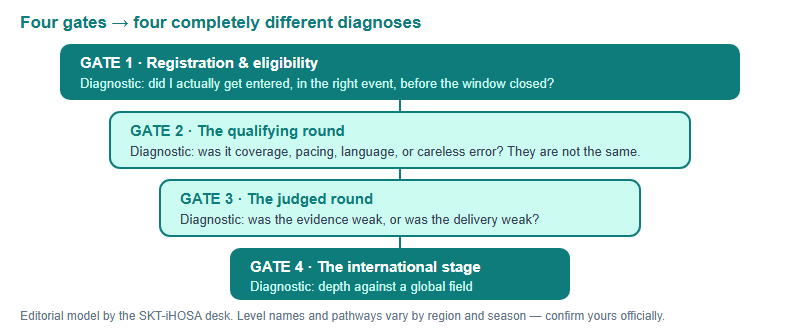
Gate 1 deserves a sentence of its own, because it is the most demoralising and the most preventable. Every season, students who prepared properly never sit anything, because a registration window closed while the family was still deciding, or the event chosen turned out not to match the student’s division or eligibility. If that was you, your entire fix is administrative: put next season’s window in a shared family calendar with a two-week early alarm, and confirm eligibility for your chosen event in writing before you prepare for it. Nothing about your ability is in question.
Diagnosing the two gates where most students actually stall
Gates 2 and 3 account for the overwhelming majority of early exits, and each splits into sub-causes with different remedies. Work through the symptom column honestly — ideally with your paper, your notes, or your team’s feedback in front of you rather than from memory.
| Gate | Symptom you remember | Likely cause | The fix that actually changes the result |
|---|---|---|---|
| 2 | Blanks at the bottom of the paper | Pacing, no triage system | Three-pass discipline; timed blocks with a per-item budget |
| 2 | Practice scores fine, test-day score low | You never rehearsed full length under a clock | Full-length simulations, same time of day, no pauses |
| 2 | Errors cluster in one or two topics | Genuine coverage gap | Targeted content work on those topics only — not a full re-read |
| 2 | Errors scattered; “I knew that one” | Stem misreads and careless marking | Qualifier drills (EXCEPT, LEAST, BEST initial) and a typed error log |
| 2 | Slowed down by unfamiliar English terms | Language layer, not content | Medical word-root decoding, revision written in English |
| 3 | Judges asked simple questions you fumbled | Thin depth behind a polished deliverable | Build a bank of 20 likely questions; answer each aloud in 60 seconds |
| 3 | Ran badly over or under time | Never rehearsed against a timer | Rehearse to the clock in front of someone who is not on the team |
| 3 | Materials looked excellent, scored mid | Optimised for aesthetics, not the rubric | Map every rubric line to a specific section, then cut what maps to nothing |
| 3 | Team understood it but could not say it | Delivery under pressure, often language load | Script and memorise the first 60 seconds; rehearse standing, aloud |
| 3 | Impressive project, no measurable reach | Scope without a real audience | Design for a defined audience from week one and record what happened |
Notice how many of the gate-2 rows are not content problems. That is the single most common misdiagnosis we see: a student re-reads an entire textbook over the summer to fix what was actually a sixty-second-per-question pacing failure, and arrives at the next season with better knowledge and the identical result. If you cannot tell which row you are in, that itself is the finding — you need an error log next season, with a cause column, from day one.
For gate 3, the sharpest question to ask your team is: would a judge who had never met us understand what we did, why it mattered, and what happened, in ninety seconds? If the answer needs the full deck, your evidence is fine and your framing is not.

Repeat, switch event, or switch track?
This is the decision that August exists for, and the instinct to “try something new” is usually wrong. Repeating the same event with a changed method is the highest-return option for most students, because you keep a year of accumulated content and lose only the mistakes. Switching burns the knowledge and restarts the learning curve — which is right only when the mismatch was structural rather than tactical.
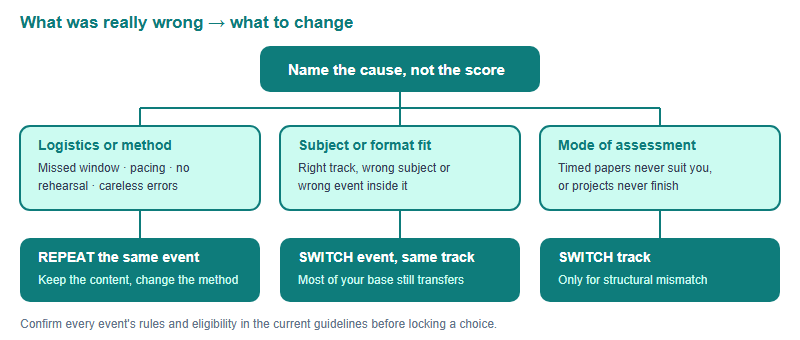
Two honest cases for switching. The first is subject fit: you were on the foundational testing route in a subject your school course does not support, and the gap was too wide to close in a season. Moving to another subject or another event in the same track keeps most of your base. The second is mode fit: some strong students simply do not perform on a 45-minute multiple-choice paper — per Hanlin, the 2027 SKT-iHOSA online round runs 45 minutes for 45 scored items plus 5 tiebreakers — but perform very well when they build and defend something over months. That student belongs on a project or clinical route, and our ATC vs CCE vs BCE comparison is the right place to make that call. HOSA also publishes distinct competitive event categories — Health Science, Health Professions, Emergency Preparedness, Leadership, Teamwork and Recognition Events among them — so the range of formats is wider than most students realise. Browse the full catalogue on our competitive events page, then confirm the current season’s list and rules on hosa.org.
What is not a good reason to switch: the belief that another event is easier. Every event is competitive at the level where advancement is decided, and chasing a soft option usually means starting a new learning curve with the same habits that cost you the last season.
What survives a season that ended early
More than students expect, and less than marketing suggests. Nobody can promise that a competition result — good or bad — will move a university decision, and you should be wary of anyone who says otherwise. What does survive is concrete:
- The knowledge. A term of structured health science reading is real, whether or not it converted into a placement. It carries into your school course and into next season.
- The artefacts. Project work, service records, presentation materials and any measurable outcome exist independently of the result. Save them properly now, with dates and evidence, while you still remember the details.
- The habits. An error log, a rehearsal routine, the ability to read a rubric — these transfer to every timed assessment you will sit, including school exams.
- The honest story. “I ran a public-health project, learned that our reach was too narrow, and redesigned it” reads better than a medal with nothing behind it. Write about the work, not the placement.
Do this bookkeeping in the first week of August while the memory is fresh. A one-page record — event entered, what you built, what happened, what you learned — is worth more in twelve months than a folder of files you can no longer explain.
A six-week reset: August to mid-September
The calendar does the deciding here. HOSA states that the 2026–2027 Guidelines will be released on 1 September 2026, so the four weeks before that date are for diagnosis and base-building, and the two after are for locking choices against the actual rules. Do not buy materials or finalise an event before the guidelines publish — references and requirements can change between seasons.
| Week | Focus | Output you should be able to show |
|---|---|---|
| 1 (early Aug) | Post-mortem: name your gate and cause | One page: gate, cause, evidence, what you will change |
| 2 | Rebuild the identified base — content gap, pacing, or delivery | A daily 20–40 minute slot that is actually running |
| 3 | Event research: shortlist two options, check eligibility and division | A two-option shortlist with reasons, not a single assumption |
| 4 | Install the missing method (error log, rehearsal routine, project scoping) | The system exists on paper and has been used once |
| 5 (from 1 Sept) | Guidelines drop: audit changes against your shortlist, then decide | Event locked, with the current rules read end to end |
| 6 | Registration preparation (see the China pathway page) and calendar the window | Deadline in a shared calendar with a two-week alarm |
Set the far end of the runway too. Per hosa.org, the next International Leadership Conference runs 22–25 June 2027 at the Pennsylvania Convention Center in Philadelphia — useful not because you should assume you will be there, but because a student who can see the end of the road plans the middle of it better. Those are the conference dates; a China-based delegation’s own programme window can sit a day either side, so confirm yours with the operator before booking travel. Our ILC guide shows what that level actually demands, which is a healthy reality check to read in August rather than in May.
One closing thought. A season that ends at gate 2 is the most common outcome in any competition with a qualifying round; it is not a verdict on whether you belong in health science. The students who improve most between seasons are almost never the ones who worked hardest over the summer — they are the ones who correctly identified what went wrong before they started working.
Frequently asked questions
Should I repeat the same event or try a new one?
Repeat if the cause was pacing, logistics or rehearsal. Switch only if the subject or the whole assessment format genuinely did not fit you.
When can I plan next season properly?
HOSA states the 2026–2027 Guidelines publish on 1 September 2026. Diagnose and rebuild in August; lock your event after they land.
Is a season worth anything if I didn't advance?
The knowledge, artefacts and habits survive the result. Record what you built and learned now, and write about the work rather than the placement.
How do I know if it was pacing or a content gap?
Look at where the errors sit. Blanks at the end mean pacing; errors clustered in one topic mean coverage. Scattered errors usually mean misread stems.
Published by the HOSA (SKT-iHOSA) editorial desk, operated by Hanlin Education for China-based international-school students. Official rules are set by the competition and change yearly — confirm current details on hosa.org. Any error will be corrected within 7 working days.

Oct 20, 2026
iHOSA ATC Division I vs II: Allocating Study Time by Weighting Differences
Students in grades 9-10 and 11-12 face different topic weightings in the iHOSA ATC Biology and Chemistry exams. This guide breaks down…
Oct 17, 2026
iHOSA Biology Explanations: Connect a Feedback Loop to a Change in the Body
Mastering negative and positive feedback loops is essential for iHOSA Biology. Learn how to connect physiological mechanisms to observable changes with worked…
Oct 15, 2026
iHOSA Health Education: Test Whether an Audience Understood Your Message
In iHOSA Health Education, testing whether your audience understood your message is not an afterthought—it is the core deliverable. Learn how to…