
Your HOSA project can have a second life as an Extended Essay, EPQ, AP Research paper or school capstone, but only if you plan the handover before the season closes. HOSA's own rules require new content every competition year, materials submitted at the conference can become HOSA property, and rating sheets are never returned. The conversion is therefore an archiving problem first and a writing problem second.
Why your HOSA work needs a second home (and why HOSA will not take it twice)
Most students finish a season with a genuinely valuable body of work: a research question they lived with for months, a literature base, a data set or survey, figures, and a set of arguments they have already defended out loud. Then it sits in a folder and dies.
Part of the reason is a rule almost nobody reads until it bites. HOSA's General Rules and Regulations (August 2025), published on hosa.org, state under Content from Year to Year that "Content for all competitive events must be unique and new each membership/school year. Content used in a previous membership year's competition may not be used again." The stated intent is "to use new material every year," and a discovered violation carries 35 penalty points deducted in tabulations.
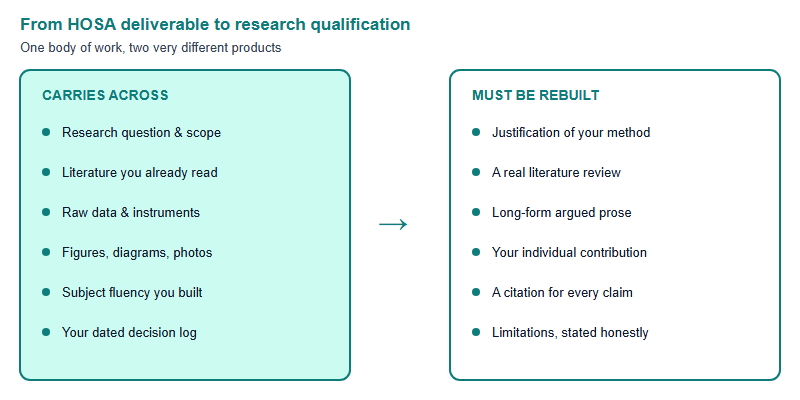
Read that plainly: recycling last year's project into this year's HOSA entry is not a shortcut, it is a scoring risk. The productive move is the opposite direction. Retire the work from competition and move it into a qualification that actively rewards depth on a single question. That is exactly what the IB Extended Essay, the AQA Extended Project Qualification, AP Research and most school capstones are built to assess.
Note that these are HOSA's international rules. The iHOSA China round is operated separately as SKT-iHOSA, and its own submission and content terms may differ, so confirm the current wording on the official iHOSA channels and on hosa.org before you rely on any of it. If you are still working out which track produces reusable material at all, start with our breakdown of ATC versus CCE versus BCE, and with the overview of what HOSA is.
Capture before you submit: five artefacts you cannot get back
Two more rules make in-season archiving urgent rather than optional.
First, Material Submission: unless an event guideline says otherwise, copies and materials submitted at the International Leadership Conference "become the property of HOSA-Future Health Professionals," and submission implies consent for HOSA and affiliated partners to publish those materials for promotion. Second, Rating Sheets and Test Scores: participant rating sheets and test scores are HOSA property and "will NOT be returned or released."
So the feedback you most want for a rewrite, the judges' annotated sheet, is the one thing you will never hold. Build your own record instead, during the season, not after:
- The master file. Your own editable original of every board, deck, notebook or report, saved before anything is printed, mounted or uploaded.
- Raw data and instruments. Survey forms, response exports, interview notes, measurement logs, with dates. Aggregated charts are not data.
- The source list with links. Every study, statistic and guideline you drew on, captured at the moment you used it, not reconstructed nine months later.
- Your own photographs. Of the display, the setup, the equipment, taken by you.
- A dated decision log. Two lines per working session on what you tried and why you changed direction. This is the single hardest thing to fake afterwards and the single most useful thing for an EE reflection or an EPQ production log.
If your season ends at a conference, do this capture the week before you travel. Our ILC guide covers what conference week actually looks like, and the honest answer is that you will not be organising files on the day.

Matching the work to the right qualification
Different qualifications want different shapes. A public-health project with survey data is a natural AP Research or EPQ; a conceptual argument about health policy sits better as an Extended Essay. The table below is a planning aid, not a specification. Published requirements change, so confirm current word counts, deadlines and components with your DP coordinator, EPQ supervisor or Capstone teacher before you commit.
| Qualification | Typical written form | What you must add on top of HOSA work | Best-fit HOSA starting material |
|---|---|---|---|
| IB Extended Essay | Formal essay of up to about 4,000 words | A narrow research question, sustained argument, supervisor reflection sessions | A BCE project or a concept-led CCE topic |
| AP Research | Academic paper of roughly 4,000–5,000 words, plus presentation and oral defence | Explicit method justification and a defensible gap in existing work | Any project where you collected your own data |
| AP Seminar | Shorter individual written argument plus team components | Multiple-perspective analysis rather than one recommendation | Health-policy or public-health arguments |
| AQA EPQ | Written report broadly in the 1,000–5,000 word range, around 5,000 for a research report, plus production log and presentation | Disciplined logging and an evaluation of your own process | Almost any sustained BCE or CCE body of work |
| School capstone or personal project | Set by your school | Whatever your school's rubric weights most | Service, outreach and chapter-level work |
One structural warning. Subject Internal Assessments in IB sciences usually require your own individually designed investigation with your own data, so a team HOSA project rarely converts cleanly into an IA. Treat ATC subject knowledge as revision fuel for those courses instead, and route project work towards EE, EPQ, AP Research or capstone.
The integrity checks nobody warns you about
This is where conversions go wrong, and the failures are boring rather than dramatic.
Team-to-individual attribution. HOSA runs many project events in teams, and its rules on independent work carve out team events explicitly: outside team events, "competitors must work independently, without assistance from judges, teachers, fellow students, or observers." A qualification that assesses you individually needs the opposite discipline. Before you write a word, name in your own log which sections of the analysis, which instruments and which figures are yours, and say so openly in the submission. Co-authored data can usually be used with acknowledgement; co-authored argument cannot be presented as yours.
Dual submission. Most programmes restrict submitting the same piece of work for more than one assessed component. Reusing your research and data is normally fine; reusing an already-submitted text is normally not. Ask your coordinator the question directly and in writing.
Citation debt. A competition board can carry a claim with a small source line. A 4,000-word paper cannot. Every number you kept from the HOSA version needs its source traced again before it goes into an academic draft. If you cannot find where a statistic came from, cut it rather than guess at a citation.
Human data. If your project involved surveys, interviews or any personal information, check consent and de-identification again before republishing. HOSA's rules already push in this direction: competitors are told to use good judgment on content, and material "of a highly personal nature should be avoided and may not be judged."
A six-week conversion plan, and why to start it now
Six focused weeks is a realistic budget for a strong first full draft if the archive exists. Without the archive, add two weeks of reconstruction, which is precisely the cost you avoid by capturing during the season.
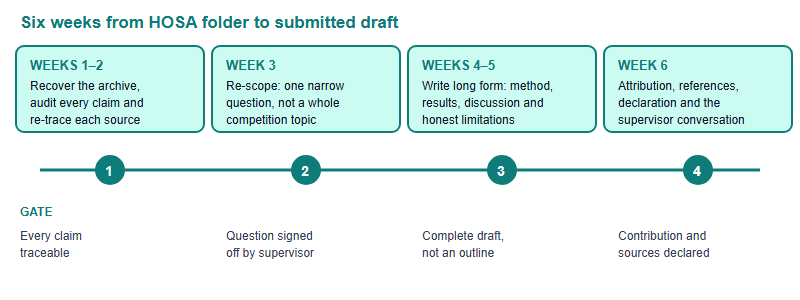
The awkward truth about this workflow is that the highest-value step, the archive, has to happen when you are least motivated to do it: the week you are exhausted and the season is ending. Everything after that is ordinary academic work.
The operator has flagged 20 August 2026 as the next HOSA-related date for the China cohort. Confirm exactly what it covers and its precise terms on the official iHOSA and SKT channels before treating it as a deadline for anything, but treat it as a useful prompt: if a new season is about to start, close out the old one properly first. Anything you intend to carry into an EE, EPQ or capstone should be archived and, per the content rule above, retired from competition rather than resubmitted.
Across recent seasons, students we have worked with have taken ATC biology and chemistry national medals and a behavioural-health national bronze and several advancements to the global round (per Hanlin, de-identified, results vary). The pattern behind the ones who also got a strong EE or EPQ out of it is unglamorous: they kept their own files.
FAQ
Can I enter the same project in HOSA twice?
No. HOSA's rules require new content each membership year, and a discovered violation carries 35 penalty points. Confirm the iHOSA China-round wording on official channels.
Will I get my judges' rating sheet back to guide a rewrite?
No. HOSA states that rating sheets and test scores are its property and will not be returned or released, so build your own evidence record during the season.
Can a team HOSA project become my individual Extended Essay?
Usually only in part. Reuse shared data with acknowledgement, but the research question, analysis and writing must be demonstrably yours. Ask your coordinator first.
Which HOSA track produces the most reusable material?
Project-based BCE work usually converts most easily, because it already has a question and evidence. ATC subject knowledge is better used as course revision than as a paper.
Published by the HOSA (SKT-iHOSA) editorial desk, operated by Hanlin Education for China-based international-school students. Official rules are set by the competition and change yearly, so confirm current details on hosa.org. Errors are corrected within 7 working days.

Oct 20, 2026
iHOSA ATC Division I vs II: Allocating Study Time by Weighting Differences
Students in grades 9-10 and 11-12 face different topic weightings in the iHOSA ATC Biology and Chemistry exams. This guide breaks down…
Oct 17, 2026
iHOSA Biology Explanations: Connect a Feedback Loop to a Change in the Body
Mastering negative and positive feedback loops is essential for iHOSA Biology. Learn how to connect physiological mechanisms to observable changes with worked…
Oct 15, 2026
iHOSA Health Education: Test Whether an Audience Understood Your Message
In iHOSA Health Education, testing whether your audience understood your message is not an afterthought—it is the core deliverable. Learn how to…