HOSA is written about almost entirely as a pre-med activity, and that framing quietly costs students. The competitive programme is organised into six categories, and each one produces a different kind of evidence: tested recall, a clinical procedure, a response under pressure, an argument, a team product, a service record. If you are applying for nursing, public health, biomedical engineering, health policy or psychology, the useful question is not "is HOSA good" but "which category produces the evidence my file is missing."
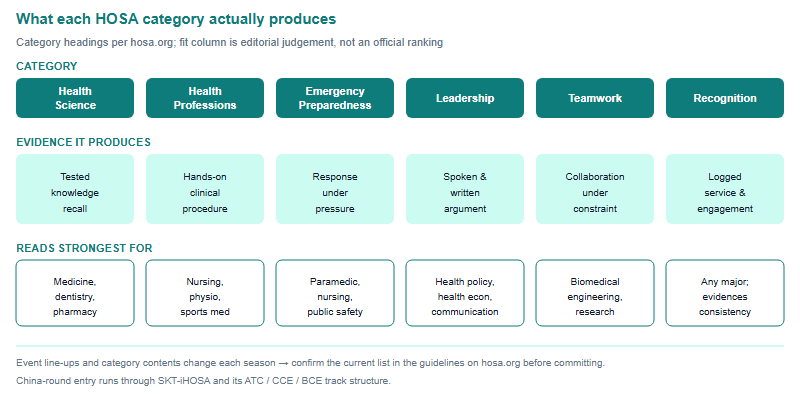
Six categories, six different kinds of proof
HOSA's own guidance on choosing an event describes six categories: Health Science, Health Professions, Emergency Preparedness, Leadership, Teamwork and Recognition. The 2025–2026 guidelines index published on hosa.org uses the same headings, plus a separate NGL | Cengage Academic Testing Center section and a set of events unique to middle school members.
The descriptions matter more than the names. HOSA describes Health Science events as exams testing knowledge on topics such as "Medical Terminology, Medical Law and Ethics, and even Pathophysiology." Health Professions events are for students who want to "enhance your clinical skill set, enabling you to learn skills such as taping for sports medicine or how to take a blood pressure." Emergency Preparedness covers skills including "CERT Skills or CPR/First Aid." Leadership events include "Prepared Speaking, Job Seeking Skills, Extemporaneous Writing, and Extemporaneous Health Poster." Teamwork covers events such as Medical Innovation, HOSA Bowl and Biomedical Debate. Recognition sits apart in a different way: HOSA says members may enter as many Recognition events as they wish, and the category spans community service, chapter involvement and knowledge of current health issues.
Read that list again with a non-medical major in mind and the mismatch in most students' plans becomes obvious. A biomedical engineering applicant who spends two seasons on a terminology exam has demonstrated recall, not design. A health policy applicant who never enters a speaking or writing event has no artefact showing they can hold an argument in front of a sceptical adult.
Start from the gap in your file, not from the event list
Most students pick an event from a list of names. The better order is to ask what an admissions reader for your specific course will already have seen ten times in your file, and what they will not have seen at all.
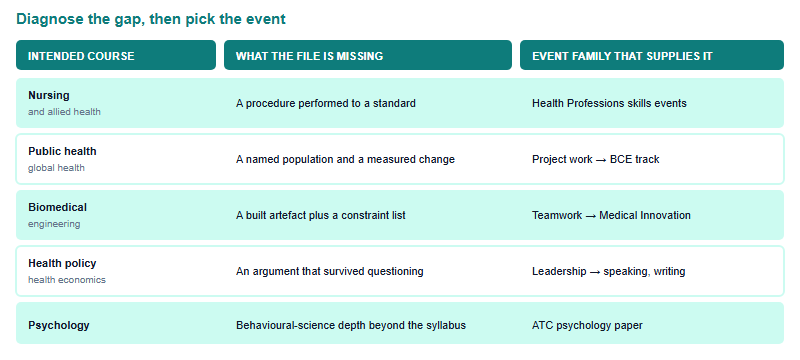
A UK nursing or midwifery application is read against a values-and-care framework; a US biomedical engineering application is read for build-and-test evidence; a public health or health policy application is read for population-level thinking and the ability to defend a recommendation. HOSA can supply any of those, but only if you enter the category that actually generates it. That mapping is what the table below does. Treat the middle column as the diagnosis and the right-hand column as the prescription.
| Intended course | Evidence the file usually lacks | Category to enter | Representative event types |
|---|---|---|---|
| Nursing / midwifery | Procedure performed to a standard, under observation | Health Professions | Nursing Assisting, Clinical Nursing |
| Public health / global health | A population-level problem addressed with a delivered intervention | Emergency Preparedness (plus BCE-style project work) | Public Health, Epidemiology, MRC Partnership |
| Biomedical engineering | A designed solution, prototyped and justified | Teamwork | Medical Innovation |
| Health policy / health economics | An argument held under questioning | Leadership | Prepared Speaking, Extemporaneous Writing |
| Psychology / neuroscience | Behavioural-science depth beyond a school syllabus | Academic testing (ATC) | Psychology paper in the iHOSA ATC track |
| Paramedic science / emergency care | Performance when the clock is running | Emergency Preparedness | CPR/First Aid, CERT Skills, EMT |
| Pre-med, dentistry, pharmacy | Tested breadth across health-science knowledge | Health Science | Medical Terminology, Medical Law and Ethics, Pathophysiology |

Four non-pre-med routes, in detail
Nursing and allied health. The distinguishing feature of Health Professions events is that you are assessed doing something, not describing it. That is exactly the evidence a nursing personal statement struggles to produce from an international school in China, where clinical placements for minors are rare. A skills event gives you a defensible sentence: not "I am interested in patient care" but "I was assessed on a nursing-assisting procedure against a published rating sheet, and here is what I got wrong the first time." Reflection on the failure is usually stronger evidence than the placing.
Public health and global health. This is the clearest fit for project work, and in the China round it maps onto the BCE track, which is built around public-welfare projects rather than tests. The trap is scale confusion. A public health project is not a clinic and not a poster about a disease; it is an intervention aimed at a defined population with a stated need, a delivery mechanism and some attempt at measurement. If your project cannot name the population and the denominator, it is a health-education project wearing a public-health label. Our editorial view is that the smallest honest project — one school, one behaviour, one measured change — reads better than an unmeasured campaign aimed at "teenagers."
Biomedical engineering. HOSA lists Medical Innovation under Teamwork, and for an engineering applicant that is the highest-value event in the whole programme, because it produces the one artefact engineering admissions actually wants: a thing you built, plus the reasoning for why it is built that way. Engineering readers are unimpressed by a device that solves an imagined problem. They respond to a constraint list — cost, sterilisation, power, user hand strength — and to evidence you discarded an earlier design. Keep your rejected prototypes; they are the interview material.
Health policy, health economics and health communication. These applicants often have strong essays and no evidence of live argument. Leadership events fix that. Prepared Speaking gives you a rehearsed case; Extemporaneous Writing gives you a timed one. Both produce something rarer than a certificate: the experience of having your reasoning questioned by an adult who is not your teacher. If you want the full picture of how the three China-round tracks differ before choosing, the ATC, CCE and BCE comparison sets out what each one asks for.
What changes for China-based competitors
Two structural facts should shape your planning. First, the China round is operated as SKT-iHOSA and organises entry into three tracks — ATC for foundational tests, CCE for professional and clinical work, BCE for public-welfare projects. That is a coarser grid than HOSA's six international categories, so the mapping above has to be translated: a nursing-leaning student is looking at CCE, a public-health-leaning student at BCE, a psychology-leaning student at ATC. For the iHOSA 2027 season, online round one is a 45-minute paper of 45 multiple-choice questions plus five tiebreaker questions, with ATC offered in biology, chemistry and psychology.
Second, HOSA's published guidelines carry an explicit warning that they are written for the International Leadership Conference and that "States may have different event processes and deadlines, including upload deadlines!" Read that as a general principle: the international guideline tells you what the event is, and your own round tells you how and when to submit it. Never build a submission calendar from the international document alone. If you are new to the structure, the HOSA overview explains how the rounds fit together, and the ILC guide shows what the international conference actually involves.
There is also a timing point worth putting in your calendar now. The guidelines index on hosa.org states that the 2026–2027 guidelines will be released on 1 September 2026. Until that date, any event page you are reading describes the previous season. Choose your category in August; confirm the specific event after the new guidelines publish.
The honest limits of this strategy
Three cautions, because the major-matching idea is easy to over-apply.
- An event does not admit you anywhere. No competition, HOSA included, produces an admissions outcome on its own. What a well-chosen event does is give you something specific and true to write about, which is a modest and real advantage over a file of generalities.
- Fit is not a substitute for depth. A shallow Medical Innovation entry is worse for an engineering application than two serious seasons in a Health Science exam event, because depth is legible and dabbling is not. If you cannot commit properly to the "correct" category, stay where you can do real work.
- Do not manufacture a conversion story. If you genuinely want medicine, enter Health Science or Health Professions events and stop reading this article. The point is not to look unusual; it is to stop mis-spending a season on evidence your course does not ask for.
The practical takeaway is a single sentence you should be able to write before you register: "I am applying for X; the thing my file cannot currently show is Y; the event that produces Y is Z." If you cannot complete that sentence, you are not ready to choose an event yet — you are ready to choose a category.
Frequently asked questions
Is HOSA only useful for students applying to medicine?
No. HOSA lists six event categories covering exams, clinical skills, emergency response, leadership, teamwork and recognition, so it supports nursing, public health, engineering and policy routes too.
Which HOSA category suits a biomedical engineering applicant?
Teamwork events, particularly Medical Innovation, because they produce a designed artefact and a justification — the evidence engineering admissions readers look for.
Can I enter more than one category in a season?
Rules on how many events a member may enter are set by the organiser and differ by round. Check the current guidelines and your round's entry rules on hosa.org.
When do the 2026-2027 event guidelines appear?
The guidelines page on hosa.org states the 2026–2027 guidelines will be released on 1 September 2026. Confirm event details there before registering.
Published by the HOSA (SKT-iHOSA) editorial desk, operated by Hanlin Education for China-based international-school students. Official rules are set by the competition and change yearly — confirm current details on hosa.org. Errors are corrected within 7 working days.

Oct 20, 2026
iHOSA ATC Division I vs II: Allocating Study Time by Weighting Differences
Students in grades 9-10 and 11-12 face different topic weightings in the iHOSA ATC Biology and Chemistry exams. This guide breaks down…
Oct 17, 2026
iHOSA Biology Explanations: Connect a Feedback Loop to a Change in the Body
Mastering negative and positive feedback loops is essential for iHOSA Biology. Learn how to connect physiological mechanisms to observable changes with worked…
Oct 15, 2026
iHOSA Health Education: Test Whether an Audience Understood Your Message
In iHOSA Health Education, testing whether your audience understood your message is not an afterthought—it is the core deliverable. Learn how to…