
HOSA's rulebook contains one line that settles most arguments about research ethics in a competition project: all sources must be cited, including AI. Put that next to the requirement that competitive event materials be the original work of the competitors, and the practical job is clear. You need a source ladder, a research log, and the habit of verifying every number before it reaches a board.
The rule most competitors have never actually read
HOSA's General Rules and Regulations (August 2025), published on hosa.org, state under Ethics and Integrity: that HOSA members are held to a higher professional standard, that plagiarism, copyright violation and falsification are prohibited, that "All sources must be cited, including AI," and that ethics violations can cost awards, recognition or other HOSA privileges.
The preceding rule is equally direct: "All competitive event materials (such as presentations, projects, portfolios, etc.) must be the original work of the competitors."
Two things follow. First, disclosure is the default, not a confession. HOSA does not ask you to pretend a tool was never opened; it asks you to cite it. Second, the standard applied here is professional rather than academic. The framing is explicitly about behaving like a future health professional, and in health, an unsourced number is not a stylistic problem. It is a safety problem.
As always, these are HOSA's international rules. The iHOSA China round is operated separately as SKT-iHOSA and may specify its own submission, proctoring and disclosure terms, so confirm current wording on the official iHOSA channels and on hosa.org before relying on any detail. If the structure is new to you, start with the HOSA overview and the ATC, CCE and BCE comparison.
Your source ladder: what counts as evidence for a health claim
Most weak HOSA projects are not dishonest. They are built on whatever appeared first in a search, and they collapse the moment a judge asks where a figure came from. Fix that with a ranked ladder you apply before a claim goes anywhere near a slide.
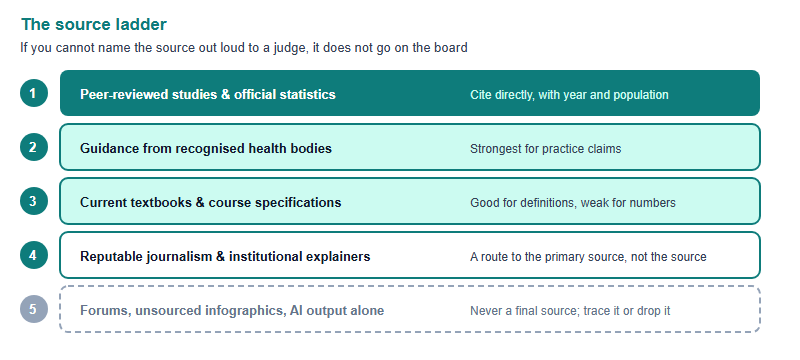
Tier five deserves its own warning. An unsourced statistic circulating on social media is not evidence, and neither is a plausible-sounding sentence produced by a chatbot. Both can be true; neither is verified until you have found where the number originally came from.
The research log, and how AI use gets recorded in it
A research log is the cheapest insurance in competitive research, and it does three jobs at once: it makes citation trivial, it makes judge questions answerable, and it produces the provenance trail that any later academic use of the work will demand.
| Column | What goes in it | Why it matters later |
|---|---|---|
| Date | The working session, not the publication date | Shows the work developed over time rather than appearing at once |
| Question asked | The specific thing you were trying to find out | Turns a pile of reading into a visible line of reasoning |
| Where you looked | Database, body, journal, textbook chapter, or tool | This is the column where AI use gets recorded honestly |
| What you found | The finding plus the full reference and page or table | Removes the end-of-project scramble to re-find citations |
| What changed | How the project or argument moved as a result | Answers the "what would you do differently" question directly |
| Status | Verified against the original, or still second-hand | Nothing unverified reaches the final artefact |
One row per session is enough. The status column is the one students skip and the one that catches errors: it forces you to distinguish between a number you have actually seen in its original source and a number you have only seen quoted somewhere else.
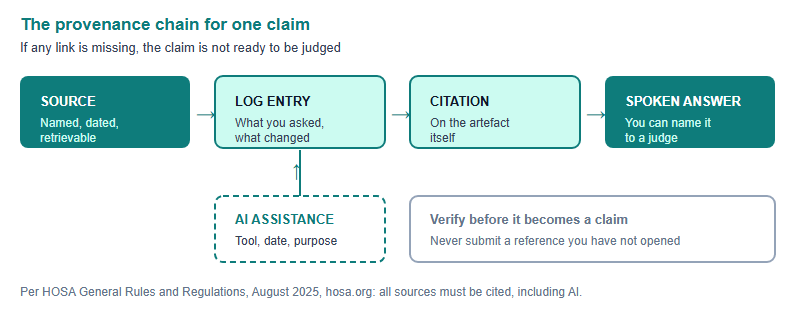
The rule says sources must be cited, "including AI." It does not tell you the format, and formats differ by citation style and by school, so follow whatever your event guideline and your school require. What matters is that the disclosure is specific enough to be meaningful:
- Which tool and which version, and the date you used it. Outputs are not reproducible across versions or dates.
- What you used it for, in one honest phrase: brainstorming candidate topics, summarising a paper you had already read, checking grammar in your own draft, generating code for a chart.
- What you did with the output, especially whether any wording survived into the submitted text.
Two failure modes cause almost all the damage. The first is the fabricated reference: language models produce citations that look correct and do not exist, and a judge who tries to look one up will find nothing. Every reference in your project must be one you have personally opened. The second is quiet drafting: letting a tool write passages that are then submitted as yours. That runs straight into the original-work requirement, not just the citation requirement, and the rules describe severe penalties including forfeiture of awards.
A workable line for most students: use tools to help you understand, plan and check, never to produce the claims or the final prose you submit. If a sentence contains a fact, you should be able to say where the fact came from without opening a chat history.
Where the help line sits: independent work, teams and coaching
Under Independent Work, HOSA states that "Except for team events, competitors must work independently, without assistance from judges, teachers, fellow students, or observers," and that any attempt to gain an unfair advantage will be treated as an ethics violation. Team events are carved out, which is precisely why team projects need their own internal record of who did what.
That line does not mean nobody may teach you anything. In practice the distinction that holds up is between capability and output:
- Reasonable support: teaching a technique, explaining a concept, pointing you towards a database, watching a rehearsal and reacting, checking whether your argument is clear.
- Not your work any more: someone else choosing the research question, writing the text, producing the analysis, or building the artefact you submit.
Two related rules are worth internalising. Content from Year to Year requires content to be unique and new each membership year, with 35 penalty points where a violation is discovered. And under Changing Event Content, when advancing between levels, competitors are generally allowed to change or improve a speech, notebook, portfolio or other event product, with all changes made before published deadlines. Improving between rounds is expected; recycling across years is not. Our ILC guide covers what the later rounds involve.
People, privacy and the test room
If your project touches real people, two further rules shape what you can responsibly include. Under Content Selection, competitors are told to use good judgment and discretion, and content that "could be interpreted as insensitive or of a highly personal nature should be avoided and may not be judged." Under Material Submission, materials submitted at the International Leadership Conference generally become HOSA property, and submission implies consent for HOSA and affiliated partners to publish them for promotion.
Read together, the practical rule is simple: assume anything you submit may be seen publicly. Get consent for interviews and surveys, de-identify responses before they enter your data set, never include identifiable images or clinical details of real patients, and aggregate small samples so individuals cannot be reverse-identified.
Integrity also applies in the test room. HOSA's Online Testing rule requires proctors to ensure valid, reliable and secure administration, keeps confidential materials from being disclosed to unauthorised individuals "including HOSA student members and local advisors," and lists the testing rules competitors must follow: "no talking, no cell phone/smart watch use, no textbook use, no internet use outside of the testing browser, no notes, and no electronic devices." For a timed online qualifier, described for the iHOSA 2027 season as 45 minutes for 45 multiple-choice questions plus 5 tiebreakers across ATC biology, chemistry and psychology, a smart watch left on your wrist is an avoidable way to end a season. Confirm the China round's own proctoring terms on official channels before test day.
Across recent seasons, students we have worked with have taken national medals in ATC biology and chemistry and a behavioural-health national gold (per Hanlin, de-identified, results vary). Nothing in this article is about being cautious for its own sake. Projects with a clean provenance chain simply survive questioning better, and they are the ones still usable a year later.
FAQ
Do I really have to cite AI in a HOSA project?
HOSA's rules state that all sources must be cited, including AI. Formats vary by event guideline and school, so follow those, but disclose the tool, date and purpose.
Can my teacher help me prepare my project?
Outside team events, HOSA requires competitors to work independently without assistance from teachers, students or observers. Teaching a skill differs from producing your work; keep the output yours.
What happens if I reuse last year's content?
Content must be unique and new each membership year. HOSA states a discovered violation carries 35 penalty points, deducted in tabulations.
Can I take a smart watch into the online test?
No. HOSA's online testing rules list no cell phone or smart watch use, no textbooks, no notes and no electronic devices. Confirm iHOSA China-round terms officially.
Published by the HOSA (SKT-iHOSA) editorial desk, operated by Hanlin Education for China-based international-school students. Official rules are set by the competition and change yearly, so confirm current details on hosa.org. Errors are corrected within 7 working days.

Oct 20, 2026
iHOSA ATC Division I vs II: Allocating Study Time by Weighting Differences
Students in grades 9-10 and 11-12 face different topic weightings in the iHOSA ATC Biology and Chemistry exams. This guide breaks down…
Oct 17, 2026
iHOSA Biology Explanations: Connect a Feedback Loop to a Change in the Body
Mastering negative and positive feedback loops is essential for iHOSA Biology. Learn how to connect physiological mechanisms to observable changes with worked…
Oct 15, 2026
iHOSA Health Education: Test Whether an Audience Understood Your Message
In iHOSA Health Education, testing whether your audience understood your message is not an afterthought—it is the core deliverable. Learn how to…