
Most weak HOSA projects do not fail on citation formatting. They fail one step earlier: the evidence itself was found by typing a topic into a search bar and taking the first readable result. This guide covers the skill nobody teaches — building a search that finds the right studies, triaging them fast, and deciding honestly whether a paper actually supports the sentence you want to write.
Finding evidence is a different skill from citing it
Citation is a formatting problem with a right answer. Searching is a judgement problem, and it is where the real marks are won and lost, because a judge who knows the field can tell within thirty seconds whether you read the literature or skimmed the top of a results page.
Three symptoms give away a search-bar project every time:
- Every source is a secondary retelling. News articles, health-content websites and encyclopaedia entries describing studies, with no primary study anywhere in the reference list.
- The sources all agree. Real literature on any live health question contains disagreement. A reference list with no tension in it means you stopped searching when you found confirmation.
- The evidence is from the wrong population. A statistic about American adolescents, presented as if it described students in Shanghai, because it was the first number available in English.
This matters most in project-based and professional events, where a written report and a judge conversation sit on top of your evidence base. If you are still choosing which track to sit in, our comparison of the ATC, CCE and BCE tracks sets out which ones carry a research load; the general HOSA overview covers the structure around them.
Build the search string before you open a database
The single highest-return habit: convert your question into three concept blocks, list synonyms inside each block, then combine. Inside a block, terms are alternatives — joined with OR. Between blocks, terms must all be present — joined with AND. Quotation marks hold a phrase together.
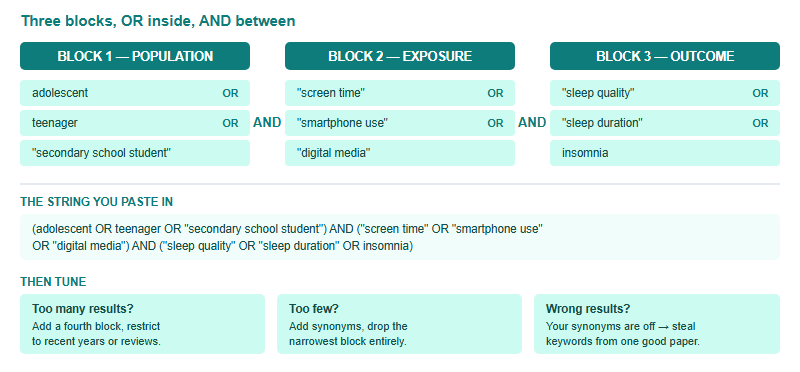
Two refinements worth the ten minutes. In PubMed, controlled vocabulary (MeSH) tags papers by concept regardless of the author's wording, so a MeSH term can catch studies your synonym list missed. And once you find one genuinely good paper, mine it in both directions: read its reference list backwards in time, and look at what has cited it since. That citation-chaining habit routinely finds better sources than another hour of keyword guessing.
Where to actually look
| Source | Best for | What it cannot do | Watch out for |
|---|---|---|---|
| PubMed (US National Library of Medicine) | Primary biomedical and clinical studies; the default starting point | Full text is not always free; indexing is biomedical, so social-science angles are thin | Abstract-only reading — the limitation section lives in the full text |
| Cochrane Library | Systematic reviews that pool many studies on an intervention question | Coverage is narrow; many topics have no review at all | Reviews concluding "evidence is insufficient" — that is a finding, not a dead end |
| WHO and national health agencies | Definitions, burden-of-disease figures, official guidance | Rarely answers a novel question; guidance is not a study | Quoting a figure without its year and its geography |
| National and municipal statistics bureaus | Population denominators for your own region — often the missing local number | No causal claims; categories may not match your question | Comparing years after a definition change |
| Google Scholar | Fast coverage, citation chaining, finding legitimate open versions | No quality filter whatsoever; mixes preprints, theses and journals | Predatory-journal results sitting beside real ones |
| Your school library databases | Legitimate full-text access you already pay for | Subscription scope varies by school | Not asking the librarian — consistently the most under-used resource |
One practical note for students working from mainland China: access to individual platforms varies, and the answer is never to route around a paywall. Ask your school librarian for institutional access, use the legitimate open-access version when the authors have deposited one, and email the corresponding author — researchers frequently send a copy to a student who asks politely and explains the project.

Triage an abstract in ninety seconds
You will screen far more papers than you read. Screening is a filter, not reading, and it has a fixed order. Ask five questions of the abstract, in this sequence, and stop the moment one fails:
- Population. Who was studied — age band, country, setting? If it is adults in a hospital and your project is about school students, stop here.
- Design. Survey, cohort, trial, review? This sets a hard ceiling on what the paper can claim.
- Size. How many participants? Note it now; you will need it when you write.
- Direction and magnitude. What did they find, and how big was it? "Statistically significant" is not the same as "large enough to matter".
- Stated limitation. Good abstracts name one. If the authors hedge, you must hedge too.
Keep a one-line record per paper as you go: population, design, n, finding, limitation. Fifteen of those lines is a literature review that practically writes itself — and it is also the note you will want in your hand when a judge starts asking questions, a scenario we break down in our guides to conference-level events such as the ILC experience.
The applicability test: does this study describe your population?
This is the step that separates a competent project from a good one, and the one Chinese international-school students most need, because the accessible English-language literature is disproportionately American and European. A finding from a US public high school may or may not describe a bilingual international school in Shenzhen — the honest move is to say which, not to quietly assume.
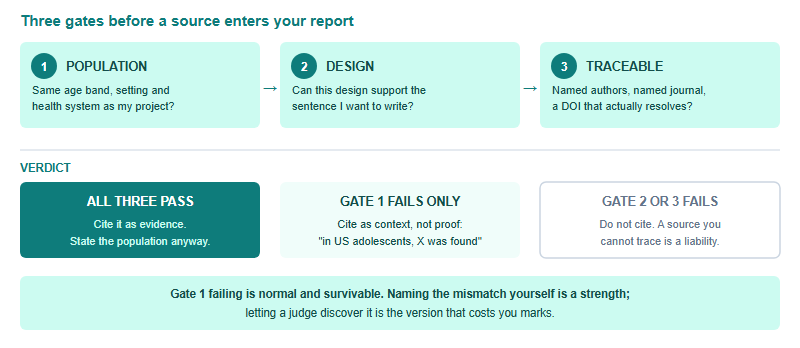
Gate 2 deserves a sentence of its own, because it is where students overclaim without noticing. A cross-sectional survey measures two things at one moment and can show that they occur together; it cannot tell you which came first, so it cannot support the word "causes". A cohort study follows people over time and can establish sequence. A randomised trial is the design built to test whether an intervention works. A systematic review pools existing studies and inherits every weakness of the studies it pools. Match your verb to your design: is associated with and causes are not interchangeable, and a judge in a health-science event will know the difference.
Red flags, and the reference check that takes four minutes
Four warning signs that a source should not enter your report:
- The claim has no study behind it. Follow "studies show" back to the actual study. If the trail ends at another article, you have found a rumour with citations.
- A press release standing in for a paper. Institutional announcements systematically overstate findings. Locate the paper.
- Predatory-journal markers. Absurdly broad scope, promises of publication within days, no identifiable editorial board, invented impact metrics.
- A citation that does not resolve. Generative AI tools produce plausible references to papers that do not exist, with real-looking authors and DOIs. This is now one of the most common integrity failures in student work.
So run this check before you submit anything. Take every reference in your list, paste the DOI into doi.org or the exact title into PubMed or Google Scholar, and confirm three things: the paper exists, the authors match, and the sentence you attributed to it is a sentence it actually supports. On a fifteen-source list this takes about four minutes and it removes the single most damaging category of error — a fabricated or misattributed citation that a judge happens to check.
Finally, the requirement that matters more than any of this: what your specific event asks for. HOSA publishes General Rules and Regulations alongside each event's own guideline, with reference expectations sitting in the event guideline, and hosa.org states that the 2026–2027 guidelines will be released on 1 September 2026. Read the guideline for your event when it appears, and do not assume a rule you have read about a different competition — a science fair, a research olympiad, an essay prize — applies here. Borrowed rules are the most common source of confident, avoidable mistakes.
Frequently asked questions
How many sources does a HOSA project need?
There is no universal number. Reference expectations are set in each event's guideline on hosa.org — check yours rather than copying a figure from another competition.
Can I cite a study I only read the abstract of?
Only for facts the abstract actually states. Limitations and methods live in the full text, and a judge may ask about exactly those.
Is it acceptable to use Western data for a China-based project?
Yes, if you label it. Write "in US adolescents, X was found" and say why it may or may not transfer to your population.
Can I use an AI tool to find sources?
Check the AI usage statement in HOSA's General Rules and Regulations on hosa.org, which was updated for 2026–2027, before you rely on any AI tool. Never paste an AI-produced citation without verifying it resolves — fabricated references are common and are treated as an integrity failure.
Published by the HOSA (SKT-iHOSA) editorial desk, operated by Hanlin Education for China-based international-school students. Official rules are set by the competition and change yearly — confirm current details on hosa.org. Errors are corrected within 7 working days.

Oct 20, 2026
iHOSA ATC Division I vs II: Allocating Study Time by Weighting Differences
Students in grades 9-10 and 11-12 face different topic weightings in the iHOSA ATC Biology and Chemistry exams. This guide breaks down…
Oct 17, 2026
iHOSA Biology Explanations: Connect a Feedback Loop to a Change in the Body
Mastering negative and positive feedback loops is essential for iHOSA Biology. Learn how to connect physiological mechanisms to observable changes with worked…
Oct 15, 2026
iHOSA Health Education: Test Whether an Audience Understood Your Message
In iHOSA Health Education, testing whether your audience understood your message is not an afterthought—it is the core deliverable. Learn how to…