A HOSA project that collects its own data is more defensible than one that only quotes other people — but only if the instrument survives scrutiny. Most school health surveys are already unusable before the first response arrives, because the questions were written in an afternoon. This guide covers item wording, bilingual translation, consent with minors, and what your sample size honestly lets you claim.
Primary data raises your ceiling and your risk
Collecting your own data changes what you are able to say. Instead of restating findings from elsewhere, you can describe something nobody has measured: what actually happens in your school, your grade, your community. Judges notice, because it is rare and it cannot be assembled the night before.
It also introduces failure modes that a literature-only project never faces. Three that end projects:
- An item that measures nothing. Ambiguous wording produces numbers that look like data and mean nothing — and you cannot fix it after collection.
- An ethics problem discovered late. Asking minors about health without permission, or collecting enough detail to identify individuals, is the kind of issue that surfaces in a judge's question at the worst possible moment.
- A claim the sample cannot carry. Sixty responses from one school does not describe "teenagers". Writing as though it does is the fastest route to a damaging follow-up question.
This work sits mainly in the project-based track. Our comparison of the ATC, CCE and BCE tracks shows which routes carry a project load, and the HOSA overview covers the surrounding structure.
The six ways a question breaks
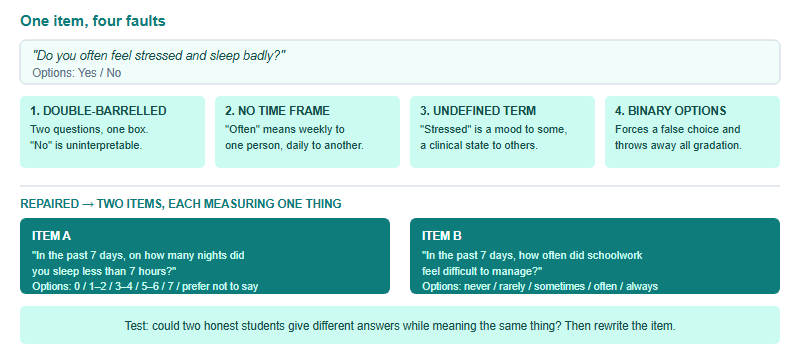
Beyond the four faults above, two more account for most of the remaining damage:
| Fault | Example | Why it ruins the data | Repair |
|---|---|---|---|
| Leading wording | "Do you agree that students should get more sleep?" | Signals the expected answer; agreement rates inflate and mean nothing | Ask behaviour, not endorsement: how many hours did you sleep last night? |
| Unbalanced scale | Excellent / Good / Average / Poor | Three positive options against one negative shifts the average upward by construction | Balance both sides around a neutral midpoint |
| Non-exhaustive options | "How do you commute? Bus / Car / Walk" | Cyclists and metro users pick something false, contaminating every category | Add "other" with a text box, and a "prefer not to say" |
| Recall beyond memory | "How many hours did you exercise last term?" | Nobody knows; you collect invention | Shorten the window to 7 days, or ask about a typical week |
| Assumed premise | "How much do you enjoy PE class?" | Assumes enjoyment; students who dislike it have no honest answer | Ask the filter question first, then branch |
| Compulsory sensitive items | A required mental-health question | Coercive, ethically unsound, and it drives dropout mid-survey | Every sensitive item skippable, always |
A bilingual survey is really two surveys
If some respondents answer in English and some in Chinese, you are running two instruments and hoping they measure the same construct. Frequently they do not, and the drift is invisible in the results.
The standard fix is back-translation, and it takes an evening. Write the item in English. Have a fluent bilingual peer translate it into Chinese. Have a second person, who has not seen the original, translate that Chinese back into English. Compare version one with version three. Where they diverge, the concept is unstable and you rewrite until it holds.
Watch three categories in particular. Frequency words ("often", "sometimes") rarely map cleanly between languages — which is another argument for numeric options. Health and psychological terms carry different weight and stigma across the two languages, so a term that reads as everyday in English may read as clinical in Chinese. And politeness norms differ: agreement-style items can attract more assent in the Chinese version simply because disagreeing feels ruder. Report which language each respondent used; it is a variable, not a formatting detail.
Consent, assent and the approvals you actually need
Your respondents are minors, and often your classmates — which makes voluntariness genuinely hard, because a request from a peer carries social pressure. Standard research practice for school-based studies involves layers:
- School approval first. Before you distribute anything, a named staff sponsor and whoever your school designates should see the final instrument. Get this in writing.
- Guardian permission and participant assent. For minors, the usual expectation is permission from a parent or guardian plus the young person's own agreement to take part. Both, not either.
- A plain-language information sheet. Who you are, what the study is for, how long it takes, that participation is voluntary, that any question can be skipped, that they can stop at any time, what happens to the data, and who to contact.
- A support plan for sensitive topics. If you ask about mental health, wellbeing or risk behaviour, the survey must end with signposting to real support — school counsellor, local services — and your staff sponsor must have agreed the wording in advance.
One distinction students routinely get wrong: anonymous is not the same as confidential. Anonymous means you cannot link a response to a person, even if you wanted to — no names, no email addresses, no auto-captured accounts. Confidential means you could, but you protect it. Most school surveys claim anonymity while collecting grade, class, gender and nationality, which in a cohort of forty can identify one specific student. If your demographic questions could single somebody out, either widen the categories or stop calling the survey anonymous.
On the competition side, a caution that matters more than any of the above: do not import another competition's paperwork. Science fairs and research olympiads have their own documentation regimes, and students routinely assume those forms apply here. HOSA sets requirements inside each event's own guideline, and hosa.org states that the 2026–2027 guidelines will be released on 1 September 2026. Read the guideline for your event when it appears, follow your school's rules, and confirm anything ambiguous on the official site rather than reasoning by analogy.
What your sample size honestly buys
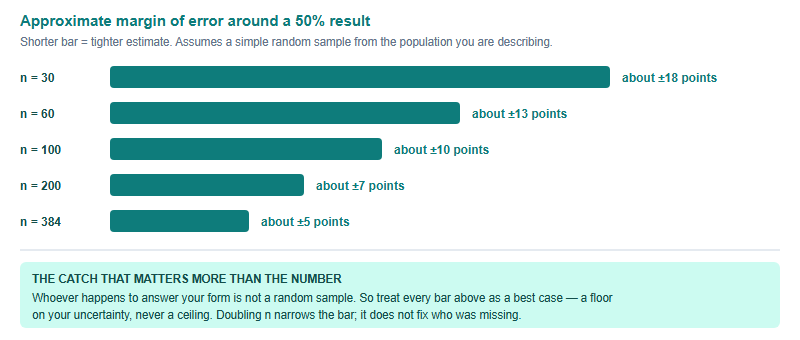
Read the chart honestly and it reframes the whole project. At sixty responses, a result of 55% versus 45% is indistinguishable from an even split. Reporting that as "a majority of students" is an overclaim a judge can dismantle in one question — and defending exactly this kind of number under pressure is a large part of what conference-level judging tests, as our ILC guide describes.
Three rules follow. Under about twenty responses, report raw counts, not percentages — "11 of 18 students" is honest, "61%" is theatre. Second, name your population precisely: you did not study adolescents, you studied students in Years 10 to 12 at one international school in one city during one week. Write that sentence into the report. Third, treat non-response as a finding. If you sent it to 300 and 60 answered, ask who the missing 240 are likely to be — if the topic is sleep and the busiest students ignored your form, your sample is systematically biased towards the well-rested, and saying so is a strength.
Pilot first: the two weeks that save the project
Never launch cold. A workable runway looks like this:
- Days 1–3. Draft the items. Write next to each one the exact sentence you hope to write in the report — if you cannot, the item has no job and should be deleted. Short surveys finish; twelve good items beat thirty.
- Days 4–5. Back-translate, then get school approval and the sponsor sign-off on the final wording.
- Days 6–8. Pilot with five to eight people who are not your friends. Sit with them. Watch where they hesitate, re-read, or ask what a word means — every hesitation is a broken item. Time it.
- Days 9–10. Rewrite the items that stumbled, then run the pilot data through your planned analysis. If you cannot produce a chart from the pilot, your response options are wrong — and fixing that now is free.
- Days 11–14. Launch, with a stated closing date. Discard pilot responses; the instrument changed.
One last discipline. Decide your analysis before data arrives: which questions cross with which, which chart shows what. Deciding afterwards is how students end up hunting through their spreadsheet for any pairing that looks interesting — and a judge who asks "was that what you set out to test?" will find the answer in about four seconds.
Frequently asked questions
How many responses does a school survey need?
There is no required number. Around 60 gives roughly ±13 points of uncertainty, so match your claim to your n and report counts under about 20.
Do I need parental consent to survey classmates?
Your respondents are minors, so plan for guardian permission plus the student's own assent, and get school sign-off before distributing anything.
Does HOSA require specific research forms?
Requirements sit inside each event's guideline on hosa.org, released for 2026–2027 on 1 September 2026. Never assume another competition's forms apply.
Can my survey be truly anonymous?
Only if no response can be traced back. Collecting class, grade and gender in a small cohort can identify individuals — widen categories or drop the anonymity claim.
Published by the HOSA (SKT-iHOSA) editorial desk, operated by Hanlin Education for China-based international-school students. Official rules are set by the competition and change yearly — confirm current details on hosa.org. Errors are corrected within 7 working days.

Oct 20, 2026
iHOSA ATC Division I vs II: Allocating Study Time by Weighting Differences
Students in grades 9-10 and 11-12 face different topic weightings in the iHOSA ATC Biology and Chemistry exams. This guide breaks down…
Oct 17, 2026
iHOSA Biology Explanations: Connect a Feedback Loop to a Change in the Body
Mastering negative and positive feedback loops is essential for iHOSA Biology. Learn how to connect physiological mechanisms to observable changes with worked…
Oct 15, 2026
iHOSA Health Education: Test Whether an Audience Understood Your Message
In iHOSA Health Education, testing whether your audience understood your message is not an afterthought—it is the core deliverable. Learn how to…