
The BCE public-welfare track standardises two deliverables: a 30-second public-service advertisement and a public-health class taught to a real audience (per Hanlin's SKT-iHOSA season briefing; confirm current specifications officially). Both are short, and short is the hard part. This guide covers the word budget hiding inside 30 seconds, the audience problem inside the class, and the evidence you cannot go back and collect.
Two formats, one project — and why they are set rather than free
Most competition tracks let teams choose how to present. The BCE track does not, and that is a gift once you see it. Two teams working on wildly different topics still produce the same two artefacts, which means judges compare craft rather than format ambition — and it means you can practise the format long before your topic is settled.
It also removes the most common project-based failure: the team that spends eleven weeks on research and three days deciding what to actually make. Here, the deliverable shape is known from day one. Work backwards from it.
BCE is the project, team route rather than an individual exam; our comparison of the ATC, CCE and BCE tracks sets out how the three differ in workload and evidence, and the HOSA overview covers the surrounding structure.
| The 30-second PSA | The public-health class | |
|---|---|---|
| What it really tests | Compression — can you strip one idea to its irreducible form | Transfer — can you move an idea into someone else's head |
| Unit of work | Roughly 70–80 spoken words (our own planning estimate) | One learning objective, defensible in a sentence |
| Main failure mode | Cramming a lecture into half a minute | Presenting at an audience instead of teaching them |
| Hardest logistics | Filming and re-filming until the timing is clean | Securing a genuine audience, a room and a date |
| Evidence to capture | Script, storyboard, timing sheet, permission for anyone on camera | Lesson plan, photographs, audience size, before/after responses |
| When to start it | After the message is settled — never before | First, because scheduling other people is the long pole |
Thirty seconds is a word budget — and five decisions fill it
Teams routinely storyboard a 30-second advertisement containing four statistics, a definition, two interviews and a closing appeal. Then they record it and discover it runs ninety seconds. The fix is to plan in words, not scenes.
Comfortable, intelligible narration — the kind a listener can follow in a second language — runs at roughly two-and-a-half words per second. Push past three and comprehension falls away sharply, especially for a bilingual audience. That is our own editorial planning rule rather than an organiser specification, but the arithmetic is unforgiving: thirty seconds holds about seventy-five words. One paragraph. That is the entire asset.
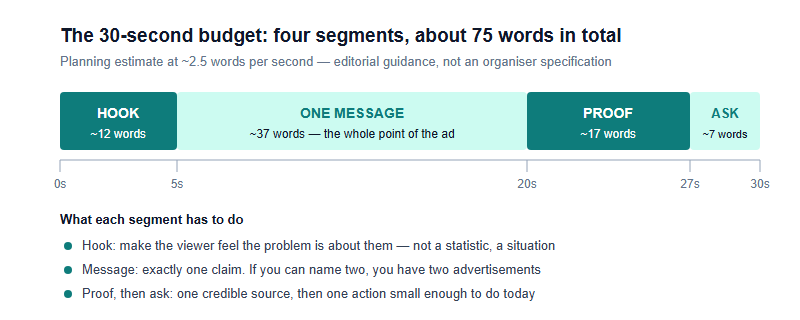
Write the script first and time it out loud with a stopwatch before anyone touches a camera. Read it at the pace you would use for a nervous listener, not the pace you would use to make it fit. If it overruns, cut a claim — never cut the pauses.
Once the arithmetic is settled, the build order matters more than the equipment. Teams that buy a microphone before settling the message produce a beautifully recorded muddle. Take these five decisions in sequence, and refuse to skip ahead:
- 1. Name the one behaviour you want changed. Not the topic — the behaviour. "Teenagers should care about sleep" is a topic. "Put the phone outside the bedroom" is a behaviour. Only the second can be advertised.
- 2. Name the specific viewer. A Year 9 student in your own school is a viewer. "The public" is not. Every later decision — language, tone, whether you subtitle in Chinese — follows from this one.
- 3. Write the ask before the hook. Working backwards from the action stops you writing thirty seconds of atmosphere that lands nowhere. The ask must be small, free and immediate; "talk to your doctor" fails all three for most students.
- 4. Storyboard in six frames maximum. One frame per five seconds. If a shot cannot be understood without narration explaining it, that shot is doing no work.
- 5. Record it badly, on purpose, first. A phone rehearsal exposes the timing problem in ten minutes. Polish is the last step, not the first.
Two integrity points worth getting right, whatever the mark scheme says. Anyone identifiable on camera needs permission, and for classmates who are minors that means the same guardian permission you would need for research participation. And any statistic on screen needs a source you can name aloud when a judge asks — a number with no provenance is worse than no number at all.

The public-health class: the audience is the assignment
The second deliverable specifies a class taught to a real audience. Students consistently underrate that word. A slide deck presented to your own three teammates is a rehearsal; it is not the deliverable. Securing genuine learners — and a date, and a room — is the longest lead time in the whole project, which is why it belongs in week one rather than week nine.
Realistic audiences for a China-based international-school team, roughly in order of how easily they are arranged: a younger form group or homeroom at your own school; a school club or co-curricular session; a primary section or feeder school; a parents' evening slot; a community partner such as a library or community centre. Ask through your staff sponsor rather than cold, and ask for a smaller slot than you think you need — twenty focused minutes are easier to grant, and easier to teach well, than an hour.
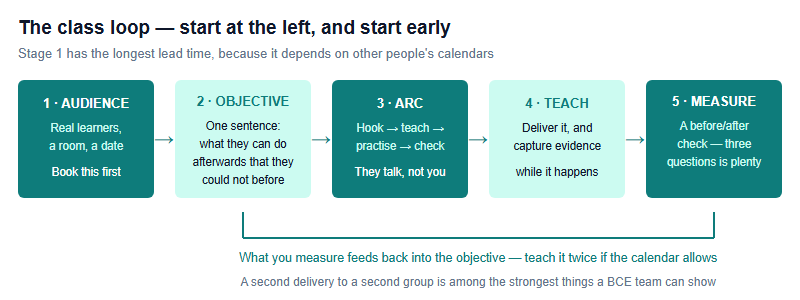
The arc that works is not a presentation. Hook for two minutes, teach the single objective for five, then hand the room over: let learners practise the thing — sort the cards, rehearse the refusal, read the label, demonstrate the handwashing — and finish by checking whether it stuck. If your learners speak for less than a third of the session, you gave a talk.
Keep the objective ruthlessly small. "Understand mental health" cannot be taught in twenty minutes or assessed at all. "Name two people in this building you could talk to, and say one sentence to start the conversation" can be taught, practised and checked before the bell.
Capture the evidence while it is happening
Everything a judge later asks about is easy to collect on the day and impossible to reconstruct in March. Assign one team member to documentation as a named role, the way you would assign research or design.
- The lesson plan as taught — including what you changed mid-session, which is more interesting to a judge than a plan that supposedly ran perfectly.
- Photographs of learners working, not of your team standing at the front — with permission secured in advance, and avoiding identifiable faces of minors unless you have that permission in writing.
- Audience size and description: how many, what age, and why that group was the right one for your objective.
- The before/after check, even if it is three questions on a slip of paper. Honest, modest movement beats an unverifiable claim of transformation every time.
- One thing that went wrong. Teams hide these; judges reward them. A team that can say "our first activity confused them, so we cut it and re-explained" is demonstrably a team that was actually in the room.
These same presentation and defence habits recur later in the season, where work is discussed live rather than simply submitted — our conference-round guide gives a sense of that environment.
Your lane changes the topic, not the craft
The BCE track runs two parallel lanes: an annual set theme, and a self-proposed route where a team picks its own topic within physical, mental, social or environmental health, judged in its own pool against the same criteria (per Hanlin's season briefing). The annual theme is published in early September.
Notice what this does not change. Both lanes end in the same two deliverables. So the waiting period before a theme drops is not dead time — it is exactly when a team should be securing an audience slot for the autumn, agreeing who owns documentation, and rehearsing a 75-word script on any throwaway topic simply to feel how little thirty seconds holds. Teams that reach the theme having already practised the formats start weeks ahead of teams beginning from zero.
Registration for this season ran to 20 August and has now closed, so this is preparation for teams already entered. The preliminary round falls in mid-to-late December (per Hanlin; confirm dates officially), which makes the autumn term the working window for both artefacts.
Frequently asked questions
How many words fit in a 30-second PSA?
About 75 at a comprehensible pace. That is our editorial planning estimate at roughly 2.5 words per second — one short paragraph in total.
What counts as a real audience for the public-health class?
Genuine learners who are not your own team — a younger form group, a club, a feeder school or a community partner. Confirm requirements officially.
Which deliverable should a BCE team start first?
The class. Booking other people's time is the longest lead item; the PSA script can be written in a week once your message is settled.
Does the self-proposed lane use different deliverables?
No. Per Hanlin's briefing both lanes are judged on the same criteria in separate pools; the lane changes your topic, not the two formats.
Published by the HOSA (SKT-iHOSA) editorial desk, operated by Hanlin Education for China-based international-school students. Official rules are set by the competition and change yearly — confirm current details on hosa.org. Errors are corrected within 7 working days.

Oct 20, 2026
iHOSA ATC Division I vs II: Allocating Study Time by Weighting Differences
Students in grades 9-10 and 11-12 face different topic weightings in the iHOSA ATC Biology and Chemistry exams. This guide breaks down…
Oct 17, 2026
iHOSA Biology Explanations: Connect a Feedback Loop to a Change in the Body
Mastering negative and positive feedback loops is essential for iHOSA Biology. Learn how to connect physiological mechanisms to observable changes with worked…
Oct 15, 2026
iHOSA Health Education: Test Whether an Audience Understood Your Message
In iHOSA Health Education, testing whether your audience understood your message is not an afterthought—it is the core deliverable. Learn how to…