
Four decisions in an iHOSA season genuinely belong to a parent: what the family will spend, which school weeks are protected, what permissions you will sign, and whether the household can accept an honest outcome. Almost everything else works better when the student owns it — and the single most expensive mistake is a well-meaning adult doing the work.
The four decisions that are actually yours
Parents of China-based international-school students usually arrive at a competition season with the wrong question, which is "how do I help my child do better?" The more useful question is narrower: which parts of this season cannot proceed without an adult? There are four, and they are worth deciding deliberately rather than drifting into.
- The ceiling on money. Not the individual line items — the total you are willing to commit before the season starts, including the possibility of travel later. Set it once, say it out loud, and then stop renegotiating it at every stage. A ceiling decided in September is a boundary; a ceiling decided in May is a fight.
- Which term weeks are protected. Mock exams, internal assessment deadlines, application deadlines. A parent can see the whole year at once in a way a fifteen-year-old genuinely cannot. Marking three or four weeks as untouchable is more valuable than any amount of encouragement.
- Consent and access. A Public-Welfare (BCE) project that surveys people or teaches a class needs an adult to secure a venue, an audience and, where minors are involved, the consent of their guardians. Students cannot obtain those on their own authority. This is real, unglamorous, high-value help.
- Whether the family can accept the honest version. Most competitors do not reach a global round. If the household treats anything short of that as failure, the season becomes a source of damage rather than development, whatever the result.
If the competition itself is still unfamiliar, read the overview of HOSA and the SKT-iHOSA pathway before the first family conversation. Discussing a season you have not understood tends to produce pressure rather than direction.
What support looks like at each stage
Parental usefulness is not constant across a season. It is high at the start, near zero in the week of a test, and high again when travel and money re-enter. The mistake is applying the same level of involvement throughout — usually a steady, low-level anxiety that peaks precisely when the student most needs quiet.
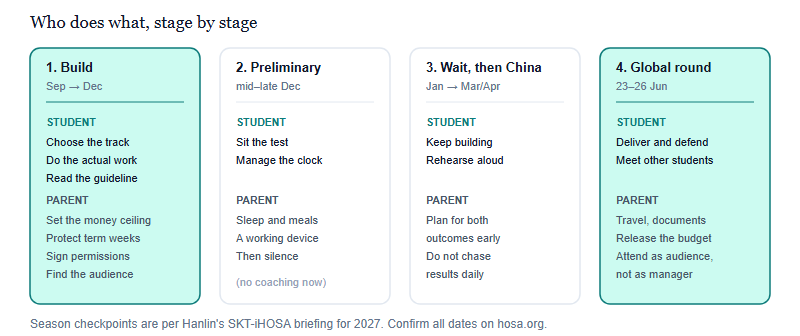
Stage two deserves emphasis because it is where families most often do harm. The 2027 online first round for the Foundational (ATC) track runs 45 minutes with 45 single-answer questions plus five tie-break items (per Hanlin's briefing; confirm officially). Forty-five minutes. Nothing a parent says in the preceding week meaningfully changes a forty-five-minute test, and a great deal of what parents say raises the resting anxiety a student carries into it. The highest-value parental contribution that week is a boring house.
The most expensive mistake: a helpful adult writing the work
This is worth stating plainly because it is common, it is usually well-intentioned, and it reliably backfires. A parent — or a tutor, or an older sibling — looks at a rough draft, sees how much better it could be, and improves it. Sometimes considerably. The student submits work they could not have produced and, more importantly, cannot fully explain.
The structural problem is that competition work does not stay on paper. Where a track requires the student to deliver or defend the work in person — and the Public-Welfare track's standardised deliverables include a public health class taught to a real audience — adult authorship fails at exactly the moment it is examined. A judge asks why a particular measure was chosen over an alternative, and there is a pause. Everyone in the room understands the pause. It is a worse outcome than an honest, rougher project would have produced, and it is unrecoverable.
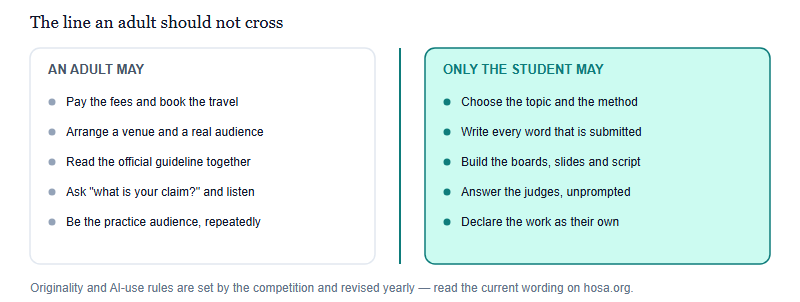
A workable rule for the household: adults may ask questions, and may not supply answers. "What is your claim?" is legitimate and useful. "Your claim should be this" is not. The difference feels trivial in the moment and is enormous over a season, because the first version produces a student who can think under questioning and the second produces one who cannot.

Reading the result without inflating or deflating it
Award structures in the 2027 season work in national bands — roughly a top five per cent band, then five to fifteen per cent, then fifteen to thirty per cent — with regional bands awarded afterwards across five regions once national winners have been removed from the pool (per Hanlin's briefing; the mechanics are the organiser's and should be confirmed officially). Two consequences follow, and both are worth understanding before results arrive rather than after.
| What you hear at home | What it usually means | The useful parental response |
|---|---|---|
| "I got a regional award, not a national one" | A separate pool, awarded after national winners are removed — not a consolation version of the same thing | Ask what they learned, not where they placed |
| "I was just outside the band" | Band boundaries are percentile lines; a small score difference can cross one | Treat it as noise, not as a verdict on the child |
| "Everyone else did better" | Almost always false, and almost always based on the two loudest classmates | Ask for the actual distribution before agreeing |
| "It was a waste of a year" | Usually said within 48 hours of a result | Revisit the conversation in a fortnight, not that evening |
For calibration: five students in our own cohort advanced to the global round last season (de-identified, per Hanlin, our own tally; results vary). That is a real number from one operator's cohort, not a projection for any individual student, and nobody should read it as a probability. What it does illustrate is the shape of a season — a funnel, in which most participants exit at a stage that is nonetheless worth having reached.
Questions worth asking a school, a coach, or us
Whether your child is supported by a school chapter, an external programme, or nobody at all, the following questions separate a serious arrangement from a marketed one. Ask them early, and listen carefully to hedging.
- "Who will actually write this?" The only acceptable answer is the student. Any answer involving templates, sample projects to adapt, or editing that rewrites content should end the conversation.
- "What does the fee cover, itemised?" Ask for the list in writing, including what is not covered — travel and accommodation for a later round are frequently separate.
- "What happens if my child does not advance?" A serious answer describes what the student keeps: the project, the data, the rehearsed explanation, the transferable subject knowledge.
- "Which track are you recommending, and why this one for this student?" A recommendation that does not reference your child's subjects, year group and English confidence is not a recommendation. The comparison of the ATC, CCE and BCE tracks is the vocabulary you need for that conversation.
- "What are the hours per week, honestly, in November?" Ask about the worst month, not the average.
- Anything framed as an admissions guarantee. Walk away. No competition result causes a university offer, and any programme claiming otherwise is telling you something about itself.
What a season is actually for
The honest case for a competition season is not the certificate. It is that a student who has read a real guideline, built something to a deadline, defended it to an adult who was not obliged to be kind, and then measured whether it worked, has done something most sixteen-year-olds have never done. That capability shows up later in interviews, in personal statements, in laboratory work and in the first year of a demanding degree — and it shows up whether or not the result was a top band.
If the season reaches an international conference stage, it also changes what the student thinks is normal, which is harder to quantify and often more durable; the guide to how a HOSA international conference runs gives a realistic picture of that end of the process. Parents who hold that frame tend to run better seasons than parents who hold a target. The work is the same. The house is calmer, and the student is more likely to still be doing this in two years.
Questions parents ask
How many hours a week should I expect?
It varies by track and peaks well above the average in the weeks before a deadline. Ask any coach about the worst month, not the mean.
Is it acceptable for me to proofread?
Ask questions rather than supply corrections. Originality and AI-use rules are set by the competition and revised yearly — check hosa.org.
Will this improve my child's university chances?
No competition result causes an admissions outcome. What it can produce is evidence and capability the student can genuinely speak to.
My child did not advance. What now?
Wait a fortnight before drawing conclusions, then look at what was kept: the project, the data and the rehearsed explanation all carry forward.
Published by the HOSA (SKT-iHOSA) editorial desk, operated by Hanlin Education for China-based international-school students. Official rules are set by the competition and change yearly — confirm current details on hosa.org. Errors are corrected within 7 working days.

Oct 20, 2026
iHOSA ATC Division I vs II: Allocating Study Time by Weighting Differences
Students in grades 9-10 and 11-12 face different topic weightings in the iHOSA ATC Biology and Chemistry exams. This guide breaks down…
Oct 17, 2026
iHOSA Biology Explanations: Connect a Feedback Loop to a Change in the Body
Mastering negative and positive feedback loops is essential for iHOSA Biology. Learn how to connect physiological mechanisms to observable changes with worked…
Oct 15, 2026
iHOSA Health Education: Test Whether an Audience Understood Your Message
In iHOSA Health Education, testing whether your audience understood your message is not an afterthought—it is the core deliverable. Learn how to…