
Most competition writing by second-language students does not fail on grammar. It fails because a judge cannot find the claim, cannot see which numbers are yours, and cannot tell what you want them to do about it. Those are structural problems, and they are fixed in a fixed order — structure, then evidence, then sentences, then terminology. Never all at once.
Where the writing load actually sits
The three tracks put very different demands on your English, and students frequently prepare for the wrong one. The Foundational track is a test: in the 2027 season the online first round runs 45 minutes with 45 single-answer questions plus five tie-break items (per Hanlin's briefing; confirm officially). That is a reading-speed problem, not a writing problem — nothing you compose is assessed. The Public-Welfare track is the opposite: it is where nearly all of the composed English lives. If you are still choosing between them, the comparison of the ATC, CCE and BCE tracks sets out what each one asks for.
| Track | English you produce | Who receives it | What failure looks like |
|---|---|---|---|
| ATC (Foundational) | None that is assessed — the demand is reading under a clock | Nobody; the test is scored on answers alone | Running out of time on stems, not on knowledge |
| CCE (Professional / clinical) | Documentation and spoken explanation; formats set by the competition and revised yearly — read the current guideline | An adult evaluator, in the room, often interrupting | Fluent writing, then hesitation when questioned |
| BCE (Public-welfare / project) | The project record, a 30-second public-service advertisement script, and a public health class delivered to a real audience | Judges, plus an actual audience who are not being graded and will simply stop listening | A good project nobody can restate afterwards |
Note the third column. The BCE class has an audience with no obligation to you. That is the single most useful editing test available to a student writer, because a bored fourteen-year-old at the back of a room is a more honest reviewer than any teacher.
The failure is structural, not grammatical
School English teaching in most international programmes rewards fluency, range and correctness. Competition judging rewards something narrower: can the reader locate the claim, trace the evidence to it, and see what follows. A grammatically flawless paragraph that buries its claim in the fourth sentence scores worse than a plainer paragraph that opens with it.
Three patterns cause most of the damage, and all three are invisible to a spell-checker. The first is the delayed claim — four sentences of context before anything is asserted, usually because the student is writing in the order they thought in. The second is the untraceable number: a percentage appears with no year, no source, and no indication whether it came from a paper or from the student's own survey. The third is uniform hedging, where every sentence is equally tentative, so the reader cannot tell which findings you are confident about and which you are not.
The four passes, in order
The method is simple and the discipline is the hard part: one problem per pass, and never fix a sentence during a structure pass. Students who revise everything simultaneously spend an hour polishing a paragraph that a structure pass would have deleted.
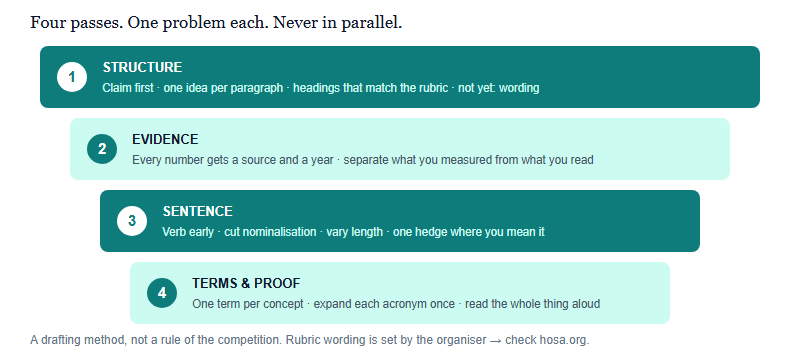
Pass one asks a single question of every paragraph: what does this assert, and is that assertion in the first sentence? Paragraphs that cannot answer are either merged or deleted. Pass two goes through the document hunting numbers, and attaches to each one a source and a year, and a clear marker of whether it is yours or borrowed — "in our survey of 118 students in March 2027" reads very differently from "studies show". Pass three is the first time you are permitted to care about wording. Pass four is mechanical: consistent terminology, acronyms expanded on first use, and a full read-aloud, which catches more than a silent proofread ever will.

Six failure modes specific to second-language scientific English
These are the patterns that recur most often in work by strong students whose English is otherwise excellent. Each example below is invented for illustration.
- Nominalisation. "The implementation of a screening procedure was carried out" → "We screened 120 students." Hidden verbs make writing longer and vaguer at the same time, and they are the single most common marker of translated scientific prose.
- Undifferentiated hedging. "This may possibly perhaps suggest" → "This suggests." Hedge once, where you genuinely have a limitation, and state everything else plainly. Hedging everything reads as not knowing which parts are solid.
- Register slips in clinical vocabulary. "Patients felt very painful" → "Patients reported severe pain." Similarly, "cure" where you mean "treat" or "manage" — a small word choice that changes a claim into an overclaim.
- The chained sentence. Three clauses joined by "and" and "so", carrying two separate findings. Split it. In English scientific prose the full stop is a structural tool, not a stylistic one.
- The translated opener. "With the rapid development of modern society, health problems have attracted wide attention." Delete it. It turns up constantly in the first drafts our own teaching team reads, and asserts nothing; the paragraph almost always improves by starting at its second sentence.
- Article drift. "We designed questionnaire and gave to students" → "We designed a questionnaire and gave it to the students." Not a comprehension problem, but a fluency signal a judge notices immediately.
None of these are about vocabulary size. They are habits, which means they are trainable within a season — but only if you can see them, which is what the error log at the end of this piece is for.
One project, three lengths
The BCE track forces a compression exercise most students have never done: the same project ends up existing as the record you keep, as a taught class, and as a thirty-second public-service advertisement. Thirty seconds of speech at an ordinary presenting pace is roughly seventy to ninety words — that is arithmetic from a normal speaking rate, not a rule from the competition, but it is close enough to plan with. Time your own reading aloud before you write to a word count.
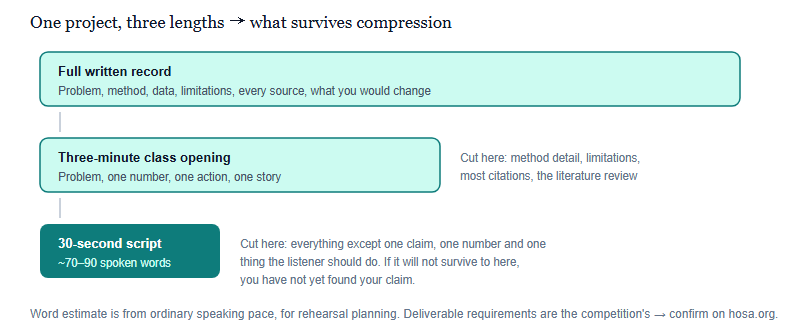
Work downward, never upward. Students who draft the thirty-second script first almost always produce a slogan with no project behind it, and the gap shows the moment anyone asks a follow-up question. Students who draft the full record first find that the script writes itself in about twenty minutes, because by then they know which single number matters.
There is a diagnostic buried in this. If you cannot compress your project into seventy words without losing the point, the problem is not your English. It is that the project has two claims, or none. Go back to the record and find out which.
Build an error log, then use it before every submission
Corrections do not transfer unless they are recorded. Keep a single running table — four columns, nothing elaborate — and add a row each time a teacher, coach or teammate marks something. Within a few weeks the rows stop being random and start clustering, because most writers repeat a small number of patterns rather than making fresh errors each time.
| Date | What I wrote | Corrected to | Pattern name |
|---|---|---|---|
| 12 Oct | "The conduction of the survey was finished in September." | "We ran the survey in September." | Nominalisation |
| 19 Oct | "About 60% of students may possibly have low awareness." | "In our survey, 61 of 104 students could not name a symptom." | Vague hedge, untraceable number |
| 2 Nov | "This programme can cure the sleep problem of teenagers." | "This programme aims to improve sleep habits." | Overclaim / register |
Before any submission, read only the fourth column, then search your draft for those patterns specifically. This takes about ten minutes and catches more than a full re-read, because you are looking for named things rather than hoping to notice something. The same log is the fastest preparation for defending your work aloud, since the patterns that weaken your writing are usually the ones that weaken your spoken answers — and by the time you reach an international conference stage, described in the guide to how a HOSA conference runs, you will be doing both under time pressure.
One closing note on scope. None of this is about writing more impressively. A judge reading twenty projects in an afternoon is not looking for range; they are looking for a claim they can restate to a colleague afterwards. Plain, traceable and compressible beats elaborate every time, and it is a far more achievable target for a student working in a second language. For a wider view of how these deliverables sit inside the season, the overview of HOSA and the SKT-iHOSA pathway is the place to start.
Questions students ask
Does the ATC round require any writing?
No composed writing is assessed — the 2027 first round is single-answer questions under a clock, so the English demand is reading speed.
Can I write in Chinese first and translate?
You can draft ideas that way, but translated prose carries nominalisation and idiom that judges notice. Do pass three directly in English.
How long should a 30-second script be?
Roughly 70 to 90 spoken words at an ordinary pace. Time your own reading aloud rather than trusting a word count.
May I use AI tools to edit my English?
Originality and AI-use rules are set by the competition and revised yearly — read the current wording on hosa.org before relying on any tool.
Published by the HOSA (SKT-iHOSA) editorial desk, operated by Hanlin Education for China-based international-school students. Official rules are set by the competition and change yearly — confirm current details on hosa.org. Errors are corrected within 7 working days.

Oct 20, 2026
iHOSA ATC Division I vs II: Allocating Study Time by Weighting Differences
Students in grades 9-10 and 11-12 face different topic weightings in the iHOSA ATC Biology and Chemistry exams. This guide breaks down…
Oct 17, 2026
iHOSA Biology Explanations: Connect a Feedback Loop to a Change in the Body
Mastering negative and positive feedback loops is essential for iHOSA Biology. Learn how to connect physiological mechanisms to observable changes with worked…
Oct 15, 2026
iHOSA Health Education: Test Whether an Audience Understood Your Message
In iHOSA Health Education, testing whether your audience understood your message is not an afterthought—it is the core deliverable. Learn how to…