
You can rehearse far more than you think, and far less than the internet implies. Sequence, spoken narration, checklist discipline, timing and error recovery are all trainable at a desk with no equipment at all. Hands-on technique is not: it needs a manikin, an instructor and a course. Knowing which is which keeps your preparation honest and stops you claiming experience you cannot defend.
The access gap, stated plainly
American health-science competition culture quietly assumes a background that most China-based students do not have. It assumes a school health-science classroom with practice equipment, a teacher certified to supervise skills, a local first-responder programme that takes teenagers, and a route into a clinical setting through a structured volunteer scheme. In mainland China, hospital shadowing for under-18s is rare and, where it happens at all, tends to depend on a personal connection rather than an open programme. Most international schools have a health office rather than a skills lab. Across the China-based cohorts we work with, this is the most consistent structural difference we see, and it is the one students most often try to solve by pretending it does not exist.
Pretending is the expensive option. An application reader or a judge only has to ask one follow-up question — who supervised you, how many times did you do it, what went wrong the first time — and an invented clinical placement stops being an advantage and becomes a credibility problem. The productive response is to separate the parts of performance that require access from the parts that do not, then train the second group to a level that access alone would never produce.
One boundary first. Which events are judged on performing a skill, what equipment is provided, what time limit applies and what a judge is instructed to look for are all set by the event guideline, and guidelines are revised yearly — read yours and confirm the current wording on hosa.org. If you are still choosing between a test-based route and a performance route, the comparison of the ATC, CCE and BCE tracks sets out what each one asks of you. Everything below is about method, not about rules.
What actually transfers without a clinic
Watch a strong performance and a weak one side by side, and the gap is usually not manual dexterity. It is that one student knows what comes next and the other is searching. Six competencies carry most of that difference, and none of the six needs equipment at all.
- Sequence. The steps, in order, produced from memory without prompting. This is pure retrieval practice, and it is the foundation everything else sits on — you cannot pace a procedure you are still trying to recall.
- Narration in English. Saying what you are doing and why, while you do it. Nobody can credit reasoning they cannot hear, and for a second-language speaker the sentences have to be automatic before the pressure arrives. Rehearse the exact phrases, not the general idea.
- Checklist discipline. Building your own checklist from the published guideline, then running against it and scoring yourself honestly. In the cohorts we work with, students who write their own checklist tend to outperform students who read someone else's, because the writing is where the guideline actually gets read.
- Timing. Knowing where you should be at the halfway mark. Almost every overrun we see is caused by spending too long on the opening steps, which are the comfortable ones.
- Error recovery. What you do after a mistake: name it, correct it, carry on. Untrained candidates freeze or pretend it did not happen. A short, calm correction is a far better look than a flawless run that never gets tested.
- Setup habits. Introducing yourself, stating what you are about to do, hand hygiene, keeping the working area ordered. These cost nothing to rehearse and are the first things an observer notices.
Only the manual technique underneath these — the hands-on part — needs a room and equipment. All six are limited by how you spend forty minutes, not by whether a hospital will have you.
Green, amber and red: what you may practise, and what you must not
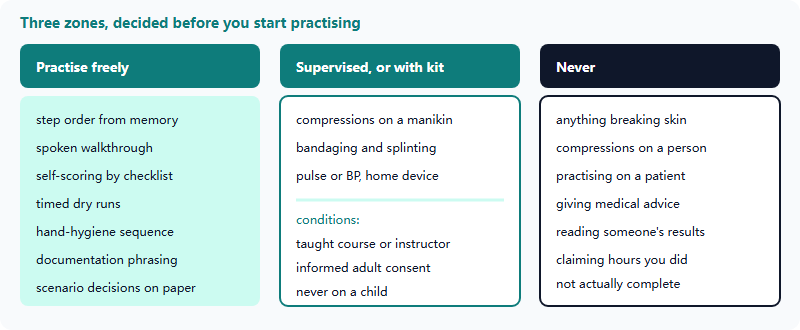
This is the part of preparation where enthusiasm becomes a safety issue, so it is worth being blunt. Chest compressions performed on a healthy person can break ribs; compressions are taught on a manikin for exactly that reason and there is no version of this rule that bends for a keen student. Anything that breaks skin is out of bounds entirely. And measuring or interpreting someone's health data is not a game — a home blood-pressure reading is not a diagnosis, and you are not in a position to tell anyone what theirs means.
| Zone | Examples | Condition | Why the line sits here |
|---|---|---|---|
| Green — practise freely | Step order from memory; spoken walkthrough in English; self-scoring against your checklist; timed dry runs; hand-hygiene and glove sequence; written documentation and handover phrasing; scenario decisions on paper | None beyond a quiet room and a phone camera | Nothing here touches another person or any device, so the only risk is that you skip it |
| Amber — only with proper kit or a trained supervisor | Compressions and rescue-breath sequence on a manikin; bandaging, slings and splinting; taking pulse or blood pressure with a home device | A taught course, or an adult who has given informed consent and understands it is practice; never on a child, and never on anyone who cannot consent | Technique learned wrongly is worse than technique not learned, and it is very hard to unlearn |
| Red — never | Injections, blood sampling or anything that breaks skin; compressions on a live person; practising on a patient; giving medical advice or interpreting anyone's results; claiming clinical hours, shadowing or patient contact you did not have | No condition makes these acceptable | Two of these can injure someone; the rest end your credibility the moment anyone checks |

The forty-minute rehearsal loop
Volume of practice matters less than structure. A repeatable loop beats an occasional long session, because the loop generates feedback and the long session mostly generates fatigue. Build the checklist once, from the published guideline for your own event, then run the four repeating stages twice a week.
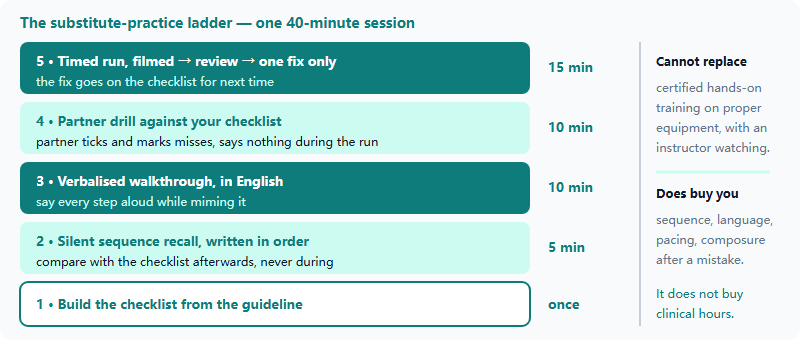
Three rules make the loop work. The partner stays silent during the run and gives feedback only from the checklist afterwards, because live coaching teaches you to perform with a coach present. The camera is non-negotiable: students often believe they narrated a step they did not narrate, and the recording settles it in four seconds. And you take exactly one fix out of each session — the largest one — and write it at the top of the checklist. Attempting to correct five things at once produces a run that is worse in all five.
Legitimate routes to real hands-on exposure in mainland China
The green zone will take you a long way, but if you want genuine equipment time there are realistic routes. None of them requires a connection inside a hospital.
- A certified first-aid course. Red Cross branches and various training providers run public first-aid and resuscitation courses in many Chinese cities. Availability, price, the minimum age accepted, the certificate issued and how long it stays valid all vary by city and provider — ask directly before you enrol, and specifically ask whether the course includes manikin time rather than lectures only. A dated certificate from a named provider is also the cleanest possible thing to put on a form later.
- Your own school. The health office, the PE department's sports-injury provision, and any teacher who holds a first-aid qualification are all closer than a hospital and considerably more likely to say yes. Some schools will fund a group course if a student asks with a plan attached.
- University outreach. Open days, summer programmes and laboratory tours at medical schools give real exposure to an environment and to people who work in it. Record it accurately as what it was — a visit, a lecture, a tour — and it remains genuinely useful.
- Non-clinical volunteering. Health-education material, registration and reception duties at community events, translation, structured visiting programmes for older residents. The tasks are real, the contribution is real, and none of it requires you to describe yourself as having done anything clinical.
Notice what is missing from that list: unsupervised practice on friends, and any arrangement that puts you next to patients without a defined, supervised role. Those are not shortcuts to experience; they are shortcuts to a problem.
Saying it honestly, to a judge and later on a form
Everything above becomes worth more if you describe it precisely. The sentence that works in front of a judge sounds like this: I have rehearsed this sequence fourteen times against my own checklist and completed a certified first-aid course in March; I have not performed it on a patient. Every clause is checkable, the limitation is volunteered rather than extracted, and the person listening now knows exactly what your competence rests on. Compare that with a vague implication of hospital experience, which survives right up until the first follow-up question.
The same discipline applies on any application form. Name the provider and the date of a course rather than gesturing at “medical training”. Describe a hospital visit as a visit. Give the number of rehearsals if you counted them, because a counted number is a stronger signal than any adjective. If your season goes as far as a conference-stage event, the conference guide covers what that environment demands; and if a teacher or parent needs the plain-English version of what the competition actually is before they help you organise any of this, send them the overview of HOSA.
The access gap is real and it is not your fault. What is within your control is that a student who has drilled sequence, language, pacing and recovery for eight weeks arrives visibly better prepared than one who spent the same eight weeks looking for a hospital that would take them.
Frequently asked questions
Can I practise chest compressions on a friend?
No. Compressions can injure a healthy person. Use a manikin in a certified course, and rehearse only the spoken sequence elsewhere.
Does the judging expect real clinical experience?
Check what your event guideline actually assesses on hosa.org. Rehearsable competence, not hospital hours, is the part you control.
How do I get hands-on exposure in mainland China?
Certified first-aid courses, your school health office and non-clinical volunteering are the realistic routes. Availability varies by city.
Can I call a hospital visit clinical experience?
Describe exactly what you did and for how long. A tour is a tour, and inflating it is the fastest way to fail an interview probe.
Published by the HOSA (SKT-iHOSA) editorial desk, operated by Hanlin Education for China-based international-school students. Official rules are set by the competition and change yearly — confirm current details on hosa.org. Errors are corrected within 7 working days.

Oct 20, 2026
iHOSA ATC Division I vs II: Allocating Study Time by Weighting Differences
Students in grades 9-10 and 11-12 face different topic weightings in the iHOSA ATC Biology and Chemistry exams. This guide breaks down…
Oct 17, 2026
iHOSA Biology Explanations: Connect a Feedback Loop to a Change in the Body
Mastering negative and positive feedback loops is essential for iHOSA Biology. Learn how to connect physiological mechanisms to observable changes with worked…
Oct 15, 2026
iHOSA Health Education: Test Whether an Audience Understood Your Message
In iHOSA Health Education, testing whether your audience understood your message is not an afterthought—it is the core deliverable. Learn how to…