
HOSA is an American organisation, and its material is written for readers who grew up with mg/dL, Fahrenheit, pounds and a US health system. If your science education has been in metric SI units and British spelling, you are reading in a second language and a second measurement system at once. That second layer is small, finite and learnable in about six weeks — and almost nobody schedules it.
Why the conversion layer exists at all
HOSA is US-based and recognised by the U.S. Department of Education — it describes itself as an international organisation, but its events, references and worked examples are drafted to American conventions. That is not a criticism; it is simply the origin of the material. But it means a China-based student meets three obstacles in one question rather than one: the science, the English, and a set of conventions nobody ever taught them because their own textbooks never needed them. If you are still deciding which track you are preparing for, the comparison of the ATC, CCE and BCE tracks is the place to start; this article is about the layer underneath all three.
Timing makes the problem sharper than it looks. In the 2027 season the iHOSA online first round runs 45 minutes for 45 single-answer questions plus five tie-break items, covering biology, chemistry and psychology on the Foundational track. That is roughly sixty seconds per question. Sixty seconds is enough time to think about physiology. It is not enough time to also work out from first principles whether 5.6 is a plausible glucose value in the units on the page. Conversion has to be automatic before test day, or it eats the thinking time.
One boundary before we start: whether any particular convention appears in your event is a question only the event guideline can answer, and guidelines are revised yearly — confirm the current references and content outline on hosa.org. What follows is stable background knowledge about the material you will be reading, not a claim about what will be asked.
Ten numbers, and the ones that never change
Most of the conversion burden is carried by fewer than a dozen quantities. Learn the factor, then practise until you can produce a rough answer without arithmetic — you almost never need three decimal places, you need to know whether a number is normal, high or impossible.
| Quantity | Usual form in China / SI | Usual form in US material | Convert | Worked example |
|---|---|---|---|---|
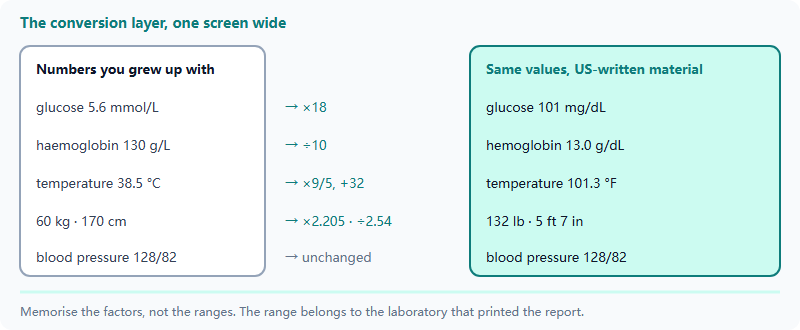
| Glucose | mmol/L | mg/dL | × 18 | 5.6 mmol/L → 101 mg/dL |
| Total, LDL, HDL cholesterol | mmol/L | mg/dL | × 38.7 | 3.0 mmol/L → 116 mg/dL |
| Triglycerides | mmol/L | mg/dL | × 88.6 | 1.7 mmol/L → 151 mg/dL |
| Creatinine | µmol/L | mg/dL | ÷ 88.4 | 88 µmol/L → 1.0 mg/dL |
| Haemoglobin | g/L | g/dL | ÷ 10 | 130 g/L → 13.0 g/dL |
| Calcium | mmol/L | mg/dL | × 4.0 | 2.4 mmol/L → 9.6 mg/dL |
| Urea nitrogen | urea, mmol/L | BUN, mg/dL | × 2.8 | 5.0 mmol/L urea → 14 mg/dL BUN |
| Body temperature | °C | °F | × 9/5, then + 32 | 38.5 °C → 101.3 °F |
| Body mass | kg | lb | × 2.205 | 60 kg → 132 lb |
| Height | cm | ft and in | ÷ 2.54 | 170 cm → 5 ft 7 in |
| Blood pressure | mmHg | mmHg | no change | 128/82 either side of the Pacific |
| Body mass index | kg/m² | kg/m² | no change | 60 kg, 170 cm → 20.8 both ways |
Two entries in that table deserve a warning. Urea nitrogen is not a unit change but a change of quantity: the American report measures the nitrogen in urea, the SI report measures urea itself, which is why the factor is 2.8 rather than something tidy. And body mass index is the trap that catches careful students, because the number is identical but the American formula looks completely different — pounds divided by inches squared, multiplied by 703. Both routes give 20.8 for a 60 kg, 170 cm body. If you calculate 20.8 one way and 0.03 the other, you have forgotten the 703, not discovered a discrepancy.
A reference range is a property of a laboratory, not a fact
Here is where second-language students lose marks they did not need to lose. They memorise a range from a revision sheet — fasting glucose 70 to 99 mg/dL, haemoglobin 12 to 16 g/dL — and then treat it as though it were a constant of nature, like the boiling point of water. It is not. A reference interval is generated by a specific laboratory from a specific reference population using a specific assay, which is exactly why every real report prints its own ranges in the column next to your result. Two hospitals in the same city can publish slightly different intervals for the same analyte and both be correct.
The practical consequences are worth internalising:
- Ranges are usually sex-specific and often age-specific. Haemoglobin intervals differ for adult men and women; many paediatric intervals differ again, and by age band.
- The units decide the shape of the number. A haemoglobin of 13 is normal in g/dL and catastrophic in g/L. Reading the unit before the number is a habit worth drilling.
- Ranges shift when the guidance shifts. Blood-pressure and lipid thresholds have been redefined more than once by professional bodies, so a number copied from an old revision sheet may be describing a superseded classification.
- An answer that quotes a range should say whose range it is. In a written report or a judged presentation, “above the reference interval reported by the testing laboratory” is stronger and safer than “above normal”.
The exam-technique version of this is simple: learn the order of magnitude and the direction of clinical concern rather than the exact boundary. Knowing that fasting glucose in mg/dL sits in double digits for most healthy adults, and that a figure in the two hundreds is a serious finding, will carry you through far more questions than a memorised cut-off you half-remember under time pressure.

American spelling, and drug names that change country
Students from IGCSE, A-Level and IB Diploma backgrounds have generally been taught British spelling, and the medical vocabulary is where the two systems diverge most visibly. You do not need to change how you write — you need to recognise both instantly, and then stay internally consistent inside any single document you produce. A report that spells it “anaemia” on page one and “anemia” on page three looks careless in a way that has nothing to do with your science.
| Category | British / Commonwealth form | American form |
|---|---|---|
| The ae / oe collapse | anaemia, haemoglobin, haemorrhage | anemia, hemoglobin, hemorrhage |
| paediatric, orthopaedic, anaesthesia | pediatric, orthopedic, anesthesia | |
| oesophagus, oedema, coeliac | esophagus, edema, celiac | |
| diarrhoea, leukaemia, foetus | diarrhea, leukemia, fetus | |
| Chemistry words | sulphur, aluminium | sulfur, aluminum |
| Drug names | paracetamol | acetaminophen |
| adrenaline, noradrenaline | epinephrine, norepinephrine | |
| salbutamol, lignocaine | albuterol, lidocaine |
The drug names are the ones that genuinely cost marks, because they are not spelling variants at all — they are different approved names for the same molecule, and no amount of phonetic guessing gets you from paracetamol to acetaminophen. Adrenaline and epinephrine is the pair most likely to appear in any emergency-related material, so learn that one first. Add to this a fourth category that is not vocabulary at all: American material writes dates month-first, so 09/11/2026 means 11 September, not 9 November. When you are reading a deadline off a US-published page, read the month name if one is offered and convert deliberately if it is not.
The system layer: who does what, who pays, who you call
The hardest part of the conversion layer is not arithmetic. It is that American health-science material assumes a health system you have never used, with a workforce structure, a payment mechanism and an emergency architecture that differ from the ones you grew up with. Chinese hospitals are organised around departments and a largely public insurance framework; American material assumes licensed roles with defined scopes of practice and a private insurance vocabulary that appears in health-careers content constantly.
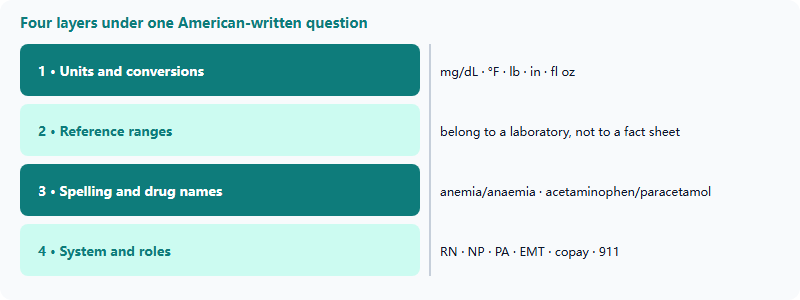
Four clusters cover most of it. Nursing and allied roles: certified nursing assistant, licensed practical or vocational nurse, registered nurse, and the advanced practice roles such as nurse practitioner; alongside them the physician assistant, the respiratory therapist, and physical and occupational therapists. Physicians and training: the US route runs four years of undergraduate study, then medical school, then residency, and it produces both MD and DO degrees, which is unlike the direct-entry route from secondary school used in the United Kingdom and in mainland China. Emergency response: emergency medical technicians and paramedics operate at defined certification levels, and the number people dial is 911, where mainland China uses 120 for medical emergencies. Paying for care: premium, deductible, copay, coinsurance, out-of-pocket maximum, in-network, plus Medicare and Medicaid as the two large public programmes. None of that is difficult; it is simply invisible until someone lists it.
One more piece belongs here because it turns up in any discussion of records or data. American material treats HIPAA, the 1996 federal statute, as the default frame for health-information privacy; mainland China's equivalent frame is the Personal Information Protection Law that took effect in November 2021. If your project handles data about real people, you are governed by the law where you collect it, not by the law in the textbook — a distinction worth stating explicitly in any written method.
Building the layer in six weeks without stealing content time
This does not deserve a study block of its own, because it is not content — it is the interface to content. Two sessions of twenty minutes a week is enough, and the sessions work best when they are attached to reading you were going to do anyway.
- Weeks 1 and 2 — the factors. Ten conversions on ten cards, tested in both directions until you can produce an approximate answer in under five seconds. Approximation is the goal: 5.6 times 18 is “about 100”, and “about 100” is enough to answer most questions.
- Weeks 3 and 4 — the two-column glossary. One page, British form on the left, American form on the right, added to whenever you meet a new pair rather than written out in advance from a list.
- Week 5 — the report drill. Take one anonymised lab report or one published health statistic, restate every number in the other system, and write two sentences in English explaining what the values suggest and what you cannot conclude from them. This is the single highest-value exercise on the list, because it rehearses units, vocabulary and cautious phrasing simultaneously.
- Week 6 — the system page. Read one page a week from a US public-health or consumer-health source and note only the system words: the roles, the payment terms, the agency names. You are not learning policy, you are learning which nouns appear.
Two last practical notes. If you will ever produce a printed document or a display board to an American specification, remember that the default paper is US Letter at 8.5 by 11 inches rather than A4, and that board dimensions in US material are given in inches — a layout designed on A4 will not sit correctly on Letter without adjustment. And if your season reaches an event held in the United States, the whole conversion layer stops being an exam skill and becomes a daily one; the conference-week guide covers what that environment looks like. For a student still deciding whether any of this is worth the effort, our overview of what HOSA is and who it suits is the better starting point.
Frequently asked questions
Do I have to memorise American lab reference ranges?
Memorise the units and the conversion factors. Ranges belong to a laboratory and are printed on the report, so treat any range as local.
Should I write American or British spelling?
Recognise both, then stay consistent inside one report or presentation. Match the spelling of the material you are answering in.
Is blood pressure measured differently in the United States?
No. Blood pressure stays in mmHg everywhere, which makes it one of the few clinical numbers you never have to convert.
How much of this appears on the test?
Only your event guideline can answer that, so confirm on hosa.org. Build the conversion layer anyway, because it speeds up reading.
Published by the HOSA (SKT-iHOSA) editorial desk, operated by Hanlin Education for China-based international-school students. Official rules are set by the competition and change yearly — confirm current details on hosa.org. Errors are corrected within 7 working days.

Oct 20, 2026
iHOSA ATC Division I vs II: Allocating Study Time by Weighting Differences
Students in grades 9-10 and 11-12 face different topic weightings in the iHOSA ATC Biology and Chemistry exams. This guide breaks down…
Oct 17, 2026
iHOSA Biology Explanations: Connect a Feedback Loop to a Change in the Body
Mastering negative and positive feedback loops is essential for iHOSA Biology. Learn how to connect physiological mechanisms to observable changes with worked…
Oct 15, 2026
iHOSA Health Education: Test Whether an Audience Understood Your Message
In iHOSA Health Education, testing whether your audience understood your message is not an afterthought—it is the core deliverable. Learn how to…