
Stepping into an iHOSA chapter president role is not about having the most impressive resume. It is about whether you can build a club that survives your graduation. Before you commit, you need a clear picture of what the workload looks like, what your school must provide, and how the leadership track connects to regional and national tiers. This article helps you evaluate that decision with concrete planning steps rather than generic encouragement.
Clarify School Support and Responsibilities
Every sustainable iHOSA chapter rests on two foundations: a faculty advisor and administrative backing. Your first task is confirming what your school can actually offer.
Advisor Commitment
iHOSA chapters require a faculty advisor who can supervise meetings, review competition registrations, and certify that school-affiliated activities meet institutional policies. Before running for president, ask:
- Has a specific teacher already agreed to serve as advisor, or is this still open?
- How many hours per week can the advisor dedicate to club business?
- Does the advisor have experience with competitive events, or would they need training alongside members?
If no advisor is confirmed, recruiting one becomes your first campaign priority—not an afterthought.
Administrative and Financial Backing
School support extends beyond a single teacher. You need clarity on:
- Whether the administration recognizes iHOSA as an official club with budget access
- Funding for competition fees, travel to China Station events, or materials for BCE project submissions
- Meeting space availability and scheduling constraints
- Policies on fundraising, external partnerships, and public-facing health education campaigns
Without these elements documented, a chapter president risks presiding over a group that cannot access the full iHOSA experience. The chapter development resources outline what institutional partnerships typically enable.
Build an Academic and Community Activity Plan
A chapter president who merely schedules meetings will see membership dwindle. The role demands programming that justifies members’ time investment.
Align With the Competition Calendar
The 2027 season follows a fixed rhythm. As of September 28, 2026, the initial registration period has closed; if you are already registered or planning for future participation, consult current iHOSA notices for any updated deadlines or supplementary registration opportunities. Primary Station events occur in December 2026; China Station follows in March or April 2027; Global Station convenes June 23–26, 2027. Your club calendar must prepare members for these milestones without overwhelming their academic schedules.
Consider structuring the year around iHOSA’s three activity categories:
| Category | Format | Preparation Needs |
|---|---|---|
| ATC Academic | Individual, 45-minute objective test | Weekly study sessions aligned to AP/IB/A-Level content |
| BCE Service | Team of 3–6, project submission | Concept development, filming, script editing for PSAs; lesson planning for Health Education |
| Leadership Track | Club operations, regional/national roles | Meeting facilitation, cross-school coordination, documentation |
Source: iHOSA 2027 season materials, released June 2026.
Community Engagement Beyond Competition
The BCE Service track offers a natural bridge to community impact. A chapter president can organize health education outreach at local schools or community centers—work that feeds directly into competition projects while building genuine relationships. This is not extracurricular padding; it is how BCE projects gain authenticity and depth.
Distribute Work Instead of Naming a President Only
The most durable chapters reject the single-leader model. As you consider the presidency, design a structure that shares load and develops successors.
Role Distribution That Scales
Typical functional needs include:
- Academic coordinator: Manages ATC study groups, tracks curriculum alignment, coordinates with faculty for subject-specific support
- Project manager: Oversees BCE team formation, deadlines, and submission quality
- Outreach lead: Handles community partnerships, social media, and membership recruitment
- Secretary-treasurer: Maintains records, manages funds, documents decisions for continuity
This structure serves another purpose: it creates a pipeline of experienced members who can assume the presidency without starting from zero. The leadership transition guidance emphasizes how documented roles reduce annual disruption.
The National Council Pathway
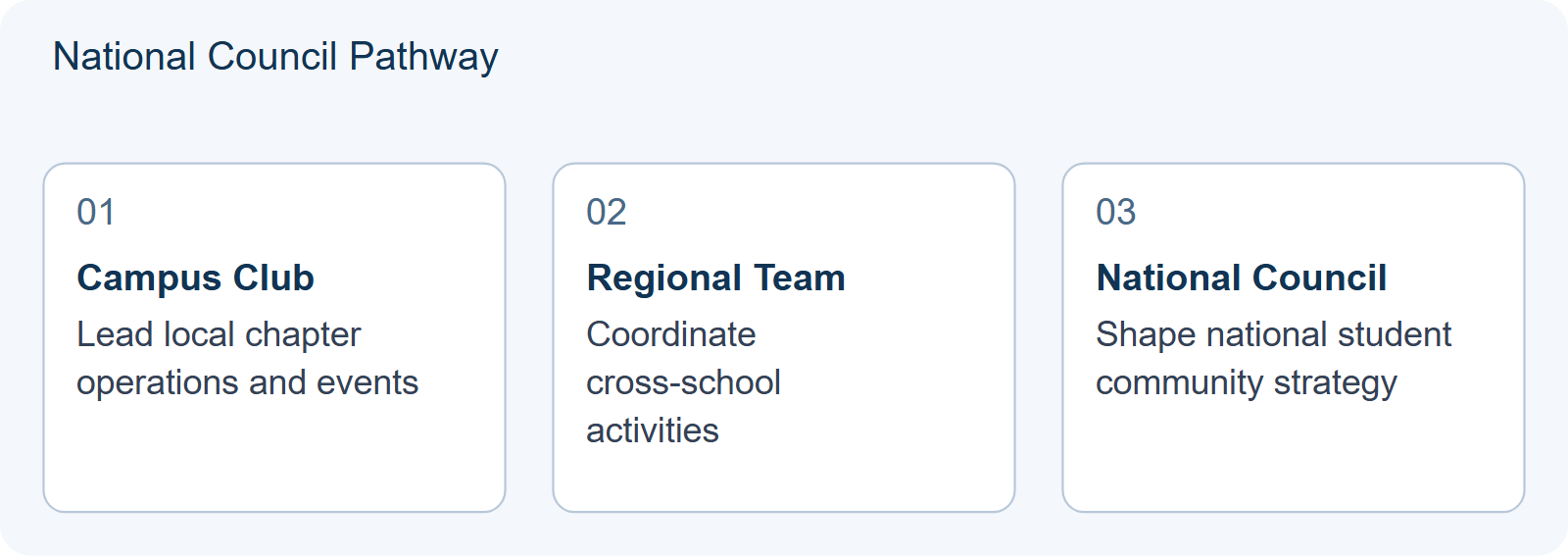
iHOSA’s leadership structure extends beyond individual schools. The progression runs: campus club → regional student leadership team → national council. Each level requires demonstrated contribution to club operations and cross-school collaboration.
For a prospective president, this means your local chapter’s quality directly affects your eligibility for advancement. National council members help shape the broader student community. The pathway rewards sustained organizational investment, not personal ambition alone. Details on regional and national tiers appear in the student leadership progression overview.

Document Projects and Continuity
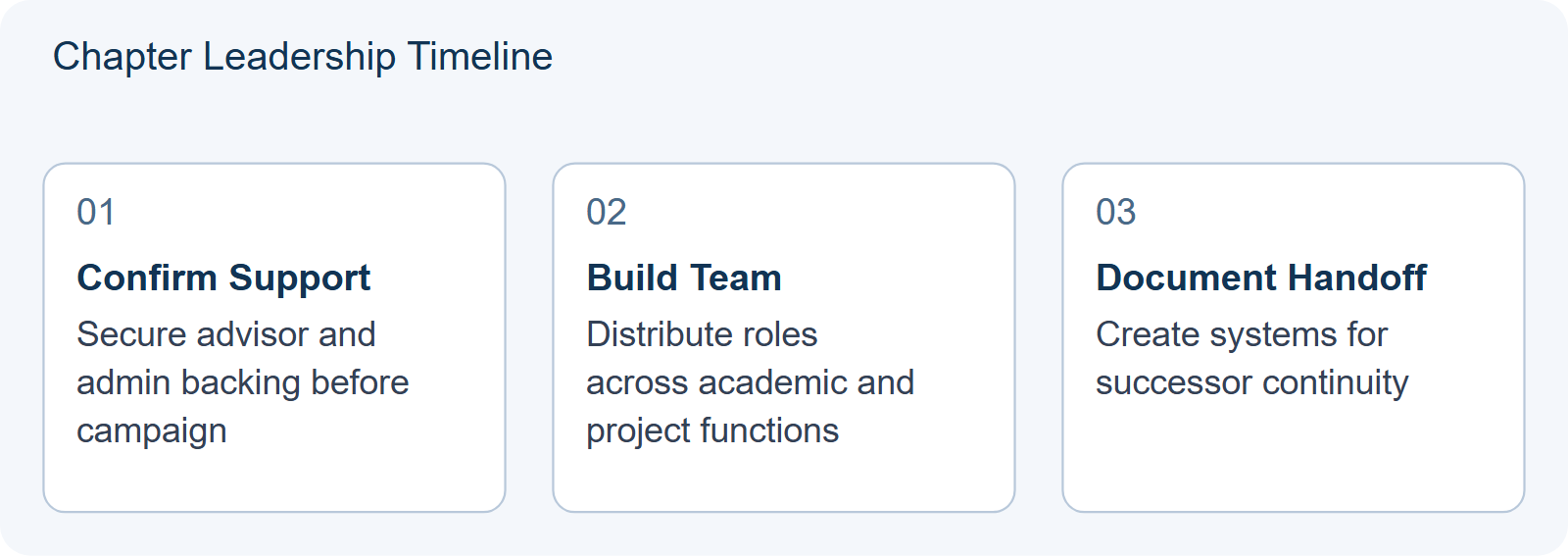
Chapters collapse when knowledge lives only in outgoing leaders’ heads. Your planning must include systems that persist.
Institutional Memory Systems
Before accepting nomination, verify you can implement:
- A shared drive or repository for competition materials, contact lists, and event templates
- Written summaries of what worked and failed in previous years
- Standardized onboarding for new members and new officers
- Financial records with clear handoff procedures
These systems matter most for BCE projects, where teams iterate on past submissions. A 30-second PSA from last year becomes a teaching example; a health education lesson plan can be adapted for new audiences.
Mentorship as Infrastructure
If your school has previously sent members to Global Station, those students represent living documentation. Establishing formal mentorship pairings—documented, with expected contact frequency—transfers tacit knowledge more reliably than occasional advice.
Questions to Clarify Before Committing
Use this checklist to assess readiness without overstating your capacity:
- Can you secure 4–6 hours weekly for club operations during competition season?
- Does your academic schedule accommodate the December Primary Station and potential March/April China Station travel?
- Have you confirmed advisor availability and school policy support?
- Do you have identified peers willing to fill distributed roles?
- Can you articulate a specific community need your chapter would address through BCE projects?
- Are you prepared to document processes for your successor?
Honest negative answers to any item indicate preparatory work still needed—not disqualification, but a signal to build infrastructure before campaigning.
Preparing for a Consultation on Chapter Leadership
If you are exploring iHOSA chapter leadership as part of broader academic planning, preparation improves the value of any guidance you receive. Before contacting advisors or program staff, assemble:
- Your school’s current status: Has an iHOSA chapter existed before, or would this be a new charter? Existing chapters have different needs than startups.
- Confirmed constraints: Advisor availability, budget ceiling, meeting space limitations—the non-negotiables.
- Your competition interests: ATC academic focus, BCE service projects, or both? This shapes club programming priorities.
- Leadership timeline: Are you aiming at campus-level presidency, regional roles, or national council? Each requires different preparation intensity.
With this information organized, consultation can address specific operational questions rather than basic orientation. For students targeting the national council tier, structured mentorship can help navigate the progression from campus operations to cross-school leadership responsibilities.
Note: HOSA-Future Health Professionals is an international organization with its own governance. SKT-iHOSA operates the China division. This article reflects preparation perspectives from that operational context.
Frequently Asked Questions
Does becoming iHOSA chapter president require winning a competition first?
No. Chapter presidency is an organizational role distinct from competition performance. What matters is demonstrated ability to manage club operations, recruit members, and sustain activities. Competition experience helps, but it is not a formal prerequisite.
How much time does chapter presidency typically require per week?
During active preparation periods, expect 4–6 hours weekly for meetings, planning, and member communication. Competition season intensifies this. The role is manageable alongside academics if you distribute work through a team structure rather than centralizing tasks.
Can a new school start an iHOSA chapter without prior participation?
Yes, though it requires additional groundwork: confirming advisor commitment, understanding registration timelines, and building initial member interest. The first year focuses on establishing systems; competition success typically follows in subsequent years.

Oct 20, 2026
iHOSA ATC Division I vs II: Allocating Study Time by Weighting Differences
Students in grades 9-10 and 11-12 face different topic weightings in the iHOSA ATC Biology and Chemistry exams. This guide breaks down…
Oct 17, 2026
iHOSA Biology Explanations: Connect a Feedback Loop to a Change in the Body
Mastering negative and positive feedback loops is essential for iHOSA Biology. Learn how to connect physiological mechanisms to observable changes with worked…
Oct 15, 2026
iHOSA Health Education: Test Whether an Audience Understood Your Message
In iHOSA Health Education, testing whether your audience understood your message is not an afterthought—it is the core deliverable. Learn how to…