
Many students preparing for the iHOSA ATC track assume that one study plan works for everyone, regardless of grade level. The 2027 ATC weighting tables tell a different story. Division I, intended for grades 9-10, and Division II, intended for grades 11-12, do not always reward the same topics with the same emphasis. In Biology, cell life principles and genetics carry different shares by division, while evolution appears as a separate Division II row. In Chemistry, chemical equilibrium is listed only for Division II. Psychology, by contrast, is listed for grades 9-12 without the same division split. If you spend equal hours on every topic, you may over-invest in lower-weight areas and under-invest in rows that carry a full 15% or more. This guide turns the supplied 2027 weighting tables into a practical allocation diagnostic for the HOSA ATC division you will actually enter.
How the 2027 ATC Divisions Are Defined by Grade
The ATC track separates students by grade band. Division I is listed for grades 9-10, and Division II is listed for grades 11-12. This is not just an administrative label. The weighting tables show that older students are expected to handle additional topics, particularly Chemical Equilibrium in Chemistry and Biological Evolution as a separate row in Biology. The online objective assessment is described in the source notes as a 45-minute set of 45 single-choice questions plus 5 tie-breaker single-choice questions. For planning, you can convert topic percentages into relative study blocks without assuming that every row maps perfectly to a fixed number of scored points. The key point is that your division changes the relative value of each topic. For a broader grade-planning view, see iHOSA by Your Grade: A Year 9-10 vs Year 11-12 Planning Guide for China International-School Students.
Biology Weightings: Cell Principles, Genetics and Animal Science by Division
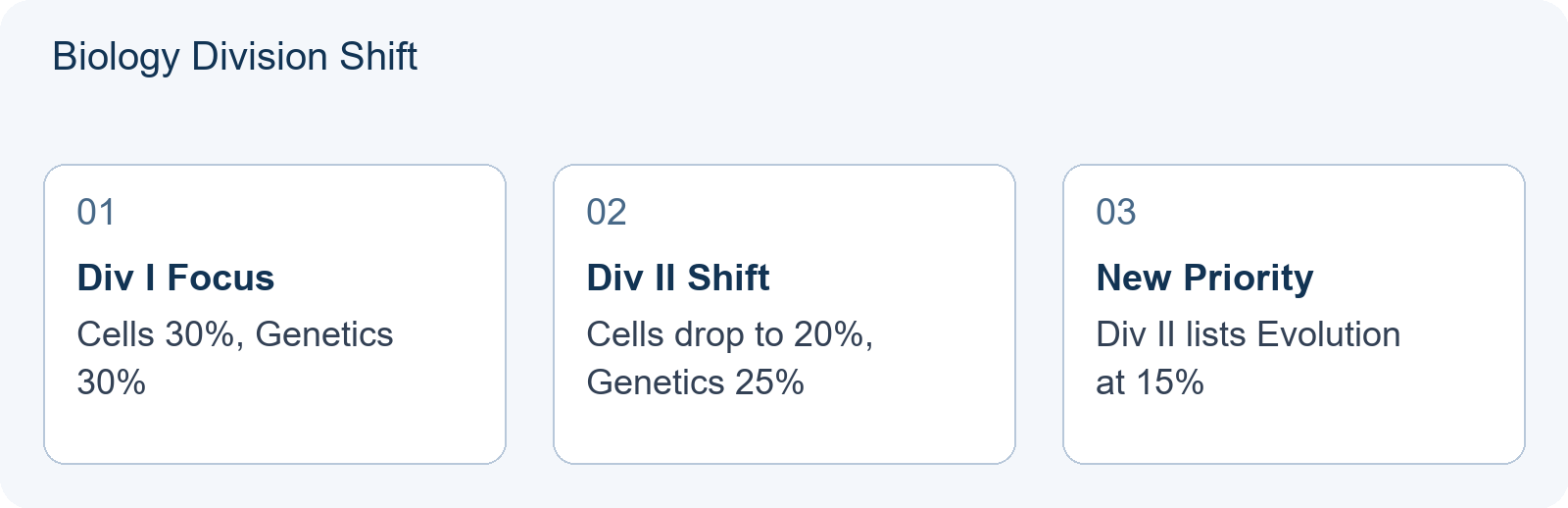
Biology shows the clearest shift between the two divisions. In Division I, Cell Life Principles are listed at 30% and Genetics at 30%. Animal Science is listed at 20% in both divisions. In Division II, Cell Life Principles drop to 20%, Genetics moves to 25%, and Biological Evolution appears as a separate row at 15%. The source table does not list a separate Division I Biological Evolution percentage. That does not necessarily mean evolution is absent from the Division I syllabus; it means the source does not publish it as a separate weighted row. The table also notes that the learning range includes botany, so the listed rows may not sum to 100% on their own.
| Biology Topic | Division I, grades 9-10 | Division II, grades 11-12 |
|---|---|---|
| Cell Life Principles | 30% | 20% |
| Genetics | 30% | 25% |
| Biological Evolution | Not listed as a separate weighting | 15% |
| Animal Science | 20% | 20% |
What does this mean in practice? A Division I student should not copy a Division II student’s plan. If you are in grades 9-10, the table justifies deep work on cell structures, transport, division, and core genetics. If you are in grades 11-12, cell principles remain important but no longer dominate the same way. Division II students need to reserve real time for evolution and for genetics, which is listed at 25% in Division II. Animal Science remains a stable 20% block in both divisions, so it deserves consistent coverage either way. For biology concept practice, see iHOSA Biology Explanations: Connect a Feedback Loop to a Change in the Body.
Chemistry Weightings: Where Division II Adds Equilibrium
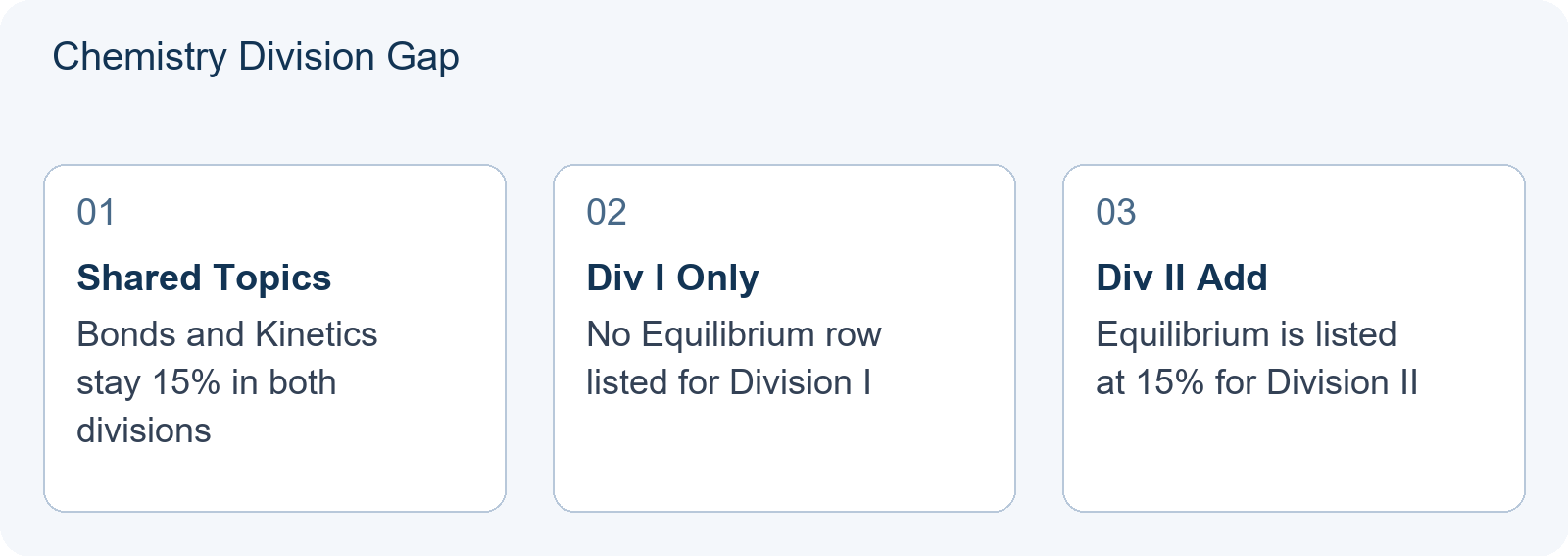
General Chemistry also separates Division I and Division II. Both divisions list Chemical Foundations at 10%, Chemical Bonds at 15%, and Chemical Kinetics at 15%. The differences appear in the middle and upper rows. Division I lists Atoms, Molecules, and Ions at 25%, Stoichiometry at 20%, and Thermodynamics at 15%. Division II lowers these to 20%, 15%, and 10%, respectively. The most important addition is Chemical Equilibrium, listed only for Division II at 15%. This single row changes the shape of a Division II study plan. A student who ignores equilibrium is ignoring a topic with the same listed weight as Chemical Bonds or Chemical Kinetics.
| Chemistry Topic | Division I, grades 9-10 | Division II, grades 11-12 |
|---|---|---|
| Chemical Foundations | 10% | 10% |
| Atoms, Molecules, Ions | 25% | 20% |
| Stoichiometry | 20% | 15% |
| Thermodynamics | 15% | 10% |
| Chemical Bonds | 15% | 15% |
| Chemical Kinetics | 15% | 15% |
| Chemical Equilibrium | Not listed as a separate weighting | 15% |
For Division I, the table still rewards strong early-chemistry foundations: atoms, molecules, ions, and stoichiometry together account for 45%. For Division II, those same areas drop to 35%, while equilibrium enters at 15%. That means a Division II student cannot simply repeat a grade 9-10 chemistry review. Equilibrium problems often require you to connect particle models, reaction direction, and quantitative reasoning. If you are reviewing particle models, see iHOSA Chemistry Explanations: Connecting Particle Models to Observable Properties. Then build equilibrium practice as its own block, not as a small add-on at the end.

Psychology: A Grades 9-12 Subject Without the Same Division Split
Behavioral Health and Psychology are listed for grades 9-12 without a separate Division I and Division II weighting table. The source gives one set of weights: Genetics and Environment 10%, Learning 20%, Memory 20%, Psychological Disorders 35%, and Treatment Methods 15%. This is a major planning difference. A grade 9 student and a grade 12 student preparing for Psychology should not assume that the topic distribution changes by division, because the source does not publish a division-specific split for this subject. The main allocation signal is Psychological Disorders at 35%, followed by Learning and Memory at 20% each.
That does not mean every psychology student has the same background. It means the published weightings do not give you a reason to shift hours between divisions. If you are strong in memory but weak in disorders, the table still tells you to give disorders the largest block. If you are already confident in disorders, do not let that confidence pull hours away from Learning and Memory, which together equal 40%. The source notes also list a high alignment with AP Psychology, but the notes conflict on the exact percentage, so the safer planning move is to use the topic weights rather than the overlap figure.
Diagnostic: Build a Weekly Allocation Table from Your Own Syllabus
To apply the weightings, create a simple diagnostic table. In one column, list each topic from your division’s table. In a second column, write the listed percentage. In a third column, note how many hours you spent on that topic in the past week. Then compare the two columns. If a topic is worth 20% of the listed weighting but receives 5% of your study time, you have found a mismatch. If a topic is not listed as a separate weighting, do not treat it as 0%. Treat it as unallocated in the source table and confirm whether your own syllabus includes it before spending major time on it.
You can also convert percentages into relative blocks. On a 50-item planning base, 10% equals 5 items and 15% equals 7.5 items. On a 45-scored-item base, 10% equals 4.5 items and 15% equals 6.75 items. Round these numbers for planning, not for score prediction. The useful comparison is relative: a 20% row deserves roughly twice the study weight of a 10% row, and a 15% row deserves more attention than a 5% row. Do this calculation separately for Biology, Chemistry, and Psychology because the division rules are not the same across all three.
Labelled Teaching Illustration: Reallocating Two Study Hours After a Weighting Check
This is a hypothetical teaching illustration, not an official scoring guideline.
Imagine a Division II Chemistry student with four weekend study hours. At first, the student spends one hour each on Stoichiometry, Thermodynamics, Chemical Bonds, and Chemical Kinetics. That is four hours, but it ignores Chemical Equilibrium, which is listed at 15% for Division II. The student checks the weightings and sees that Stoichiometry is 15%, Thermodynamics is 10%, Bonds are 15%, Kinetics are 15%, and Equilibrium is 15%. The old plan leaves a full listed row uncovered.
A corrected four-hour plan could be: Equilibrium 1.0 hour, Stoichiometry 0.75 hour, Thermodynamics 0.5 hour, Chemical Bonds 0.75 hour, and Chemical Kinetics 1.0 hour. The revised allocation sums to 4.0 hours. It does not claim that these exact decimals match official question counts. It simply shows how a weighting check can force a neglected 15% row into the schedule without adding study time. If the student has more hours available, the next move would be to raise Stoichiometry or Bonds toward the same relative block as Kinetics.
Action Plan: What to Confirm Before Buying or Reusing Prep Materials
Before you buy a third-party book or reuse a previous season’s notes, verify that the material matches the 2027 ATC syllabus. The reform summary states that Biology removed some botany details and Chemistry removed liquid and solid chapters. If your resource spends many pages on those areas, it may not match the current weighting emphasis. Next, confirm which division you are entering. A grade 10 student using a Division II Chemistry table will overstudy equilibrium and understudy the earlier foundational rows. A grade 11 student using a Division I Biology table may underprepare evolution as a separate row.
Then rebalance your weekly plan using the tables above. Keep a simple rule: high-weight rows get more hours, not just more pages. For Biology, Division II students should build evolution into the weekly rotation. For Chemistry, Division II students should schedule equilibrium practice until it feels as normal as stoichiometry. For Psychology, all grades 9-12 should treat Psychological Disorders as the largest block and then divide the remaining time across Learning, Memory, Treatment Methods, and Genetics and Environment. The goal is not to study less. It is to stop letting a shared study plan hide division-specific weighting differences.
Frequently Asked Questions
Does Psychology have different weightings for Division I and Division II?
No. The 2027 source lists Behavioral Health/Psychology for grades 9-12 with a single set of weightings, including Psychological Disorders at 35%, unlike Biology and Chemistry, which have separate division tables.
Is Chemical Equilibrium tested in Division I?
According to the 2027 Chemistry weighting table, Chemical Equilibrium is listed for Division II at 15%. It is not listed as a separate weighted category for Division I.
Do Animal Science weights change between divisions?
No. Animal Science is listed at 20% for both Division I and Division II in the Biology section, making it a stable component regardless of grade band.

Oct 17, 2026
iHOSA Biology Explanations: Connect a Feedback Loop to a Change in the Body
Mastering negative and positive feedback loops is essential for iHOSA Biology. Learn how to connect physiological mechanisms to observable changes with worked…
Oct 15, 2026
iHOSA Health Education: Test Whether an Audience Understood Your Message
In iHOSA Health Education, testing whether your audience understood your message is not an afterthought—it is the core deliverable. Learn how to…
Oct 13, 2026
iHOSA Psychology Revision: Distinguish a Concept Definition From Its Application
Many students lose marks in the iHOSA Behavioral Health exam by reciting textbook definitions instead of applying concepts to scenarios. This guide…