
There is no single right age to start iHOSA — but there is a right thing to do at each grade. A Year 9–10 student and a Year 11–12 student sit in different ATC biology divisions, carry different course loads, and should compete with different goals. This guide maps iHOSA across grades so you enter at the level that fits and build over years rather than cramming in weeks. Divisions and dates are per Hanlin (SKT-iHOSA); confirm current details officially.
Why grade matters more than most students think
iHOSA is not one contest you either win or lose in a single year — it is a ladder you can climb across secondary school. Three things change with your grade, and each one should change how you compete:
- Your division changes. On the ATC biology track, younger and older students sit different papers with different content weightings (the detail is in the next section). Entering the wrong-level paper wastes the advantage of your age.
- Your course readiness changes. A Year 9 student has met far less of the syllabus than a Year 12 student, so the same subject is a much bigger gap to close early on and much smaller later. Our ATC vs CCE vs BCE track guide explains how the tracks differ; grade decides how ready you are for each.
- Your application timing changes. A result in Year 11–12 lands close to university applications, so the stakes and the payoff are higher. A Year 9–10 result matters less on paper but builds the skills that make the later result possible.
If you are brand new to the competition, start with our What Is HOSA overview, then come back here to plan your own grade-by-grade route.
The ATC biology divisions decide your paper
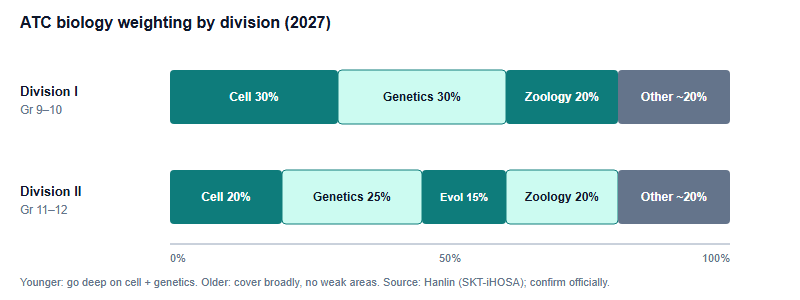
On the ATC biology track, students are split by grade into two divisions, and the two papers do not weight content the same way. Per Hanlin (SKT-iHOSA) for 2027, the published weightings are:
| Division | Grades | Cell biology | Genetics | Evolution | Zoology | Remaining |
|---|---|---|---|---|---|---|
| Division I | 9–10 | 30% | 30% | — | 20% | ~20% (per official syllabus) |
| Division II | 11–12 | 20% | 25% | 15% | 20% | ~20% (per official syllabus) |
The strategic reading is straightforward. In Division I (Year 9–10), cell biology and genetics dominate — together roughly 60% of the published weighting — so a younger student who masters those two areas covers most of the paper. In Division II (Year 11–12), the load spreads out: genetics stays heavy, but evolution appears as its own weighted area and the paper rewards broader coverage. In short, younger students win by going deep on fewer areas; older students win by going broad without weak spots.
Year 9–10 (Division I): build foundations, enter low-stakes
The best thing a younger student can do is treat these years as a skill-building runway, not a trophy hunt. A first iHOSA season in Year 9 or 10 is where you learn how the competition feels — the timed objective format, the reference-based content, the discipline of a written gap list — while the result carries relatively little weight on a future application. Concretely:
- Go deep on cell biology and genetics. They are the two heaviest areas of the Division I paper. A student who is genuinely strong on those two covers the majority of the weighting before touching anything else.
- Use it to lock in study habits. The routines that win later — working from named references, timed practice, a written list of unknown topics — are cheap to build now and expensive to build under Year 12 pressure.
- Compete without fear of the outcome. A younger student has the rare luxury of a low-stakes entry. Use it to make your mistakes early, when they cost nothing.
The point of a Year 9–10 season is not the certificate; it is arriving in Year 11 already fluent in how iHOSA works.

Year 11–12 (Division II): peak stakes, application-aligned
By Year 11–12 the calculus flips. Your course now covers far more of the syllabus, so the content gap is smaller and the timed round is more winnable — but the stakes are higher because a result lands close to university applications. Two things matter most here:
- Cover the paper broadly, with no weak spots. Division II spreads weighting across cell biology, genetics, evolution and zoology. A single neglected area can cost you the tie-breaker margin, so the older student's job is breadth without gaps rather than depth in one favourite topic.
- Aim the result at your application, honestly. A strong iHOSA result can be a meaningful signal for a health-science direction — but it is one signal among many, never a guarantee of admission. Treat it as evidence of sustained interest and rigour, and pair it with the rest of your record.
If a Division II result feeds forward, the season's pinnacle is the international stage; our ILC 2026 complete guide shows what that top level looks like and how a China delegate prepares for it.
A multi-year progression map
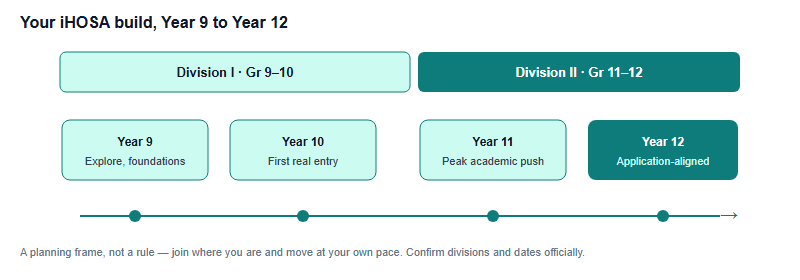
Read across the grades and iHOSA becomes a build, not a gamble. The map below is a planning frame, not a rule — students join at different points and move at different speeds — but the direction holds: explore early, compete seriously in the middle, and finish aligned to your applications.
Track choice by grade: not just biology
Grade also shapes which track suits you. The ATC individual test rewards content mastery at any age, but the team-based BCE public-welfare route and the leadership route reward different, more collaborative strengths that can suit different years:
| Grade band | Natural first move | Why it fits |
|---|---|---|
| Year 9–10 | ATC (Division I) or a BCE team role | Low-stakes way to learn the format and build habits; a team role removes solo pressure |
| Year 11 | ATC (Division II) as the main push | Course readiness is high and the result still lands before final applications |
| Year 12 | Your strongest single track, aimed at applications | Time is scarce; concentrate rather than spread across tracks |
Whatever your grade, the principle is the same: enter at the level that matches your division and your readiness, treat early seasons as a build, and concentrate your effort as the stakes rise. Students who plan across years, rather than scrambling in one, are the ones who arrive at Year 12 with both the skills and the result.
Frequently asked questions
What grade should I start iHOSA in?
You can start as early as Year 9. Treat Year 9–10 as a low-stakes build and Year 11–12 as your serious, application-aligned push. Confirm current eligibility officially.
What is the difference between the biology divisions?
Division I (Gr 9–10) weights cell biology and genetics most heavily; Division II (Gr 11–12) spreads across cell, genetics, evolution and zoology. Confirm the current syllabus officially.
Does a Year 9 iHOSA result matter for university?
Less directly than a Year 11–12 result, but it builds the skills and habits that make a strong later result possible. It is a build year, not a wasted one.
Should older students still try multiple tracks?
Usually not in Year 12 — time is scarce, so concentrate on your strongest single track. Younger students can afford to explore more widely.
Published by the HOSA (SKT-iHOSA) editorial desk, operated by Hanlin Education for China-based international-school students. Official rules are set by the competition and change yearly — confirm current details on hosa.org. Any error will be corrected within 7 working days.

Oct 20, 2026
iHOSA ATC Division I vs II: Allocating Study Time by Weighting Differences
Students in grades 9-10 and 11-12 face different topic weightings in the iHOSA ATC Biology and Chemistry exams. This guide breaks down…
Oct 17, 2026
iHOSA Biology Explanations: Connect a Feedback Loop to a Change in the Body
Mastering negative and positive feedback loops is essential for iHOSA Biology. Learn how to connect physiological mechanisms to observable changes with worked…
Oct 15, 2026
iHOSA Health Education: Test Whether an Audience Understood Your Message
In iHOSA Health Education, testing whether your audience understood your message is not an afterthought—it is the core deliverable. Learn how to…