
For students preparing for the Biology, Chemistry or Psychology? Choosing and Preparing Your iHOSA 2027 ATC Subject by Your AP, IB or A-Level Course decision, a common hurdle in the chemistry track is not just recalling facts, but explaining phenomena. The iHOSA 2027 ATC chemistry exam includes 45 minutes of objective questions testing whether you can connect abstract particle models—atoms, molecules, ions—to observable properties like boiling point, conductivity, and pressure. This article focuses specifically on that reasoning skill, distinct from broad syllabus coverage or registration logistics. Note that iHOSA 2027 Registration: Final Deadline Is 7 December 2026 applies to all competitors; the August 20 date mentioned in some prep-course materials refers only to third-party program enrollment, not official iHOSA registration.
The Core Challenge: Micro-Macro Linking
In Division I (grades 9-10) and Division II (grades 11-12) chemistry, topics like “Atoms, Molecules, Ions” (20-25% of syllabus) and “Chemical Bonding” (15%) require more than definition recall. You must explain why a substance behaves a certain way based on its structure. A frequent mistake is stating a property without citing the underlying particle interaction. The syllabus explicitly covers chemical foundations, atomic structure, stoichiometry, thermodynamics, bonding, kinetics, and equilibrium—yet the exam rewards students who can traverse scales from subatomic to macroscopic.
Division II adds chemical equilibrium (15% of that division’s content), meaning students must apply particle models to dynamic systems where concentrations shift but properties like equilibrium constants remain fixed. This demands more sophisticated micro-macro reasoning than Division I’s foundational focus.
Worked Example 1: Boiling Point Trends
Scenario: Why does water (H₂O) have a higher boiling point than hydrogen sulfide (H₂S)?
Weak Explanation: Water has oxygen, which is more electronegative than sulfur, so it boils at a higher temperature.
Strong Explanation: Both molecules are polar, but water forms extensive hydrogen bonds due to oxygen’s high electronegativity and the presence of hydrogen atoms bonded directly to oxygen. Hydrogen sulfide cannot form significant hydrogen bonds because sulfur’s electronegativity is too low and its larger atomic radius diffuses electron density. Therefore, substantially more energy is required to overcome the intermolecular forces in water—specifically, breaking approximately 20 kJ/mol of hydrogen bonds versus weaker dipole-dipole interactions in H₂S—resulting in water’s higher boiling point.
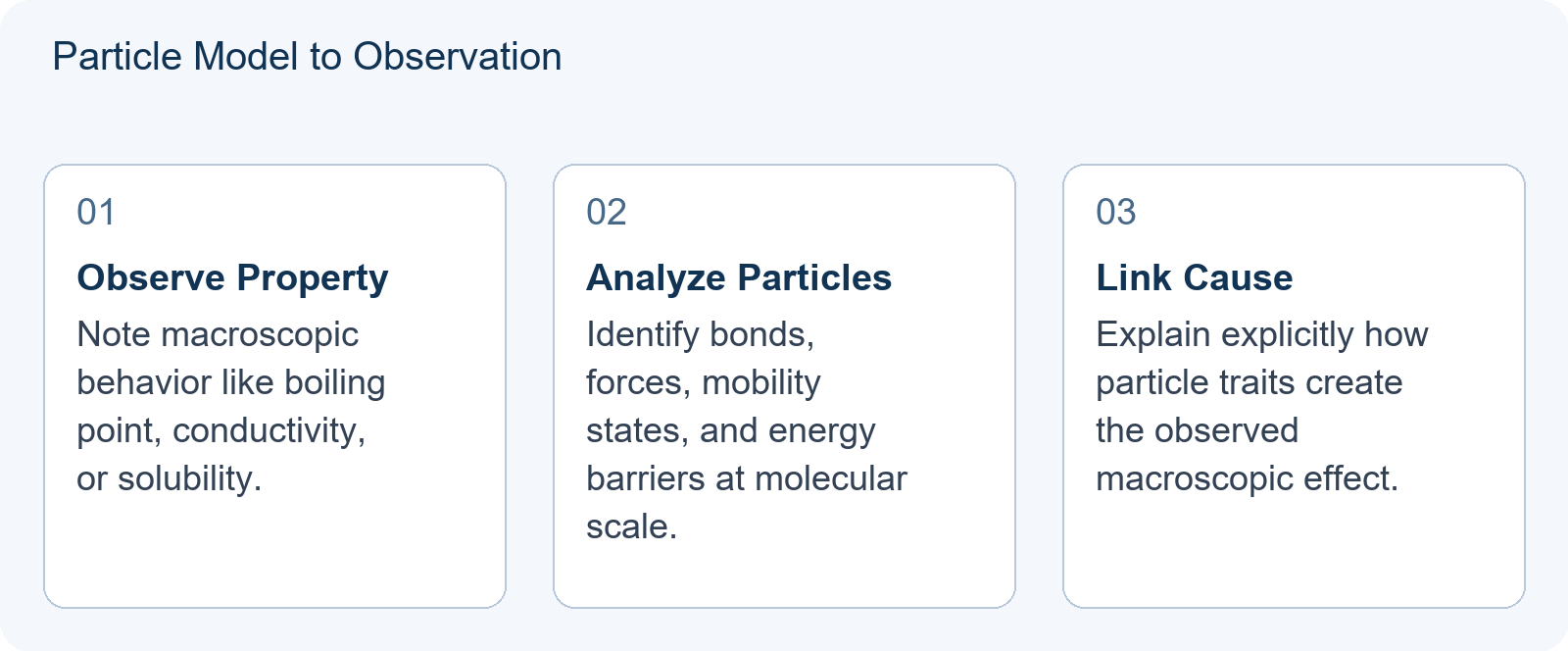
This explanation links the particle model (electronegativity difference, bond polarity, hydrogen bond donor/acceptor requirements) to the observable property (energy required for phase transition). It also correctly identifies that hydrogen bonding requires both high electronegativity and direct H-X bonding where X is N, O, or F—not merely any polar bond.
Worked Example 2: Conductivity in Solutions
Scenario: Why does solid NaCl not conduct electricity, but aqueous NaCl does?
Weak Explanation: Salt dissolves in water, so it conducts.
Strong Explanation: In solid NaCl, sodium and chloride ions occupy fixed positions in a rigid lattice with no net movement; charge carriers exist but are immobile. When dissolved in water, hydration energy overcomes lattice enthalpy, releasing mobile Na⁺(aq) and Cl⁻(aq) ions. Electrical conduction requires the directed movement of charged particles; thus, only the aqueous solution permits current flow. The conductivity magnitude further depends on ion concentration and mobility, both particle-level properties.
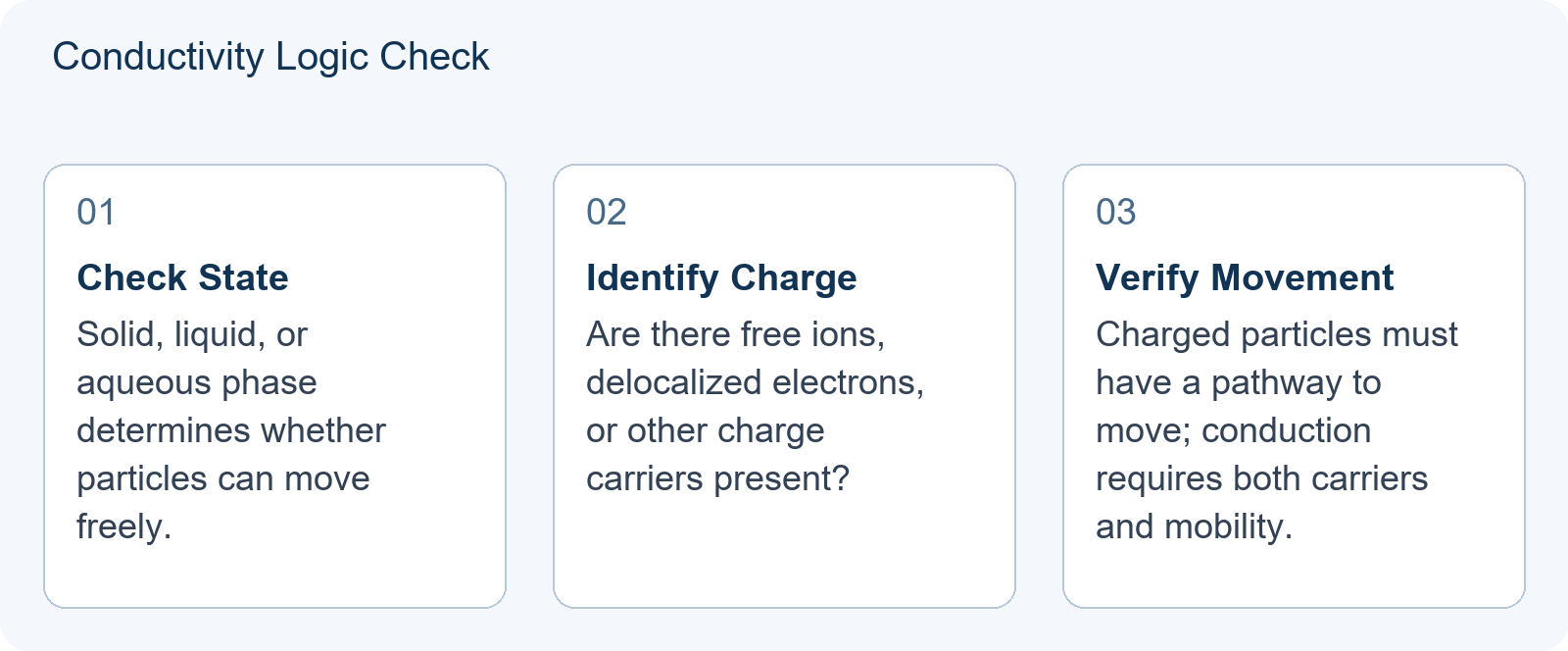
Here, the key is identifying the state of matter as determining particle mobility, not merely the presence of ions. This distinction becomes critical when comparing ionic compounds to metals, where conduction involves delocalized electrons rather than ion displacement.
Teaching Illustration: Where the Shortcut Fails
Consider a student who learns that “ionic compounds conduct electricity” and applies this to predict that molten NaCl conducts, but stumbles when asked about solid sodium metal. The shortcut fails because it conflates two different particle mechanisms: ion mobility in electrolytes versus electron delocalization in metallic bonding. The correct diagnostic is to first identify what charge carriers exist and whether they are free to move—not to memorize substance categories.
Another common shortcut failure: assuming that higher molecular mass always correlates with higher boiling point. While dispersion forces increase with electron cloud size, this ignores specific interactions like hydrogen bonding. Water (Mᵣ = 18) boils at 100°C, while hydrogen sulfide (Mᵣ = 34) boils at -60°C. The particle model—specific hydrogen bonding versus general dipole interactions—overrides the mass heuristic.
Diagnostic Table: Common Reasoning Failures
| Observation | Common Mistake | Correct Particle-Level Reasoning |
|---|---|---|
| High Melting Point | “It’s a big molecule.” | Strong intermolecular forces (e.g., hydrogen bonding) or extensive covalent network requiring significant energy to break many strong bonds simultaneously. |
| Low Solubility in Water | “It’s non-polar.” | Lack of favorable enthalpic interactions between solute particles and water molecules; entropy of dissolution insufficient to overcome positive ΔH (like-dissolves-like principle applied to particle attractions). |
| Gas Pressure Increase | “More gas was added.” | Increased frequency of collisions between gas particles and container walls due to higher particle density or increased kinetic energy (temperature); described by kinetic molecular theory. |
| Catalyst Speeds Reaction | “It adds energy.” | Provides alternative reaction pathway with lower activation energy by orienting reactants or stabilizing transition state; catalyst itself unchanged at particle level. |
Targeted Practice Sequence
To build this skill, follow this sequence using your study materials:
- Identify the Property: Pick an observable fact (e.g., iodine sublimes readily at room temperature).
- List Particle Features: Note molecular size, polarity, bond type, intermolecular forces, and crystal structure.
- Connect Mechanism: Explain quantitatively or comparatively how those features cause the observation (weak dispersion forces between I₂ molecules allow easy phase change with minimal energy input).
- Contrast: Compare with a similar substance (e.g., fluorine vs. iodine, or NaCl vs. MgO) to refine the logic and test boundary conditions.
- Verify State Dependence: Confirm whether the explanation holds across solid, liquid, and gas phases.
Review how Biology, Chemistry or Psychology? Choosing and Preparing Your iHOSA 2027 ATC Subject by Your AP, IB or A-Level Course aligns with your existing curriculum strengths to optimize preparation efficiency.
Demonstrating Competence
A learner should be able to answer short-answer or multiple-choice justification questions by explicitly naming the particle interaction responsible for the outcome. Avoid vague terms like “stronger” without specifying what is stronger (covalent bonds? intermolecular forces? ionic lattice energy?). For students also considering iHOSA BCE Deliverable Formats: Choosing Between a PSA and a Health Education Class, this precise scientific communication style transfers directly to writing health-education materials that explain mechanisms clearly to diverse audiences.
Additionally, students preparing for team leadership roles may find that organizing study groups around these micro-macro exercises builds collective understanding; see iHOSA Chapter President: Planning a School Club Before Taking the Role for structural guidance on peer learning formats.
Division-Specific Considerations
Division I competitors (grades 9-10) should master: chemical foundations (10%), atomic/molecular/ionic structure (25%), stoichiometry (20%), thermodynamics (15%), bonding (15%), and kinetics (15%). Division II competitors (grades 11-12) see adjusted weightings: atomic/molecular/ionic structure drops to 20%, stoichiometry to 15%, thermodynamics to 10%, with chemical equilibrium added at 15%. This means Division II students must apply particle models to systems where concentrations change dynamically—requiring understanding of how collision frequency and energy distribution shift with conditions.
The equilibrium constant K, for instance, is macroscopically a ratio of product and reactant concentrations, but microscopically reflects the balance between forward and reverse reaction rates where particles with sufficient activation energy successfully convert. Connecting these scales—understanding that K emerges from rate constants that depend on activation energy barriers—is the hallmark of advanced iHOSA chemistry reasoning.
Frequently Asked Questions
Does iHOSA chemistry require advanced calculations?
The focus is on conceptual understanding and linking models to properties, though stoichiometry and basic thermodynamics are part of the syllabus. Calculations typically involve mole ratios, energy changes, and concentration expressions rather than complex derivations.
How is this different from AP Chemistry prep?
While content overlaps significantly (80% AP match per source notes), iHOSA emphasizes clear scientific communication and application to health-related contexts alongside pure theory. The exam format—45 minutes with 45 standard plus 5 tiebreaker multiple-choice questions—rewards rapid, precise micro-macro reasoning rather than extended calculation.
What distinguishes Division I from Division II chemistry preparation?
Division I (grades 9-10) covers foundations through kinetics without equilibrium. Division II (grades 11-12) reduces weightings in earlier topics to add chemical equilibrium (15%), requiring students to apply particle models to dynamic systems where forward and reverse processes compete. Division II explanations must therefore incorporate rate concepts and Le Chatelier’s principle at the particle level.



Oct 20, 2026
iHOSA ATC Division I vs II: Allocating Study Time by Weighting Differences
Students in grades 9-10 and 11-12 face different topic weightings in the iHOSA ATC Biology and Chemistry exams. This guide breaks down…
Oct 17, 2026
iHOSA Biology Explanations: Connect a Feedback Loop to a Change in the Body
Mastering negative and positive feedback loops is essential for iHOSA Biology. Learn how to connect physiological mechanisms to observable changes with worked…
Oct 15, 2026
iHOSA Health Education: Test Whether an Audience Understood Your Message
In iHOSA Health Education, testing whether your audience understood your message is not an afterthought—it is the core deliverable. Learn how to…