If you are a Chinese international-school student dreading the judge Q&A, HOSA's own rules should change how you practise. Judges are encouraged to weigh content, organisation and intent above pronunciation, accent and minor grammar, unless those are core criteria for the event. So drilling your accent is the wrong investment. Drilling the shape of your answers, and your recovery when a question lands badly, is the right one.
The sentence in the rulebook that should redirect your prep
HOSA's General Rules and Regulations (August 2025), published on hosa.org, set out under English Language that all events at the international level are conducted in English, including tests, written or recorded material submitted for judging, and speaking and presentation events. Failure to submit material in English "may result in the items not being scored." Translators may be requested through the process in the appendices, but "may only be used to translate a test, or to translate in an event in which the competitor's speaking is not rated."
Then comes the sentence most competitors never read: "When members are competing in English, and English is their second language, judges are encouraged to consider content, organization, and intent over pronunciation, accent, or minor grammar inconsistencies unless these are core criteria being evaluated."
That is not a promise of leniency and it is not a loophole. It is a statement about where the marks live. If a judge is being asked to look past accent and towards content and organisation, then a student who says "we surveyed 120 students, the effect was small, and here is why I would not generalise it" in plain, slightly accented English will read better than a student who delivers polished-sounding sentences that never answer the question.
Note the scope. These are HOSA's international rules. The iHOSA China round is run separately as SKT-iHOSA, and which of its stages involve live judging is set by the operator, so confirm the current structure on the official iHOSA channels and on hosa.org. As a planning anchor: the iHOSA 2027 online round one is described as 45 minutes for 45 multiple-choice questions plus 5 tiebreakers on ATC biology, chemistry and psychology. There is no speaking in that format. Spoken defence is a later-stage skill, which is exactly why students postpone practising it until it is too late.
Where the clock actually starts
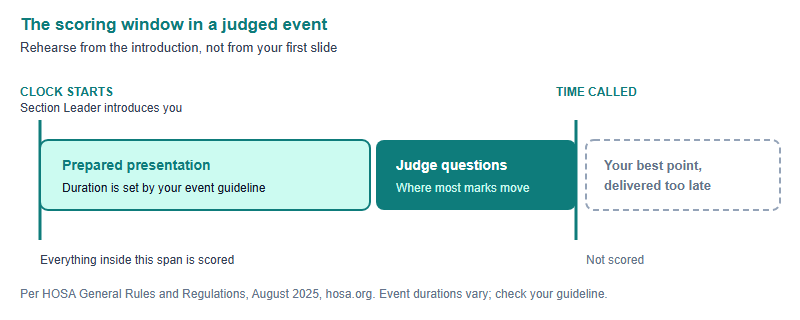
Rehearsing from your first slide is a common and expensive mistake. Under Introductions, HOSA states that for events with judges, competitors and teams are introduced by the Section Leader, and "Time will begin as soon as the Section Leader introduces the competitor/team." Your walk to the front, your laptop waking up and your throat-clearing are all inside the clock.
At the other end, End of Time is unambiguous: if you are stopped at the event time limit "there is no additional penalty. However, anything presented after the time is called will not be scored." There is no dramatic punishment for overrunning. There is simply a wall, and your best material sitting on the wrong side of it.
Individual event guidelines set the actual durations, and they differ. HOSA's 2025–26 ILC guidelines for Health Career Display, for example, describe Round Two qualifying teams reporting at an assigned appointment time to give a five-minute prepared oral presentation to judges, while Medical Innovation describes a seven-minute presentation. Those documents also note that index-card notes are permitted, that electronic notecards are permitted but will not be shown to judges, and that all team members must take an active role. Read your own event's guideline rather than assuming; formats vary by event and are revised annually.
One more clock: under Late Arrivals, ten penalty points may be assessed for non-testing events if you are more than five minutes late to your appointed time. Our ILC guide covers what conference logistics feel like in practice, and the honest summary is that travel time inside a convention centre is always longer than the map suggests.

The seven questions judges keep asking, and the shape of a good answer
Across project, display and professional events, judge questions cluster into a small number of archetypes. You cannot predict the wording, but you can pre-build a defensible answer for each shape. Prepare one strong version of each, in your own words, and you will rarely be genuinely ambushed.
| Question archetype | What it sounds like | What a strong answer contains |
|---|---|---|
| Definition check | "What do you mean by that term?" | A one-sentence definition in plain English, then one concrete example from your own work |
| Method probe | "How did you actually collect this?" | Sample, instrument, timing and who was excluded, said without hedging |
| So-what | "Why does this matter?" | Who benefits, at what scale, and what changes if you are right |
| Limitation | "What is the weakness here?" | A real limitation you name first, plus what it does and does not invalidate |
| Scale-up | "Could this work in a hospital or another city?" | One condition that must hold and one that probably would not |
| Counterfactual | "What would you do differently?" | One specific design change and the reason, not a general apology |
| Off-script factual | A detail you genuinely do not know | An honest boundary, what you do know nearby, and how you would check |
The last row is the one students fear and the one that costs least when handled well. Saying "I do not have that figure, but our data covered X, and I would check the national guideline before claiming Y" is a competent professional answer. Inventing a number is not, and it collides directly with HOSA's ethics rules on falsification of information.
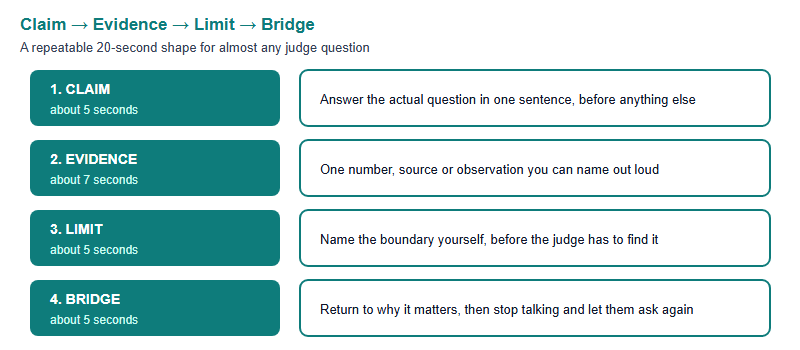
The most common failure we see is not vocabulary. It is a missing shape: students either stop after four words or talk for ninety seconds and bury the answer. Use a fixed four-part skeleton and you buy yourself structure that survives nerves.
For hands-on skill events the same instinct is written into the rules. Under Verbalization of Skills, HOSA notes it is the competitor's responsibility "to communicate fully and effectively with judges," which "may include 'thinking out loud' so that judges are clear on why the competitors are doing what they are doing." The rules also allow competitors to ask judges questions during a skill performance where those questions relate to the patient's condition, with judges responding from the scenario or judge script. Silence is not neutral in these events; it is unscored reasoning.
A four-loop rehearsal cycle
Because HOSA does not return rating sheets, your recording is the only feedback loop you will ever own. Run these loops in order, over two to three weeks, and keep the recordings.
| Loop | What you do | What you record | Pass condition before moving on |
|---|---|---|---|
| 1. Cold run | Deliver once, untimed, no notes, alone | Audio only | You can say the whole argument without reading |
| 2. Timed run | Start the timer at a spoken introduction, finish inside your event's limit | Video, phone on a shelf | You finish with 15–20 seconds spare, twice in a row |
| 3. Hostile Q&A | A partner asks all seven archetypes in random order, no warm-up | Video | Every answer opens with a claim, none exceeds 30 seconds |
| 4. Recovery drill | Partner asks three questions you genuinely cannot answer | Video | You concede cleanly, redirect once, and do not invent a figure |
Watch loop 3 and 4 recordings with the sound off once. If your posture, eye contact and pacing already look composed, the language layer matters far less than you think. Then watch with sound and transcribe only your first sentence of each answer; if the first sentence is not an answer, that is the fix.
One reassurance from the rules: under Fairness Between Sections, HOSA describes using a standard-deviation formula that, in selected events with multiple sections, adjusts for judging differences so those sections are treated as mathematically equal. You cannot control which judges you draw, and the system is designed with that in mind.
Room rules that quietly cost points
Several avoidable deductions have nothing to do with your content. From the same rulebook:
- Materials for judges. Only items specified in the event guidelines may be shown or used, and showing extra materials "may result in point deductions." Props are not allowed in any event except Public Health.
- Judge interaction. Distributing samples, gifts or thank-you notes to judges, beyond materials the guidelines specify, is not permitted.
- Handshakes. Not allowed except in Job Seeking Skills, Interviewing Skills and Health Career Preparation. A well-meant handshake is not the professional signal you might expect it to be here.
- Confidentiality. Competitors must not discuss or reveal a secret topic or scenario for any event until it has concluded.
- Devices. Personal electronic devices are defined broadly as portable devices capable of wireless communication or electronic data retrieval, so check your guideline before assuming a tablet is usable.
Which of your events involve live judging at all depends on your track, so read our comparison of ATC, CCE and BCE first, and the HOSA overview if the structure is still new to you.
Across recent seasons, students we have worked with have reached national medal positions in ATC biology and chemistry and a behavioural-health national bronze, and several advancements to the global round (per Hanlin, de-identified, results vary). The recurring difference at the judged stages is rarely fluency. It is whether the student answered the question that was asked.
FAQ
Will my accent lower my score?
HOSA's rules encourage judges to weigh content, organisation and intent over pronunciation, accent or minor grammar, unless those are core criteria for that event. Check your event guideline.
When does the timer actually start?
HOSA states that time begins as soon as the Section Leader introduces the competitor or team, so rehearse from the introduction rather than from your opening slide.
What happens if I run over time?
There is no additional penalty for being stopped at the limit, but anything presented after time is called will not be scored. Plan a deliberate ending.
Can I use a translator in a presentation event?
HOSA permits translators only for a test or where the competitor's speaking is not rated, following the process in the appendices. Confirm current terms on hosa.org.
Published by the HOSA (SKT-iHOSA) editorial desk, operated by Hanlin Education for China-based international-school students. Official rules are set by the competition and change yearly, so confirm current details on hosa.org. Errors are corrected within 7 working days.

Oct 20, 2026
iHOSA ATC Division I vs II: Allocating Study Time by Weighting Differences
Students in grades 9-10 and 11-12 face different topic weightings in the iHOSA ATC Biology and Chemistry exams. This guide breaks down…
Oct 17, 2026
iHOSA Biology Explanations: Connect a Feedback Loop to a Change in the Body
Mastering negative and positive feedback loops is essential for iHOSA Biology. Learn how to connect physiological mechanisms to observable changes with worked…
Oct 15, 2026
iHOSA Health Education: Test Whether an Audience Understood Your Message
In iHOSA Health Education, testing whether your audience understood your message is not an afterthought—it is the core deliverable. Learn how to…