
iHOSA awards run at two levels. National gold, silver and bronze go to roughly the top 5%, 5–15% and 15–30% of each challenge; regional bands are then calculated across five regions after national winners have been removed from the pool (per Hanlin's SKT-iHOSA season briefing; confirm officially). That removal step is the part almost nobody explains, and it changes how you should read every result.
The two-level structure, in plain terms
Most students assume a single ranked list with awards handed down it in order. The structure is closer to two passes over the same field. The first pass is national and takes the top slice. The second pass looks at everyone the first pass did not take, sorts them into five regions, and awards regional bands inside each one.
Three consequences follow immediately, and each one contradicts something students commonly believe.
| Common belief | What the structure actually implies |
|---|---|
| "Regional awards are the consolation tier below national bronze" | They are a separate ranking over a different population — the field left after the national winners are taken out |
| "If I score X marks I get gold" | Bands are proportions of the field, so the same mark can land differently from one year to the next |
| "Everyone competes against everyone" | Each challenge is judged separately, so your pool is your challenge — not the whole programme |
| "A stronger region makes a regional award easier" | A stronger region loses more entrants to the national pass, which reshapes the residual field in ways you cannot predict |
| "Only winners get anything" | Per the briefing, every entrant receives an official certificate of participation |
If you are still deciding how the tracks differ in what they even ask of you, our comparison of the ATC, CCE and BCE tracks covers that ground, and the HOSA overview sets out the wider structure.
Percentile bands mean the field decides, not a fixed score
This is the single most useful thing to internalise. Because the bands are expressed as proportions — roughly the top 5%, then 5–15%, then 15–30% — there is no published mark that guarantees an award, and there cannot be. Your result is a function of how you did relative to everyone else who sat your challenge this year.
Two practical implications for how you prepare and how you interpret what you hear:
- Last year's scores tell you very little. A senior who says "38 out of 45 got me silver" is describing one field in one year. Treat it as anecdote, not a target. Any real cutoff is a by-product of the distribution, and it is not something we or anyone else can promise in advance.
- Marginal marks are worth more than they feel. Wherever a band boundary falls, the candidates either side of it are packed closely together on score. That is exactly where one or two extra correct answers can move you across a band. On an ATC paper of 45 scored questions in 45 minutes (per Hanlin; confirm officially), the two questions you rushed at the end are not rounding errors.
There is a visible clue that the organiser expects candidates to finish level. The ATC paper carries five tie-break items alongside its 45 scored questions (per Hanlin; confirm officially). Tie-breakers exist because entrants tie — and wherever entrants tie, a single mark can be what separates one band from the next. If ties were rare, the mechanism would be unnecessary.
A short illustration of what proportional banding does to a cutoff. The arithmetic below is our own, for teaching the mechanic — it is not organiser data and no entrant numbers are published. Suppose a challenge draws 400 entrants in one year: gold covers roughly 20 places, silver roughly 40, bronze roughly 60. If the same challenge draws 700 the next year, those become roughly 35, 70 and 105 places. More awards exist in absolute terms, yet the mark required to reach them moves with the strength of the field, in whichever direction that field happens to move. Planning around a number you heard from a friend is planning around the one variable you cannot control.
It also means a flat, non-comparative framing is the only honest one. No preparation — ours or anyone's — can convert into a promised band, because the band depends on a field nobody has seen yet.

The removal step: why the regional pool is a residual pool
Here is the mechanic worth drawing. National awards are decided first, over the whole national field for that challenge. Those entrants are then taken out. Whoever remains is sorted by region, and regional bands are applied inside each region separately.
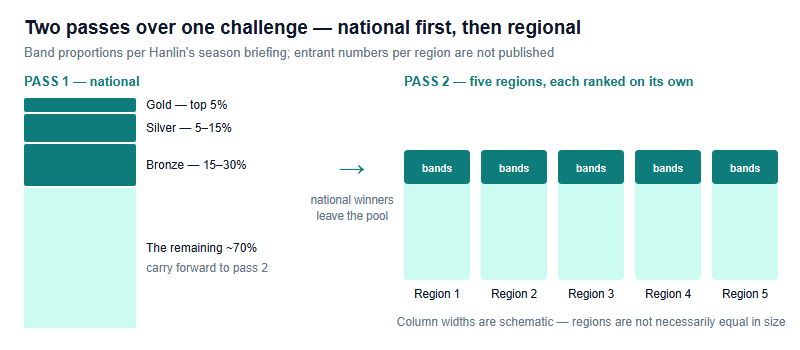
Read that carefully and a few things stop being mysterious. A single entry is recognised once, at one level — you do not collect a national bronze and then a regional gold on top of it, because taking the national award is exactly what removes you from the regional calculation. And a regional award is genuinely not "national bronze, but smaller". It is a rank inside a field that has already had its strongest performers extracted, which makes it a different measurement rather than a weaker one.
It also explains why comparing regional results across regions is meaningless without entrant numbers the organiser does not publish. If you hear a confident claim that one region is "easier", treat it as speculation.
One further consequence is worth sitting with. Because the regional pass runs only on the residual field, the number of places in a regional band depends on how many entrants that region already lost at the national pass. A region that sent many strong performers loses more of them in pass one, leaving a smaller and differently shaped residual to band. None of this is visible from outside, and none of it is published — which is the practical argument for treating your own preparation as the only variable you actually control.
Your pool is narrower than you think
Because each challenge is judged separately, the population that determines your award is not "everyone doing iHOSA". It narrows several times before it reaches you.
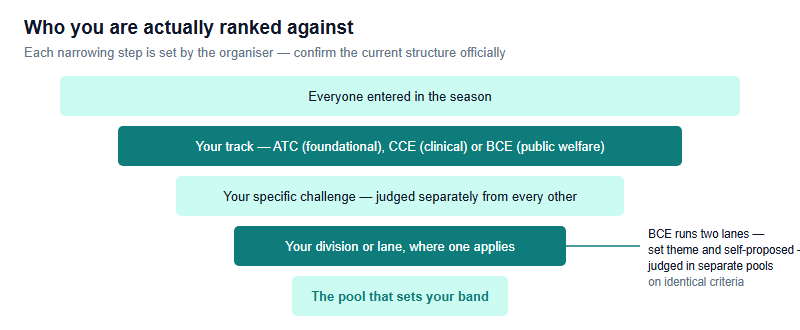
The BCE track makes this concrete. Per the briefing, the annual set theme and the new self-proposed route are judged in separate pools, on identical criteria and the same award ratios. So a team's lane choice does not change the standard it is held to, but it does change the set of teams the percentile bands are computed over. That is worth understanding clearly before assuming either lane is a softer route — on the published rules, neither is.
What an award is honestly worth — and where it sits in the season
The season runs from a preliminary round in mid-to-late December 2026 to a China round in March or April 2027, with a global round on 23–26 June 2027 (per Hanlin; confirm dates officially). Registration ran until 20 August and has closed, so award structure now matters as a way to read your own result rather than as a factor in deciding whether to enter.
From our own cohort last season, five students advanced to the global round (de-identified, per Hanlin; our own tally, and results vary). We publish that as a description of what happened, not as an expected outcome — individual results depend on the field, the challenge and the year.
On applications, be careful in both directions. A percentile band is a legible, verifiable line on an activities list, and specificity helps: "national silver band, [challenge name], among entrants nationally" reads better than an unexplained medal word. But no competition result guarantees an admissions outcome, and a reader who cannot tell what population you were ranked in will discount the claim. State the pool. Where the work itself is more interesting than the band — a project you can describe, a class you actually taught — lead with the work. Our conference-round guide gives a sense of how results are presented and discussed at that stage.
When you write the result down, three details carry the meaning:
- The level. National band or regional band — name which, because they describe different populations and a reader who knows the structure will ask.
- The challenge. Each one is judged separately, so the challenge name is the pool. "Silver" on its own tells a reader nothing about what was competed for.
- The lane or division, where one applies. Particularly on the BCE track, where the set-theme and self-proposed routes are banded in separate pools.
Anything vaguer invites the reader to assume the smallest plausible pool, which is rarely the one you were in. Precision here is not modesty; it is the difference between a claim that survives a follow-up question and one that quietly deflates.
And if you finish outside the bands: per the briefing every entrant receives an official certificate of participation, but the more durable output is the artefact you built and can still talk about a year later. That is the part an interviewer can actually probe.
Frequently asked questions
What percentage do you need for iHOSA national gold?
Roughly the top 5% of your challenge, per Hanlin's briefing. It is a proportion of the field, not a fixed mark. Confirm officially.
Can one entry win both a national and a regional award?
No. Per the briefing, regional bands are calculated after national winners are removed, so an entry is recognised at one level only.
Are the five regions the same size?
Entrant numbers per region are not published, so assume they differ. Treat cross-region comparisons of difficulty as speculation.
Is the BCE self-proposed lane an easier route to an award?
Not on the published rules. It is judged in its own pool on identical criteria and the same award ratios as the annual-theme lane.
Published by the HOSA (SKT-iHOSA) editorial desk, operated by Hanlin Education for China-based international-school students. Official rules are set by the competition and change yearly — confirm current details on hosa.org. Errors are corrected within 7 working days.

Oct 20, 2026
iHOSA ATC Division I vs II: Allocating Study Time by Weighting Differences
Students in grades 9-10 and 11-12 face different topic weightings in the iHOSA ATC Biology and Chemistry exams. This guide breaks down…
Oct 17, 2026
iHOSA Biology Explanations: Connect a Feedback Loop to a Change in the Body
Mastering negative and positive feedback loops is essential for iHOSA Biology. Learn how to connect physiological mechanisms to observable changes with worked…
Oct 15, 2026
iHOSA Health Education: Test Whether an Audience Understood Your Message
In iHOSA Health Education, testing whether your audience understood your message is not an afterthought—it is the core deliverable. Learn how to…