
Write it three times, in three registers. One season becomes an activity-list line of roughly 150 characters, a paragraph of 120 to 200 words if an essay genuinely needs one, and a spoken answer of 60 to 90 seconds. All three describe the same evidence, and the reader will cross-check them against your transcript, your teachers' letters and the dates you entered elsewhere on the form.
Start from what an admissions reader is actually doing
An application file is read as a set of sources that either agree with each other or do not. The transcript says what you took and how you did. The activity list says where your hours went. The letters say how you behave in a room with other people. The essays say how you think. A competition result is a fifth source, and its usefulness comes from corroboration: it is external, dated evidence that the interest claimed everywhere else in the file is real and sustained rather than assembled in the final year.
That is the whole reason to write carefully. The job is not to impress a reader with a name they may not know. The job is to make one season checkable in a few seconds: what you did, at what scale, with what artefact, to what level, over what dates. When a health-science transcript, a health-focused project and an essay about why you chose the subject all point the same way, the file is believable. When the activity line says “led” and the teacher's letter describes you as one of four students who took part, the reader notices the gap, and the gap costs more than the word ever earned.
Two consequences follow. First, assume the reader has never heard of the competition — a description that spends its characters explaining what HOSA is has spent them badly, because the organisation-name field already carries the name. If a teacher writing about you needs the plain-English version, send them the overview of what HOSA is and the breakdown of the ATC, CCE and BCE tracks instead of trying to compress an explanation into 150 characters. Second, the facts stay identical across systems. The character count changes; the role, the numbers and the level reached do not.
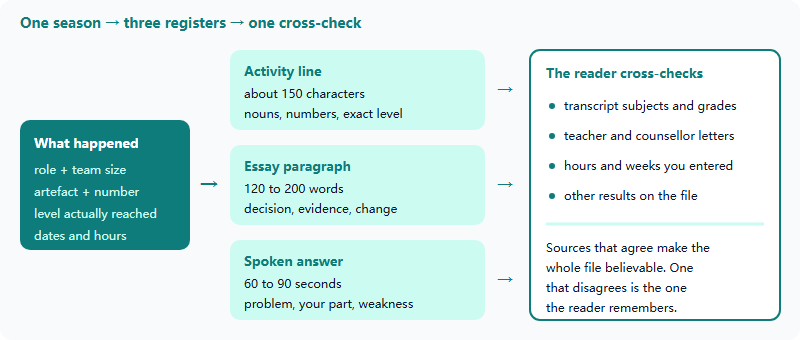
The activity line: five slots inside about 150 characters
On the Common App, the activities section splits the work across separate fields: a short position or leadership description, a longer field for the organisation name, and a description field of roughly 150 characters. Confirm the current limits when you actually fill the form, because they have been revised before. The structural point survives any revision: the name field carries the name, so the description field should carry nothing but content. Students who write “HOSA is an international health-science competition” inside the description have paid for the same information twice.
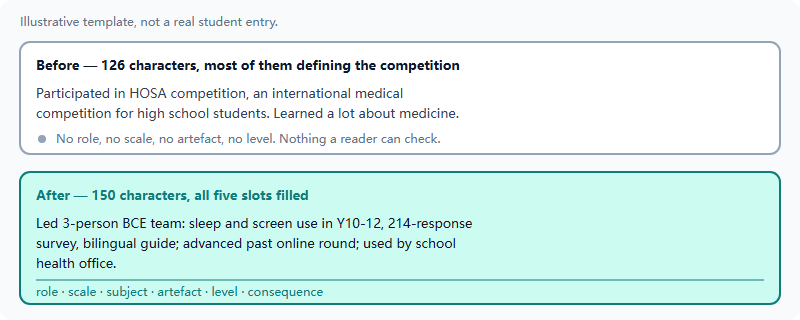
Treat the description as five slots. Fill them in this order and stop when the characters run out — the later slots are the first to go.
| Slot | What it carries | Example fragment | Characters |
|---|---|---|---|
| 1. Role and scale | Your exact position, and how many people you were responsible for | Led 3-person BCE team: | 23 |
| 2. Subject in plain words | What the work was about, understandable with no background | sleep and screen use in Y10-12, | 32 |
| 3. Artefact and number | The thing that exists, and its size | 214-response survey, bilingual guide; | 38 |
| 4. Level reached | Stated in the wording of your own result, with nothing added | advanced past online round; | 28 |
| 5. Consequence | Who used it, or what changed because it existed | used by school health office. | 29 |
Assembled, that is exactly 150 characters and it is checkable at every point. Six working rules make the difference between a line that survives and one that evaporates:
- Numbers beat adjectives. “214-response” tells a reader the scale of the work. “Extensive” tells them nothing and costs nine characters.
- Do not define the competition. The organisation-name field exists for that.
- Verbs first, no pronouns. Everything in the section is already about you, so “I” and “we” are wasted characters.
- Semicolons are cheaper than sentences. A full stop and a capital letter cost you two characters and buy nothing.
- State the level in the exact words of your own result notification. If you are unsure how the stages are named, read them rather than paraphrasing; our explainer on what the conference stage involves covers what the later rounds look like, and the current structure is confirmed on hosa.org.
- Enter hours and weeks honestly. A reader compares them against the claim. Four hours a week for eight weeks does not support the word “founded”.
Three rewrites you can copy the logic of
Almost every weak entry falls into one of three patterns. The definition line spends most of its budget explaining the competition and has nothing left for the work. The adjective line is grammatically fine and completely unfalsifiable: worked hard, gained valuable insight, developed passion for medicine. The inflated line uses a role word or an award word the rest of the file will not support, and it is the only one of the three that actively damages the application.
The fix in each case is the same move: replace every adjective with a noun or a number, and replace every claim about yourself with a claim about something that exists in the world. “Developed strong research skills” becomes “214-response survey”. “Gained deep understanding of public health” becomes “bilingual guide used by school health office”. The second version is shorter, harder to write and far harder to doubt.


The essay paragraph, and when the season does not belong in one
Most competition results do not belong in a main personal essay. That essay has one job — to sound like a specific human being — and a season narrative tends to crowd it out with logistics. The activity list already carries the fact. Repeating it at 500 words buys nothing and spends the one place on the form where nobody else can write your sentences for you.
There are three places where a paragraph genuinely earns its space. A “why this subject” supplement, where an actual project explains why your interest is specific rather than inherited. A “describe a meaningful activity” prompt, which is asking for exactly this. And the additional-information space, when there is real context a reader could not otherwise infer: your school had no chapter and you built the entry yourself, you competed and presented in your second language, or the project continued after the season ended.
A workable shape for 120 to 200 words is one sentence of situation, two sentences on a decision you made and what you traded away to make it, one sentence of evidence, and one sentence on what changed in how you work. No award adjectives. No sentence beginning “this experience taught me the importance of”. Then apply the deletion test: cross out the competition's name and read the paragraph again. If it still tells a reader something about how you think, keep it. If it collapses into nothing, you have written a trophy rather than an essay, and the trophy already had its 150 characters.
Whatever you write must survive comparison with the activity line. Same role word, same numbers, same level. Two versions of one season that quietly disagree is one of the most common self-inflicted wounds on an otherwise strong file.
The spoken answer, and the same facts in four systems
Interviews compress everything into 60 to 90 seconds, and the structure that works has three beats: the problem in one sentence, what you personally did with at least one number attached, and the weakest part of the work together with what you would change. It is easy to overrun on the first beat and never reach the third, which is unfortunate, because the third is the one that impresses. An interviewer who hears a candidate name a genuine limitation of their own project — a sample that was not representative, a question that was badly worded, an analysis that could not support the claim they wanted — has just learned more about that candidate's judgement than any award could tell them.
Rehearse it aloud in English, once, against a clock. Reading it silently does not reveal that beat one is 45 seconds long.
| System | Where the season goes | Space you get | What the reader is checking |
|---|---|---|---|
| US — Common App activities | Description field of one activity | Roughly 150 characters, plus separate name and position fields | Role, hours and dates against the rest of the file |
| US — supplemental essays | “Why this major” or “meaningful activity” prompts | Usually 100 to 300 words, set per university | Whether the stated interest is specific and self-explained |
| UK — UCAS | The question on preparation outside formal education | Three questions inside one overall character budget | Reflection and evidence, rather than a list of prizes |
| Hong Kong and Singapore | Application form, then interview | Short fields, then live questions | What you personally did, probed in real time |
Two notes on that table. UCAS restructured the personal statement into separate questions for recent cycles, and medicine and dentistry have long closed earlier in the autumn than other courses — confirm the current question format, character budget and deadline on ucas.com before you draft, because both the structure and the dates have moved. And for every system: adapt, never paste. Three facts, three lengths, one voice.
Six things not to write
- Any promise about an outcome. No result makes an admission more likely in a way you can state as a fact. Describe what the work shows and let the reader draw the conclusion.
- A role word your referee will not confirm. Before you write “led” or “founded”, ask whether the teacher writing about you would use the same word unprompted.
- Admission statistics you cannot source. If you quote an organiser's figure about where past participants went, attribute it to the organiser in the same sentence, and never present it as an independently verified number.
- Clinical experience you did not have. A hospital tour is a tour. Describing it as anything else is the claim most likely to collapse under a single follow-up question.
- Award adjectives instead of content. “Prestigious” and “world-renowned” are the reader's judgement to make, not yours to assert.
- One paragraph copied into four systems. Different questions are being asked; answering all of them with the same block of text is visible from a long way off.
The underlying discipline is simple enough to state in one line. Write only what someone else could verify, write it at the length the form asks for, and make every version agree with every other version. A file built that way does not need to shout.
Frequently asked questions
Should HOSA go in my main personal essay?
Usually no. The main essay carries your voice; the season belongs in the activity list and, if it fits, a why-this-subject supplement.
How much space does the activity description give me?
About 150 characters on the Common App, with separate fields for the organisation name and your position. Confirm current limits when you apply.
Can I say the competition helped my application?
Describe what it shows and let the reader judge. Never promise an outcome, and never quote admission statistics you cannot source.
What if my school had no chapter and I entered alone?
Say so plainly. Context you had to build yourself is checkable and specific, which is worth more than a vague leadership claim.
Published by the HOSA (SKT-iHOSA) editorial desk, operated by Hanlin Education for China-based international-school students. Official rules are set by the competition and change yearly — confirm current details on hosa.org. Errors are corrected within 7 working days.

Oct 20, 2026
iHOSA ATC Division I vs II: Allocating Study Time by Weighting Differences
Students in grades 9-10 and 11-12 face different topic weightings in the iHOSA ATC Biology and Chemistry exams. This guide breaks down…
Oct 17, 2026
iHOSA Biology Explanations: Connect a Feedback Loop to a Change in the Body
Mastering negative and positive feedback loops is essential for iHOSA Biology. Learn how to connect physiological mechanisms to observable changes with worked…
Oct 15, 2026
iHOSA Health Education: Test Whether an Audience Understood Your Message
In iHOSA Health Education, testing whether your audience understood your message is not an afterthought—it is the core deliverable. Learn how to…