HOSA offers dozens of competitive events, and the single decision that shapes your whole season is which one you enter. Pick well and your school subjects, your prep, and your event all reinforce each other; pick badly and you spend months on a syllabus that fights you. This guide gives China-based international-school students a structured way to choose — by grade, strongest subject, and goal — rather than picking the event with the most familiar name. Event lists and rules change yearly; confirm the current catalogue on hosa.org.
First, decide the question — not the event
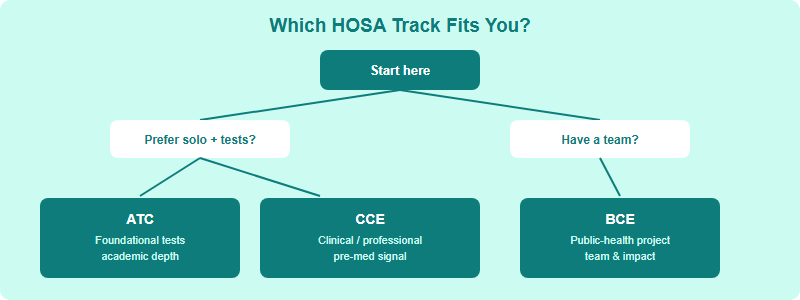
Most students start by browsing event names and picking one that sounds impressive. That is backwards. Start instead with four questions about you; the event falls out of the answers. Within SKT-iHOSA, China-cohort entry is organised around three tracks, and your event choice lives inside one of them — so the first fork is really a track fork:
- ATC — Foundational, examination-style events (think Biology/Chemistry-style knowledge tests).
- CCE — Professional / clinical, applied and skill-oriented events for pre-med and pre-health profiles.
- BCE — Public-welfare / project-based events built around a team and a real-world project.
Our ATC vs CCE vs BCE track guide is the companion to this article: it explains the three tracks in depth, while this guide focuses on how to decide between them and land on a specific event. If you are completely new to HOSA, start with the What Is HOSA overview.
The four-question filter
| Question | Why it matters | Points you toward |
|---|---|---|
| 1. What grade are you in? | Some events / divisions are grade- or division-specific; an older student near applications weighs signal differently | Confirm your division’s eligible events on hosa.org |
| 2. What is your strongest subject? | Knowledge events reward subject mastery you already have | An event whose syllabus overlaps your best subject |
| 3. Solo or team? | Project & teamwork events need a reliable group; tests are solo | BCE/teamwork if you have a team; ATC if you prefer solo |
| 4. What is the goal? | Pre-med signal, skill-building, or a public-health project are different aims | CCE for clinical signal · ATC for academic depth · BCE for impact |
Question 1 — Grade and division
HOSA organises members into divisions, and some events or rules are tied to a division (per hosa.org). Two practical implications for international-school students:
- Check which events your division can enter before you fall in love with one. The eligible-event list is set in the guidelines — confirm it for your division and year on hosa.org rather than assuming an event is open to you.
- Grade changes the goal weighting. A Grade 11-12 student close to university applications may value a clear pre-health signal (more CCE-leaning); a younger student has room to build foundations first (often ATC). The application-signal nuance is covered in our what HOSA signals on a college application piece — read it before you optimise for “prestige.”
Question 2 — Your strongest subject
For knowledge events, the cheapest competitive edge is choosing an event whose syllabus overlaps a subject you are already strong in. This is where SKT-iHOSA’s first-party data is genuinely useful for planning: for the 2027 China season, the ATC academic track subjects are Biology, Chemistry and Psychology, and SKT-iHOSA reports the ATC papers overlap heavily with mainstream curricula — for Biology, up to roughly 95% with IB, 83% with A-Level and 82% with AP (per SKT-iHOSA; confirm current figures on webloom.cn). The planning takeaway is concrete:
- If Biology is your strongest subject and you take IB/A-Level/AP Bio, an ATC biology-style event lets your school revision double as competition prep — an efficiency you should not pass up.
- If you are stronger in Chemistry or Psychology, weigh those ATC subjects instead; the right event is the one that matches your subject, not the one with the most familiar title.
- Exact ATC subjects, papers, and overlap can change year to year — verify the current season’s subjects on the SKT-iHOSA channel.
The deeper test-craft for these events — recognition speed, real-tempo mocks, tie-breakers — is in our ATC test-strategy guide.

Question 3 — Solo or team
This question quietly decides whether a project-based event is even realistic for you. BCE and teamwork-style events depend on a reliable group that can plan, build, and present together over months; a test event does not. Be honest:
- Have a committed team? A BCE public-welfare project can be the most distinctive thing on your profile, because it produces real work, not just a score. See our BCE public-health events guide.
- Prefer working alone, or can’t assemble a dependable team? An ATC or other solo event removes the coordination risk entirely — your result depends only on your own preparation.
- Want clinical / professional signal? CCE events sit between the two, applying knowledge in a pre-med direction; the CCE clinical-events guide covers them.
Question 4 — The goal, stated honestly
Different aims point to different events, and there is no single “best” event — only the best fit for your goal. SKT-iHOSA’s editorial view is to choose for fit and effort-efficiency, not for an imagined prestige ranking:
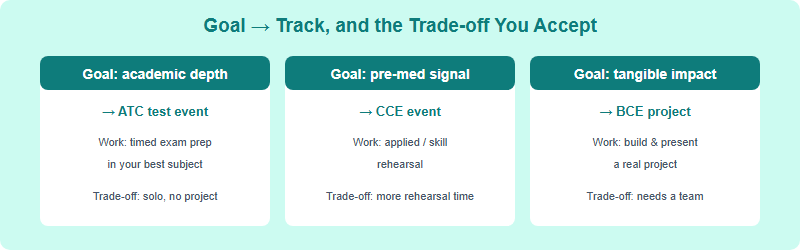
- Academic depth & a strong test record → an ATC knowledge event matched to your best subject.
- A pre-med / pre-health signal → a CCE clinical or professional event.
- Tangible impact and a story to tell → a BCE public-welfare project with a real team.
One caution: do not chase an event purely because you think admissions officers rank it highest. As our application-signal article explains, a coherent, well-executed event you genuinely engaged with reads better than a “prestigious” event you half-finished. We make no admissions guarantees — fit and follow-through are what you control.
To pull the four questions together, the matrix below maps the three goals onto the track that usually serves them best, alongside the work each demands and the main trade-off you accept. Read it as a starting orientation, not a verdict — the named events inside each track, and their eligibility for your division, are defined by HOSA and must be confirmed on hosa.org.
From shortlist to decision: a first-party method
Once the four questions give you a track and one or two candidate events, finalise the choice the disciplined way:
- Open each candidate event’s official guideline on hosa.org and read its round structure, reference list, and rating sheet. The work the event actually demands should match the effort you can give.
- Confirm eligibility for your division and the China region. Treat the SKT-iHOSA channel as authoritative for what China-based students can enter and how.
- Sanity-check the calendar. Map the event onto the season (see our ILC 2026 guide for where the international stage sits) so you know your prep runway is realistic.
- Commit before registration. Changing events mid-season usually means re-learning a different syllabus — decide once, then go.
Still torn between doing it alone or with support? Our self-study vs coaching roadmap compares both honestly for each track.
The filter applied: two worked examples
Abstract advice is easy to nod at and hard to use, so here is the four-question filter run on two realistic profiles. These are illustrative reasoning patterns, not recommendations — your eligible events still depend on your division and the current catalogue on hosa.org.
- Student A — Grade 11, strongest in Biology (AP/IB), prefers working alone, goal is a strong academic record for a science-leaning application. The filter points cleanly to an ATC biology-style knowledge event: it is solo (Q3), it overlaps her best subject so school revision doubles as prep (Q2), and it builds the academic depth she wants (Q4). She should open the event guideline, confirm her division can enter it, and anchor prep to the winter test.
- Student B — Grade 10, comfortable across subjects but energised by group work, has three reliable teammates, goal is a distinctive activity with real-world impact. The filter points to a BCE public-welfare project: he has the team (Q3), the project format rewards initiative over a single subject (Q2), and the tangible-impact goal is exactly what BCE produces (Q4). His risk is starting the build too late, so he should treat the project as a months-long commitment.
Notice that in neither case did the student pick “the most prestigious event.” They picked the event that fit their grade, subject, team situation, and goal — which is precisely how a coherent, well-executed HOSA entry comes together. The same discipline applies whatever your profile: answer the four questions honestly, shortlist inside the right track, and let the official guideline confirm the final choice.
Frequently asked questions
How many HOSA events are there, and how do I pick one?
HOSA offers dozens across five categories. Pick by grade, strongest subject, solo-vs-team, and goal — then read each candidate’s guideline on hosa.org. Confirm the current catalogue there.
Which HOSA event is best for a pre-med profile?
There is no single best event. Clinical/professional (CCE) events lean toward pre-med signal, but the right choice is the one that fits your subject, team situation, and goal.
Should I choose the event with the most prestige?
No. A well-executed event you genuinely engaged with usually reads better than a prestigious one you half-finished. We make no admissions guarantees; fit and follow-through matter most.
Can I change my event after registering?
Often you can, but it usually means learning a different syllabus and losing time. Decide deliberately before registration, and confirm change rules on the SKT-iHOSA channel.
Published by the HOSA (SKT-iHOSA) editorial desk, operated by Hanlin Education for China-based international-school students. Official rules are set by the competition and change yearly — confirm current details on hosa.org. Any error will be corrected within 7 working days.

Oct 20, 2026
iHOSA ATC Division I vs II: Allocating Study Time by Weighting Differences
Students in grades 9-10 and 11-12 face different topic weightings in the iHOSA ATC Biology and Chemistry exams. This guide breaks down…
Oct 17, 2026
iHOSA Biology Explanations: Connect a Feedback Loop to a Change in the Body
Mastering negative and positive feedback loops is essential for iHOSA Biology. Learn how to connect physiological mechanisms to observable changes with worked…
Oct 15, 2026
iHOSA Health Education: Test Whether an Audience Understood Your Message
In iHOSA Health Education, testing whether your audience understood your message is not an afterthought—it is the core deliverable. Learn how to…